Discomfort improvement for critically ill patients using electronic relaxation devices: results of the cross-over randomized controlled trial E-CHOISIR (Electronic-CHOIce of a System for Intensive care Relaxation)
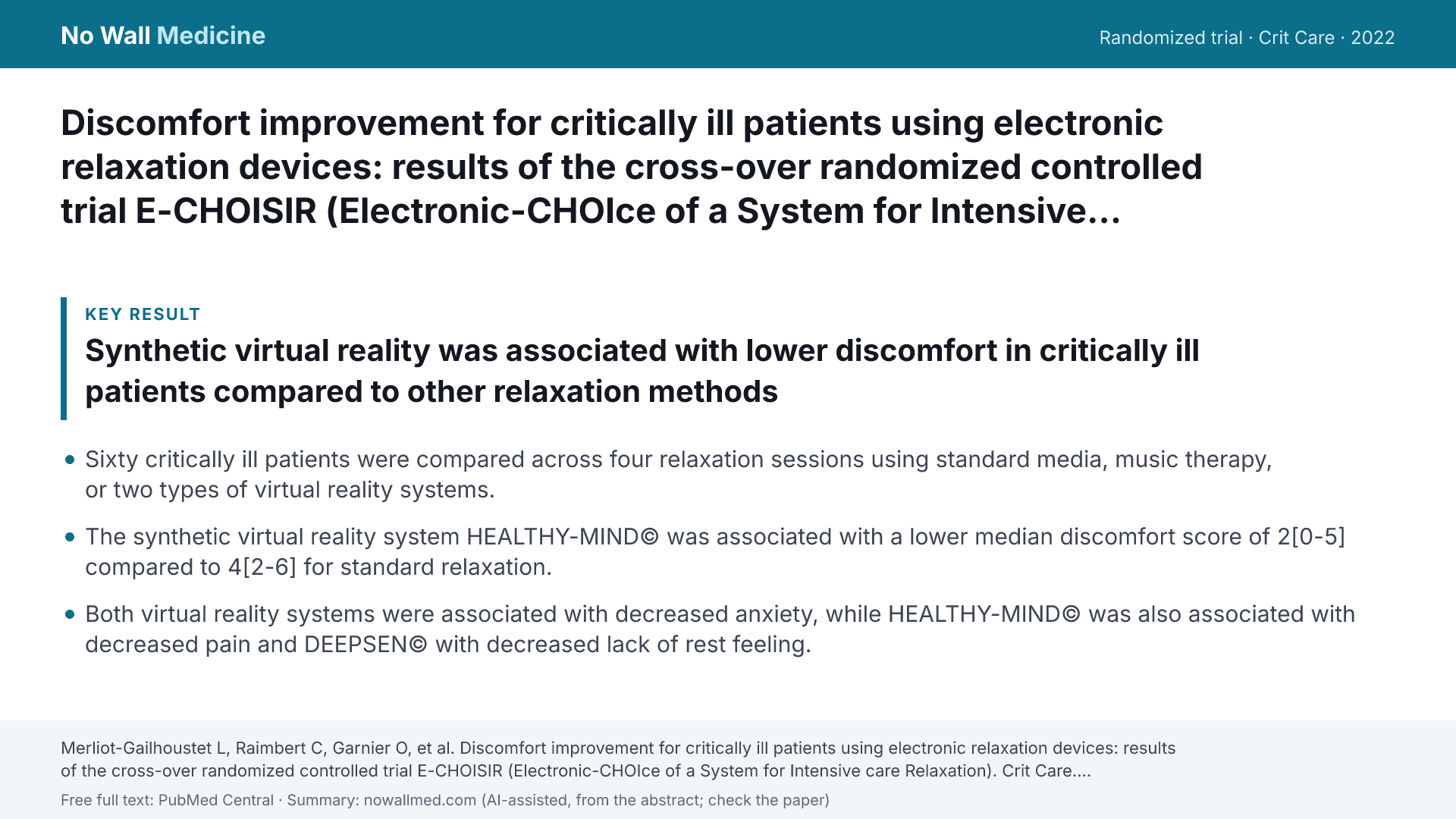
Key result: Synthetic virtual reality was associated with lower discomfort in critically ill patients compared to other relaxation methods
Key points
- Sixty critically ill patients were compared across four relaxation sessions using standard media, music therapy, or two types of virtual reality systems.
- The synthetic virtual reality system HEALTHY-MIND© was associated with a lower median discomfort score of 2[0-5] compared to 4[2-6] for standard relaxation.
- Both virtual reality systems were associated with decreased anxiety, while HEALTHY-MIND© was also associated with decreased pain and DEEPSEN© with decreased lack of rest feeling.
Why it matters: It is unknown which specific electronic relaxation devices are most effective at reducing common stressful symptoms in intensive care unit patients.
Discussion prompts
- Would these patients look like yours? Who was left out?
- Is the main outcome one that matters to patients?
- Is the difference large enough to change what you do?
Cite: Merliot-Gailhoustet L, Raimbert C, Garnier O, et al. Discomfort improvement for critically ill patients using electronic relaxation devices: results of the cross-over randomized controlled trial E-CHOISIR (Electronic-CHOIce of a System for Intensive care Relaxation). Crit Care. 2022. doi:10.1186/s13054-022-04136-4
Free full text: PubMed Central · Summary and visual abstract: nowallmed.com/a/discomfort-improvement-for-critically-ill-patients-using-electronic-15np50i/ (AI-assisted from the abstract; check the paper before relying on it).