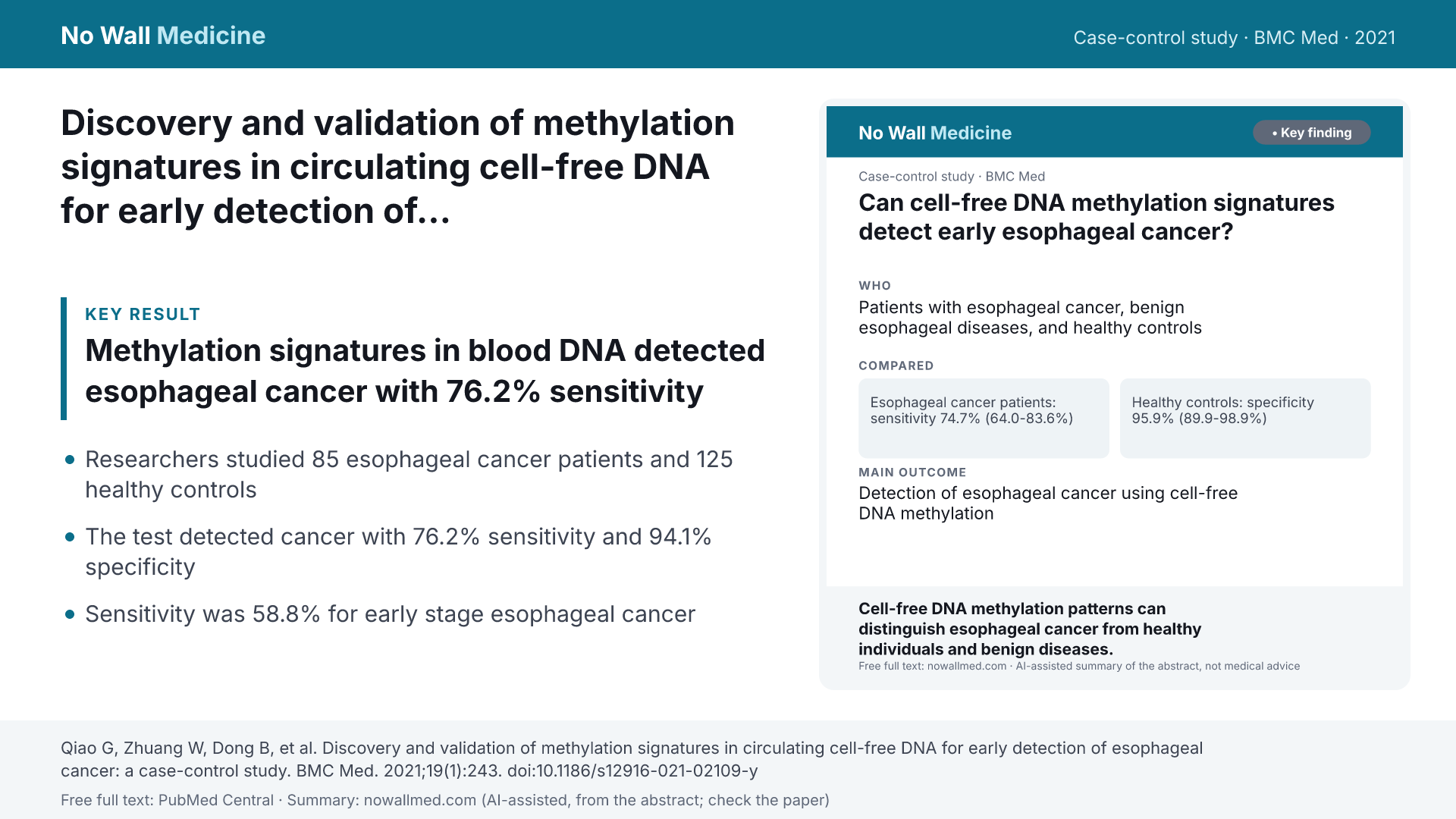
Discovery and validation of methylation signatures in circulating cell-free DNA for early detection of esophageal cancer: a case-control study
Key result: Methylation signatures in blood DNA detected esophageal cancer with 76.2% sensitivity
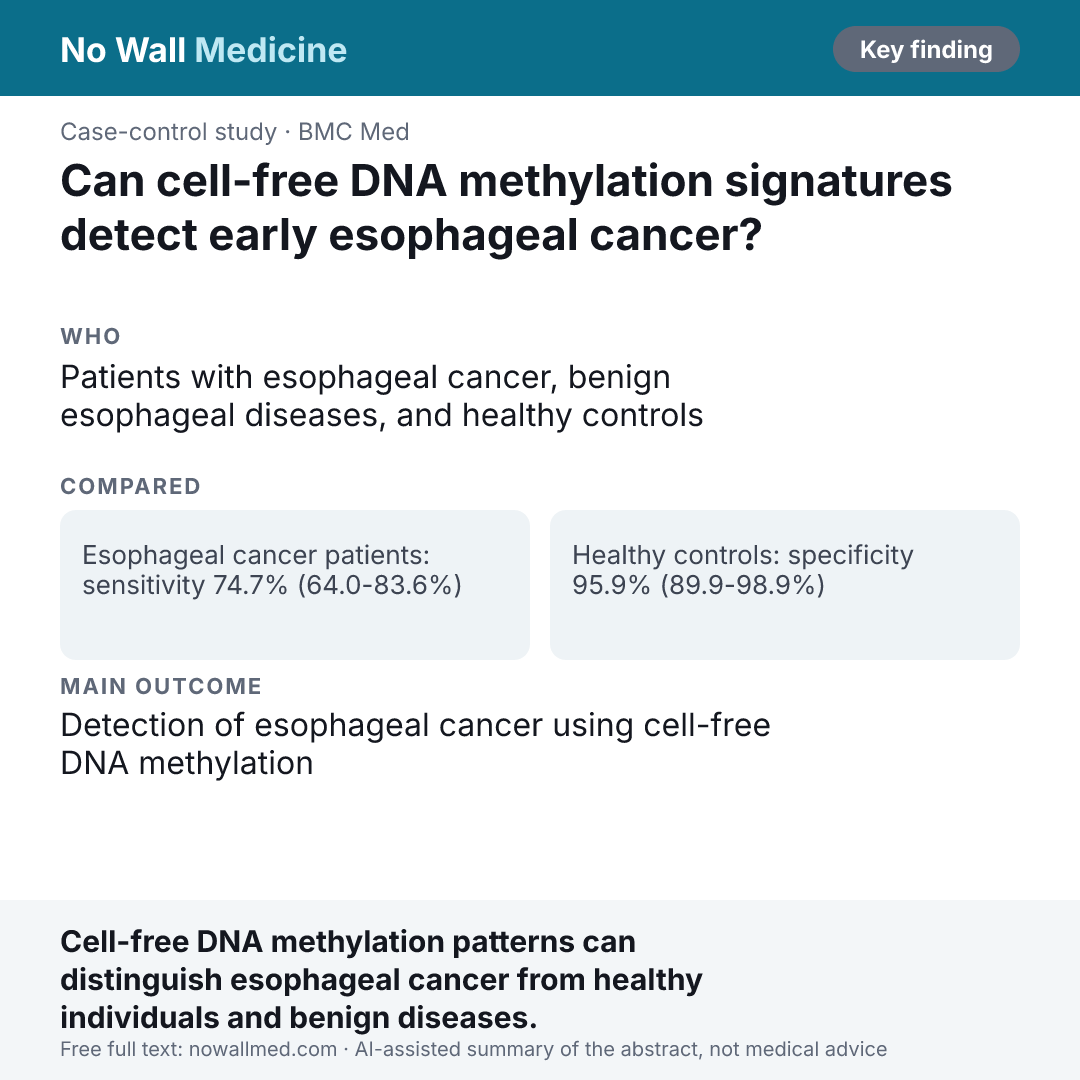
Case-control studyKey finding
Can cell-free DNA methylation signatures detect early esophageal cancer?
Who
Patients with esophageal cancer, benign esophageal diseases, and healthy controls
Compared
Esophageal cancer patients: sensitivity 74.7% (64.0-83.6%)
Healthy controls: specificity 95.9% (89.9-98.9%)
Main outcome
Detection of esophageal cancer using cell-free DNA methylation
Bottom line: Cell-free DNA methylation patterns can distinguish esophageal cancer from healthy individuals and benign diseases.
BMC Med · 2021-10-13 · Save PNG
Key points
- Researchers studied 85 esophageal cancer patients and 125 healthy controls.
- The test detected cancer with 76.2% sensitivity and 94.1% specificity.
- Sensitivity was 58.8% for early stage esophageal cancer.
Why it matters: Early detection methods for esophageal cancer are needed
Discussion prompts
- Would these patients look like yours? Who was left out?
- Is the main outcome one that matters to patients?
- Is the difference large enough to change what you do?
Cite: Qiao G, Zhuang W, Dong B, et al. Discovery and validation of methylation signatures in circulating cell-free DNA for early detection of esophageal cancer: a case-control study. BMC Med. 2021;19(1):243. doi:10.1186/s12916-021-02109-y
Free full text: PubMed Central · Summary and visual abstract: nowallmed.com/a/discovery-and-validation-of-methylation-signatures-in-circulating-1bqmttk/ (AI-assisted from the abstract; check the paper before relying on it).