Pegcetacoplan treatment was associated with slower retinal layer loss in geographic atrophy patients
Disease Activity and Therapeutic Response to Pegcetacoplan for Geographic Atrophy Identified by Deep Learning-Based Analysis of OCT
Post hoc longitudinal image analysisBenefit found
How does pegcetacoplan affect retinal pigment epithelium and photoreceptor loss in geographic atrophy?
Who
897
Patients with geographic atrophy due to age-related macular degeneration
Compared
Pegcetacoplan monthly or every other month: 22% and 20% RPE loss reduction in OAKS and DERBY
Sham
Main outcome
Change in mean area of retinal pigment epithelium and ellipsoid zone loss
Bottom line: Pegcetacoplan reduces retinal pigment epithelium and photoreceptor loss in patients with geographic atrophy.
Ophthalmology · 2024-08-14Download image
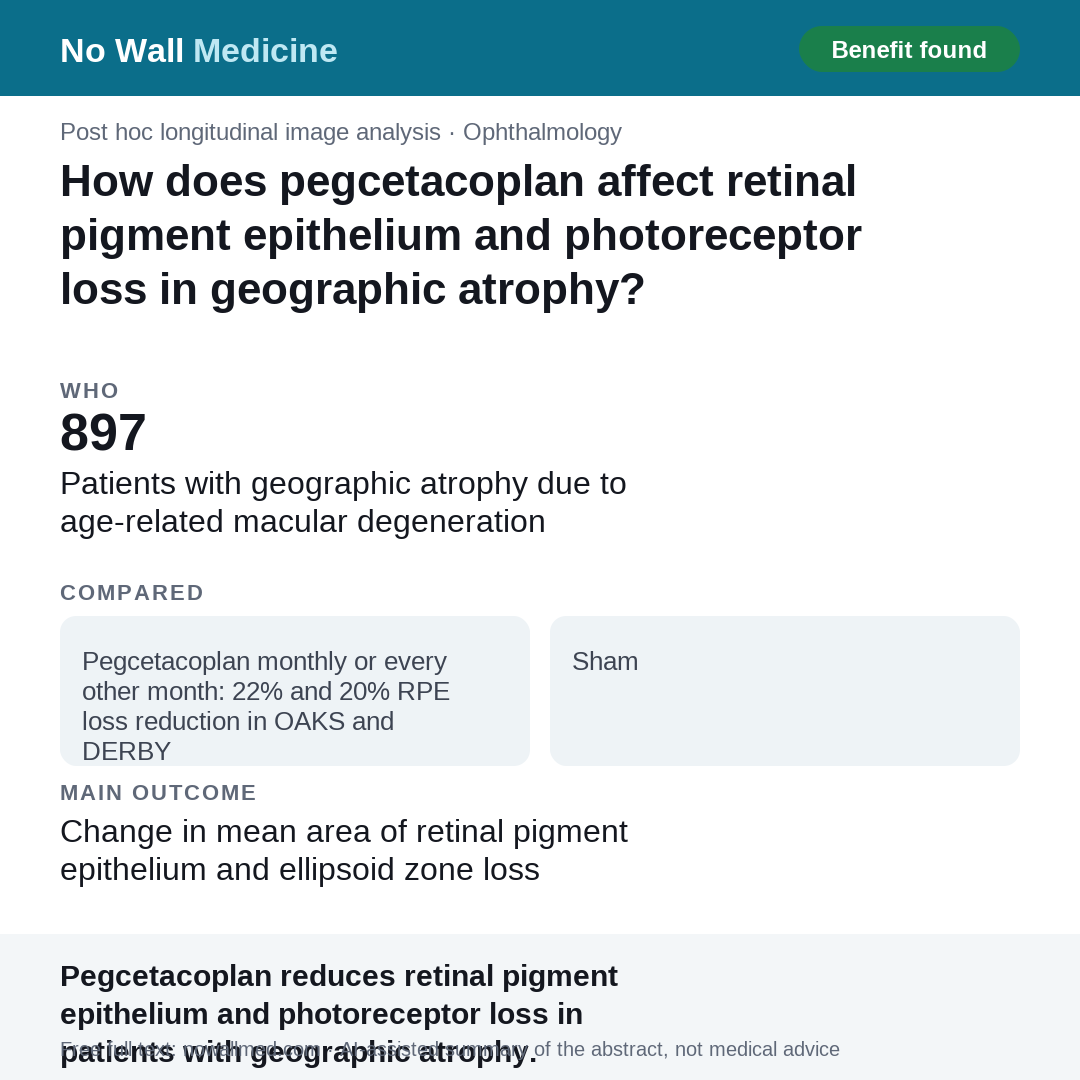
Clinical question: How does pegcetacoplan affect retinal pigment epithelium and photoreceptor loss in geographic atrophy?
Why it matters: It was unknown how pegcetacoplan affects specific retinal layers and whether the distance between the photoreceptor and retinal pigment epithelium layers influences treatment response.
Key points
- Researchers analyzed 897 eyes from two phase III clinical trials to measure changes in the retinal pigment epithelium and photoreceptor layers over 24 months.
- Pegcetacoplan treatment was associated with a 22% and 20% reduction in retinal pigment epithelium loss growth in the OAKS and DERBY trials respectively compared to sham.
- The reduction in photoreceptor layer loss was 53% and 46% in OAKS and 47% and 46% in DERBY for monthly and every other month dosing compared to sham.
Headline and key points written with AI from the paper’s abstract, with every number checked against it. Read the paper before relying on them.
Was this summary helpful?
Subject terms
Cite this article
Schmidt-Erfurth U, Mai J, Reiter GS, Riedl S, Vogl WD, Sadeghipour A. Disease Activity and Therapeutic Response to Pegcetacoplan for Geographic Atrophy Identified by Deep Learning-Based Analysis of OCT. Ophthalmology. 2024. doi:10.1016/j.ophtha.2024.08.017
Spotted a mistake? Suggest a correction
Top studies every Monday
The week’s key trials and guidelines in your specialties, plus any topics you follow. By email, free.
Get the weekly digest