Disease-Modifying Effect of Japanese Cedar Pollen Sublingual Immunotherapy Tablets
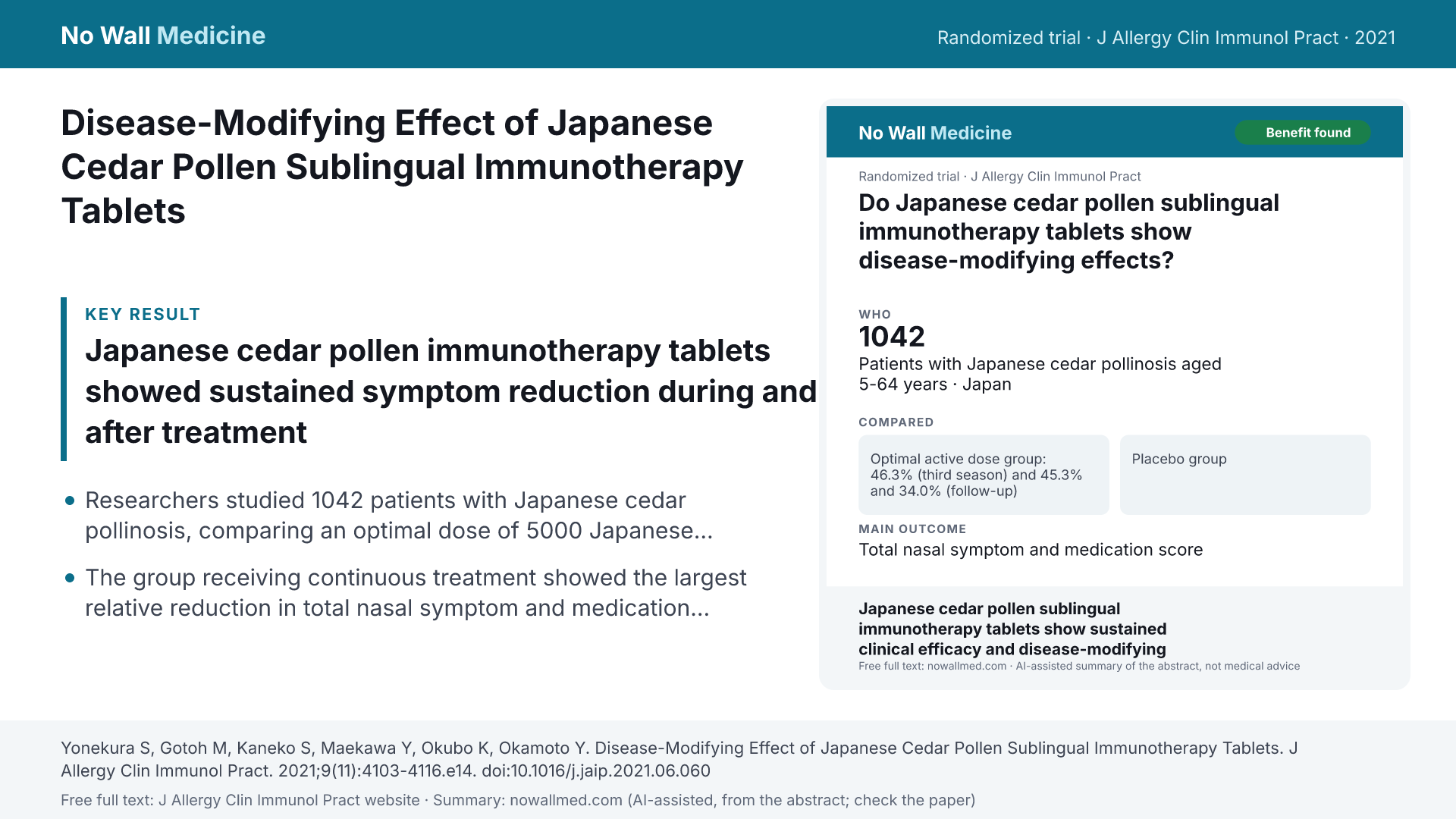
Key result: Japanese cedar pollen immunotherapy tablets showed sustained symptom reduction during and after treatment
Randomized trialBenefit found
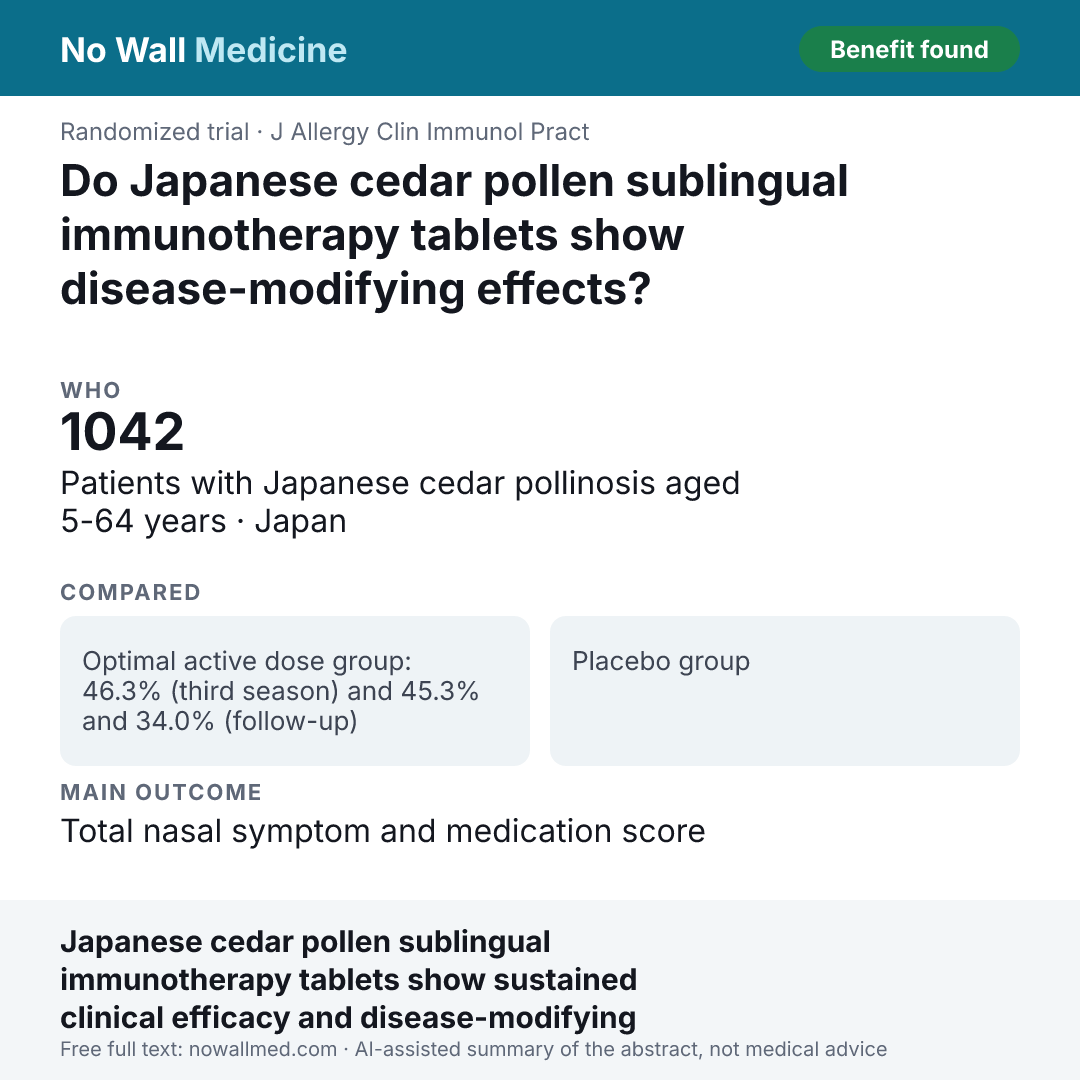
Do Japanese cedar pollen sublingual immunotherapy tablets show disease-modifying effects?
Who
1042
Patients with Japanese cedar pollinosis aged 5-64 years · Japan
Compared
Optimal active dose group: 46.3% (third season) and 45.3% and 34.0% (follow-up)
Placebo group
Main outcome
Total nasal symptom and medication score
Bottom line: Japanese cedar pollen sublingual immunotherapy tablets show sustained clinical efficacy and disease-modifying effects for at least 2 years after treatment.
J Allergy Clin Immunol Pract · 2021-07-29 · Save PNG
Key points
- Researchers studied 1042 patients with Japanese cedar pollinosis, comparing an optimal dose of 5000 Japanese allergy units to a placebo over five years.
- The group receiving continuous treatment showed the largest relative reduction in total nasal symptom and medication scores at 46.3% during the third season compared to the placebo group.
- During the two-year follow-up after stopping treatment, the continuous treatment group showed reductions of 45.3% and 34.0% compared to the placebo group.
Discussion prompts
- Would these patients look like yours? Who was left out?
- Is the main outcome one that matters to patients?
- Is the difference large enough to change what you do?
Cite: Yonekura S, Gotoh M, Kaneko S, Maekawa Y, Okubo K, Okamoto Y. Disease-Modifying Effect of Japanese Cedar Pollen Sublingual Immunotherapy Tablets. J Allergy Clin Immunol Pract. 2021;9(11):4103-4116.e14. doi:10.1016/j.jaip.2021.06.060
Free full text: J Allergy Clin Immunol Pract website · Summary and visual abstract: nowallmed.com/a/disease-modifying-effect-of-japanese-cedar-pollen-sublingual-1ris996/ (AI-assisted from the abstract; check the paper before relying on it).