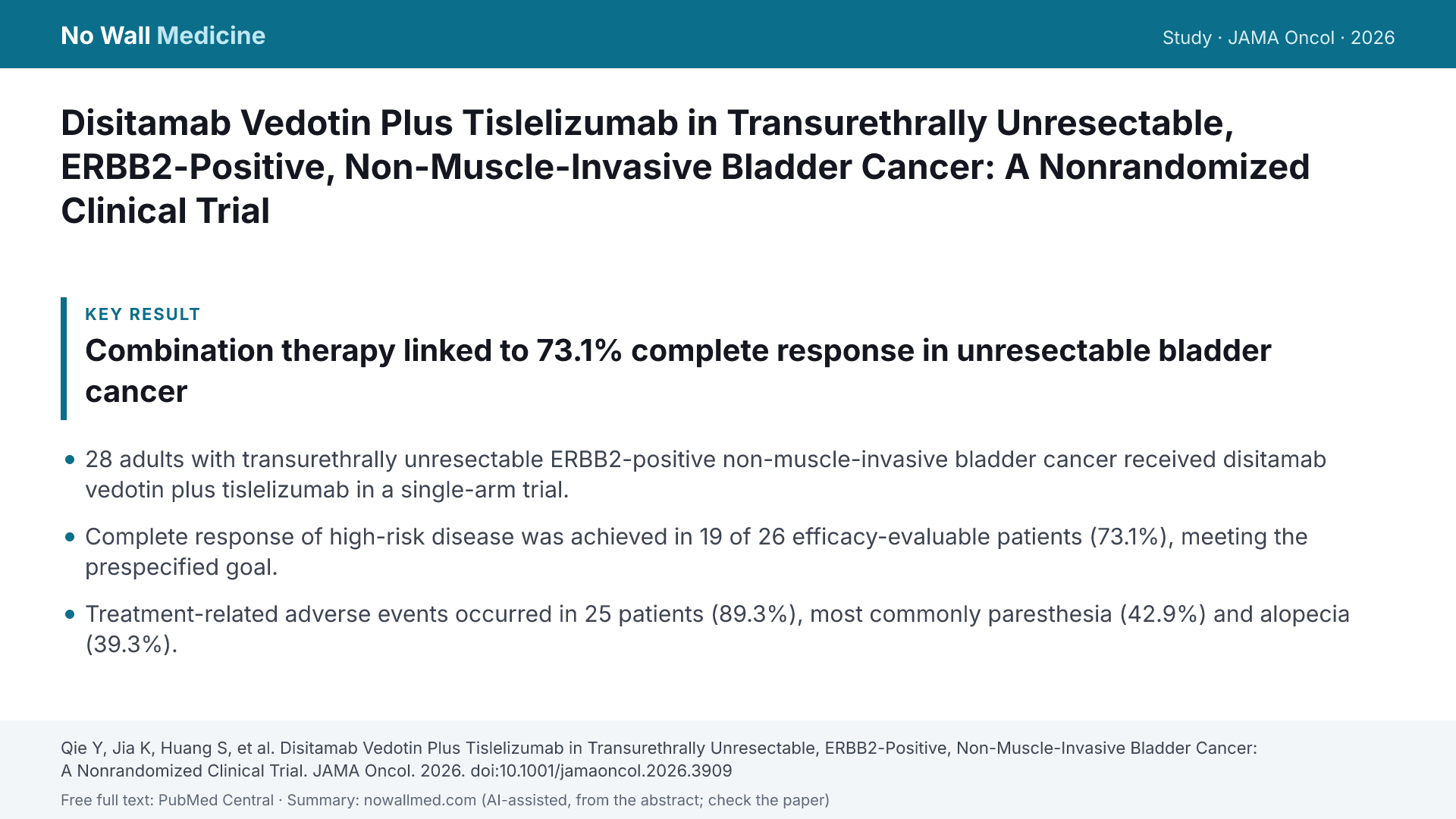
Combination therapy linked to 73.1% complete response in unresectable bladder cancer
Disitamab Vedotin Plus Tislelizumab in Transurethrally Unresectable, ERBB2-Positive, Non-Muscle-Invasive Bladder Cancer: A Nonrandomized Clinical Trial
Why it matters: Patients with transurethrally unresectable very high-risk non-muscle-invasive bladder cancer who decline or cannot have cystectomy lack established nonsurgical therapy.
Key points
- 28 adults with transurethrally unresectable ERBB2-positive non-muscle-invasive bladder cancer received disitamab vedotin plus tislelizumab in a single-arm trial.
- Complete response of high-risk disease was achieved in 19 of 26 efficacy-evaluable patients (73.1%), meeting the prespecified goal.
- Treatment-related adverse events occurred in 25 patients (89.3%), most commonly paresthesia (42.9%) and alopecia (39.3%).
Study type: Observational study: it can show a link, but not prove that one thing causes another.
Headline and key points written with AI from the paper’s abstract, with every number checked against it. Read the paper before relying on them.
Was this summary helpful?
Headline, design, result, key points, caveat and citation as plain text.
Cite this article
Qie Y, Jia K, Huang S, et al. Disitamab Vedotin Plus Tislelizumab in Transurethrally Unresectable, ERBB2-Positive, Non-Muscle-Invasive Bladder Cancer: A Nonrandomized Clinical Trial. JAMA Oncol. 2026. doi:10.1001/jamaoncol.2026.3909
Spotted a mistake? Suggest a correction