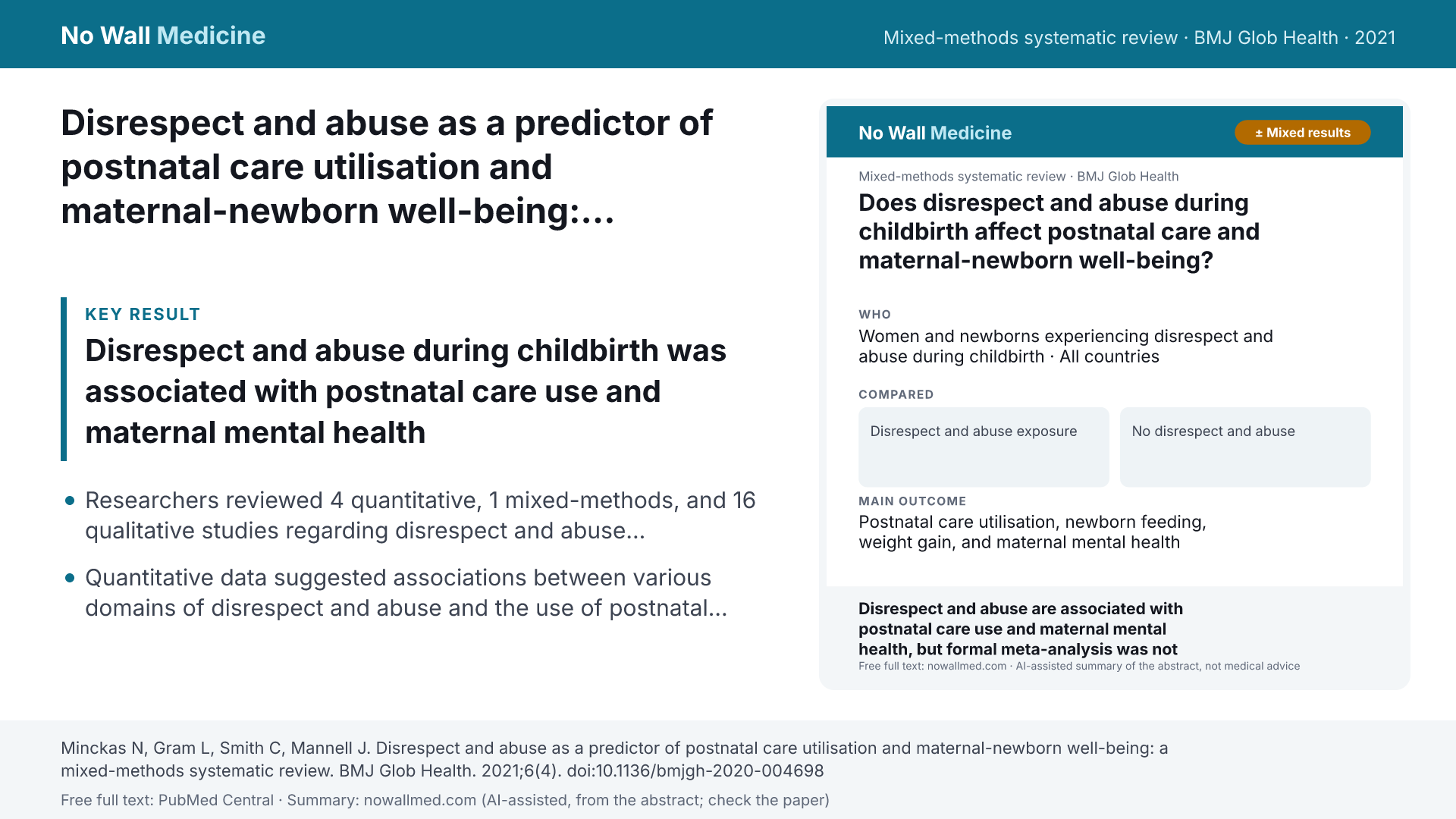
Disrespect and abuse during childbirth was associated with postnatal care use and maternal mental health
Disrespect and abuse as a predictor of postnatal care utilisation and maternal-newborn well-being: a mixed-methods systematic review
Mixed-methods systematic reviewMixed results
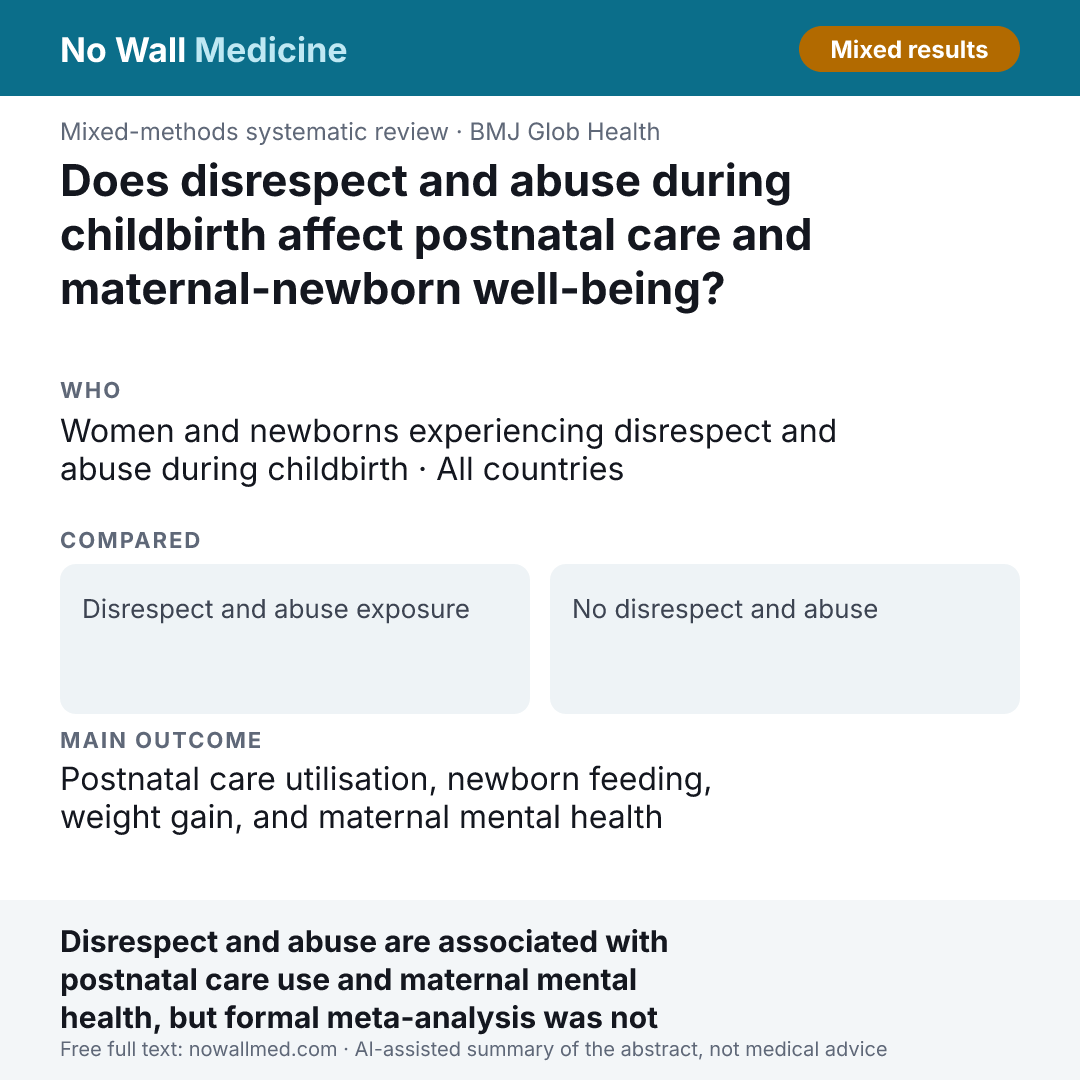
Does disrespect and abuse during childbirth affect postnatal care and maternal-newborn well-being?
Who
Women and newborns experiencing disrespect and abuse during childbirth · All countries
Compared
Disrespect and abuse exposure
No disrespect and abuse
Main outcome
Postnatal care utilisation, newborn feeding, weight gain, and maternal mental health
Bottom line: Disrespect and abuse are associated with postnatal care use and maternal mental health, but formal meta-analysis was not possible.
BMJ Glob Health · 2021-04-22 · Save PNG
Clinical question: Does disrespect and abuse during childbirth affect postnatal care and maternal-newborn well-being?
Key points
- Researchers reviewed 4 quantitative, 1 mixed-methods, and 16 qualitative studies regarding disrespect and abuse during childbirth and the immediate postnatal period.
- Quantitative data suggested associations between various domains of disrespect and abuse and the use of postnatal care and maternal mental health.
- Qualitative findings identified three main themes related to postnatal care use: women's direct experiences, expectations, and agency.
Headline and key points written with AI from the paper’s abstract, with every number checked against it. Read the paper before relying on them.
Was this summary helpful?
Abstract
Introduction
Globally, a substantial number of women experience abusive and disrespectful care from health providers during childbirth. As evidence mounts on the nature and frequency of disrespect and abuse (D&A), little is known about the consequences of a negative experience of care on health and well-being of women and newborns. This review summarises available evidence on the associations of D&A of mother and newborns during childbirth and the immediate postnatal period (understood as the first 24 hours from birth) with maternal and neonatal postnatal care (PNC) utilisation, newborn feeding practices, newborn weight gain and maternal mental health. Methods
We conducted a systematic review of all published qualitative, quantitative and mixed-methods studies on D&A and its postnatal consequences across all countries. Pubmed, Embase, Web of Science, LILACS and Scopus were searched using predetermined search terms. Quantitative and qualitative data were analysed and presented separately. Thematic analysis was used to synthesise the qualitative evidence. Results
A total of 4 quantitative, 1 mixed-methods and 16 qualitative studies were included. Quantitative studies suggested associations between several domains of D&A and use of PNC as well as maternal mental health. Different definitions of exposure meant formal meta-analysis was not possible. Three main themes emerged from the qualitative findings associated with PNC utilisation: (1) women's direct experiences; (2) women's expectations and (3) women's agency. Conclusion
This review is the first to examine the postnatal effect of D&A of women and newborns during childbirth. We highlight gaps in research that could help improve health outcomes and protect women and newborns during childbirth. Understanding the health and access consequences of a negative birth experience can help progress the respectful care agenda.
Abstract reproduced under the article’s CC BY licence.
Subject terms
Headline, design, result, key points, caveat and citation as plain text.
Cite this article
Minckas N, Gram L, Smith C, Mannell J. Disrespect and abuse as a predictor of postnatal care utilisation and maternal-newborn well-being: a mixed-methods systematic review. BMJ Glob Health. 2021;6(4). doi:10.1136/bmjgh-2020-004698
Spotted a mistake? Suggest a correction