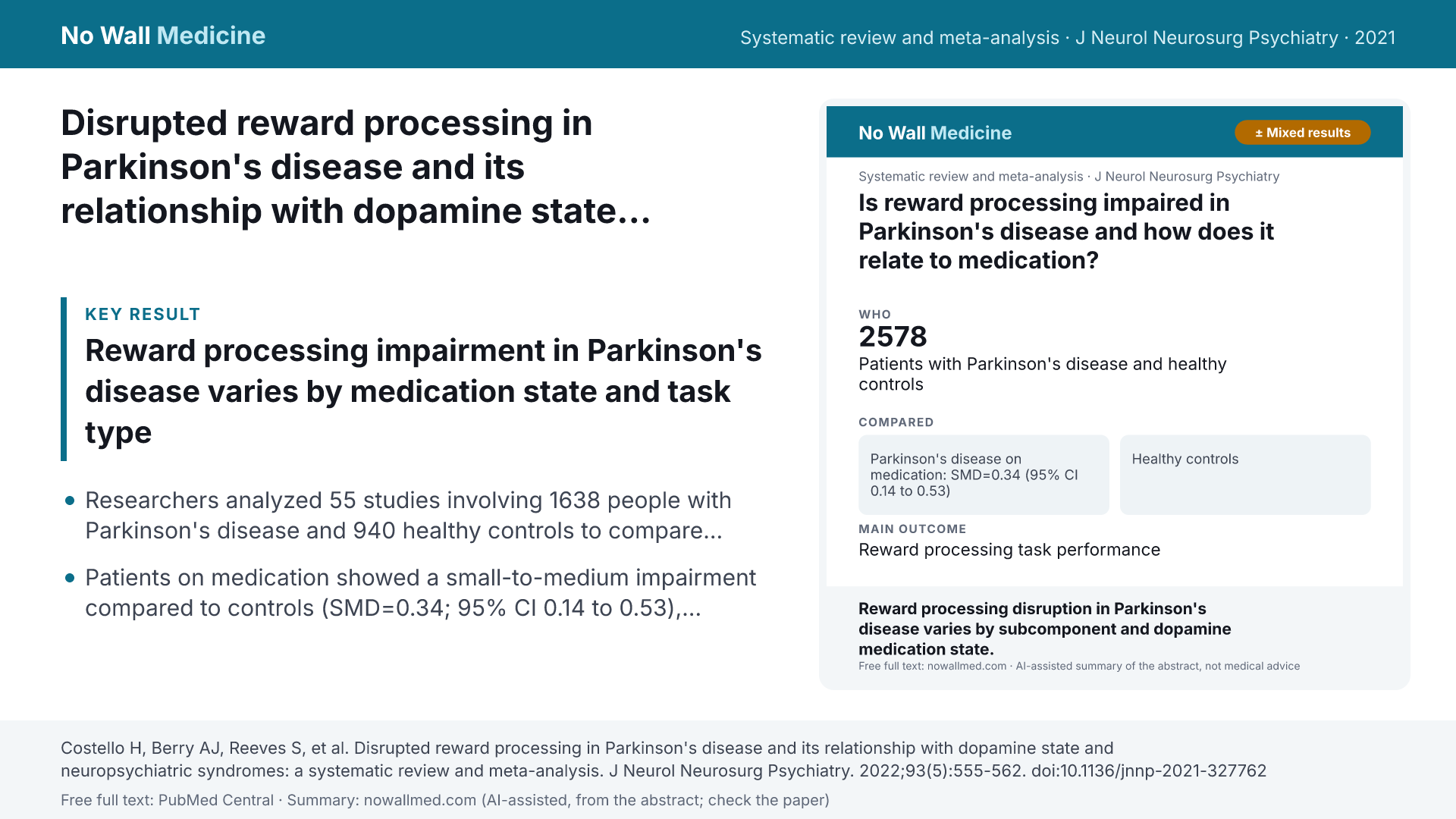
Reward processing impairment in Parkinson's disease varies by medication state and task type
Disrupted reward processing in Parkinson's disease and its relationship with dopamine state and neuropsychiatric syndromes: a systematic review and meta-analysis
Systematic review and meta-analysisMixed results
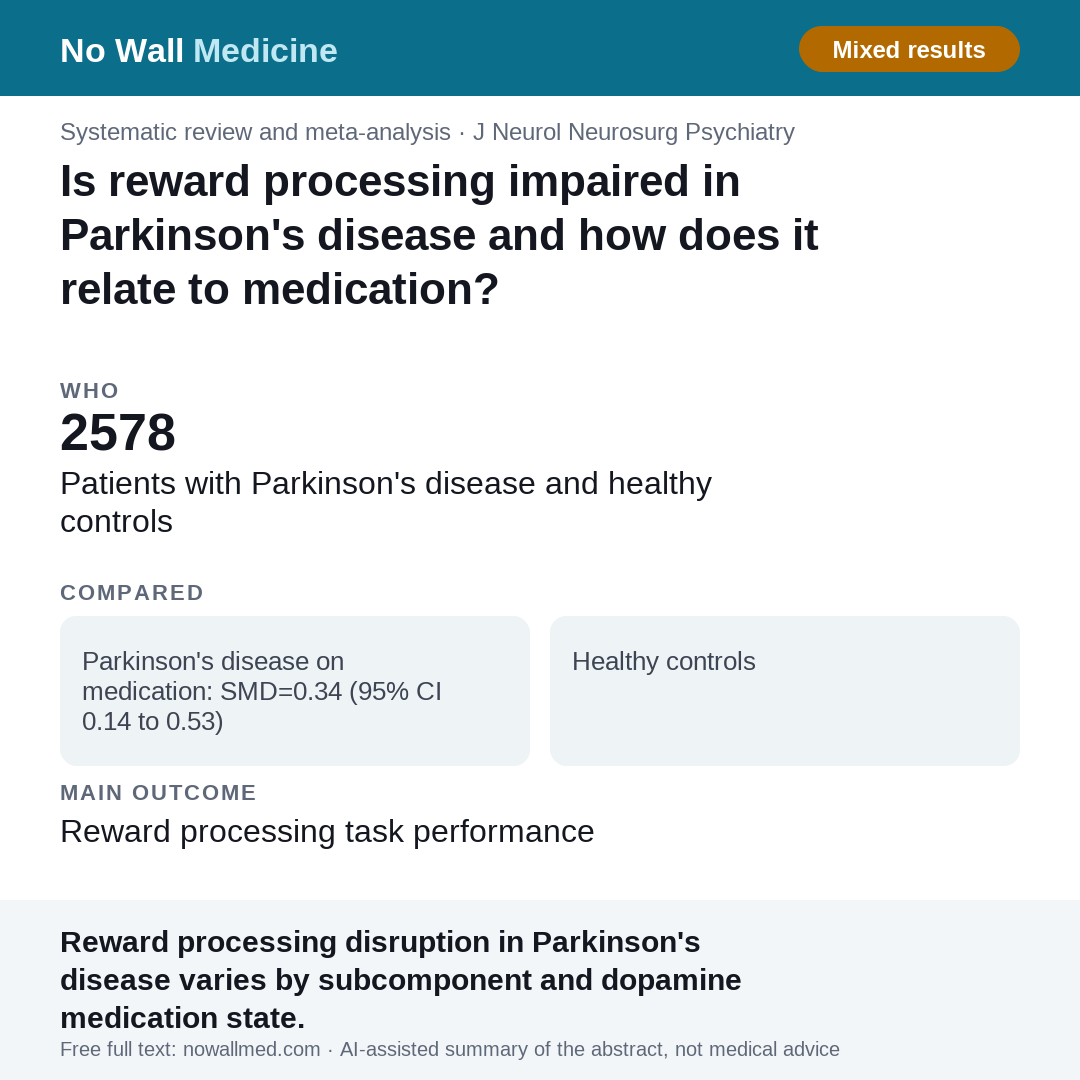
Is reward processing impaired in Parkinson's disease and how does it relate to medication?
Who
2578
Patients with Parkinson's disease and healthy controls
Compared
Parkinson's disease on medication: SMD=0.34 (95% CI 0.14 to 0.53)
Healthy controls
Main outcome
Reward processing task performance
Result: SMD=0.34 (95% CI 0.14 to 0.53)
Bottom line: Reward processing disruption in Parkinson's disease varies by subcomponent and dopamine medication state.
Limitation: Impulse control disorder was the only neuropsychiatric syndrome with sufficient studies for meta-analysis.
J Neurol Neurosurg Psychiatry · 2021-12-20Download image
Clinical question: Is reward processing impaired in Parkinson's disease and how does it relate to medication?
Why it matters: It is unknown how reward processing dysfunction relates to dopamine replacement therapy and specific neuropsychiatric syndromes in Parkinson's disease.
Key points
- Researchers analyzed 55 studies involving 1638 people with Parkinson's disease and 940 healthy controls to compare reward processing tasks.
- Patients on medication showed a small-to-medium impairment compared to controls (SMD=0.34; 95% CI 0.14 to 0.53), while those off medication showed greater impairment in certain designs (SMD=0.43, 95% CI 0.29 to 0.57).
- No significant impairment in reward processing was identified in patients with impulse control disorders compared to those without (SMD=-0.02, 95% CI -0.43 to 0.39).
Headline and key points written with AI from the paper’s abstract, with every number checked against it. Read the paper before relying on them.
Was this summary helpful?
Abstract
Background
Neuropsychiatric symptoms are common in Parkinson's disease (PD) and predict poorer outcomes. Reward processing dysfunction is a candidate mechanism for the development of psychiatric symptoms including depression and impulse control disorders (ICDs). We aimed to determine whether reward processing is impaired in PD and its relationship with neuropsychiatric syndromes and dopamine replacement therapy. Methods
The Ovid MEDLINE/PubMed, Embase and PsycInfo databases were searched for articles published up to 5 November 2020. Studies reporting reward processing task performance by patients with PD and healthy controls were included. Summary statistics comparing reward processing between groups were converted to standardised mean difference (SMD) scores and meta-analysed using a random effects model. Results
We identified 55 studies containing 2578 participants (1638 PD and 940 healthy controls). Studies assessing three subcomponent categories of reward processing tasks were included: option valuation (n=12), reinforcement learning (n=37) and reward response vigour (n=6). Across all studies, patients with PD on medication exhibited a small-to-medium impairment versus healthy controls (SMD=0.34; 95% CI 0.14 to 0.53), with greater impairments observed off dopaminergic medication in within-subjects designs (SMD=0.43, 95% CI 0.29 to 0.57). Within-subjects subcomponent analysis revealed impaired processing off medication on option valuation (SMD=0.57, 95% CI 0.39 to 0.75) and reward response vigour (SMD=0.36, 95% CI 0.13 to 0.59) tasks. However, the opposite applied for reinforcement learning, which relative to healthy controls was impaired on-medication (SMD=0.45, 95% CI 0.25 to 0.65) but not off-medication (SMD=0.28, 95% CI -0.03 to 0.59). ICD was the only neuropsychiatric syndrome with sufficient studies (n=13) for meta-analysis, but no significant impairment was identified compared tonon-ICD patients (SMD=-0.02, 95% CI -0.43 to 0.39). Conclusion
Reward processing disruption in PD differs according to subcomponent and dopamine medication state, and warrants further study as a potential treatment target and mechanism underlying associated neuropsychiatric syndromes.
Abstract reproduced under the article’s CC BY licence.
Subject terms
Cite this article
Costello H, Berry AJ, Reeves S, et al. Disrupted reward processing in Parkinson's disease and its relationship with dopamine state and neuropsychiatric syndromes: a systematic review and meta-analysis. J Neurol Neurosurg Psychiatry. 2021. doi:10.1136/jnnp-2021-327762
Spotted a mistake? Suggest a correction