Dissecting the multifaceted impact of statin use on fatty liver disease: a multidimensional study
Cross-sectional investigation and meta-analysisKey finding
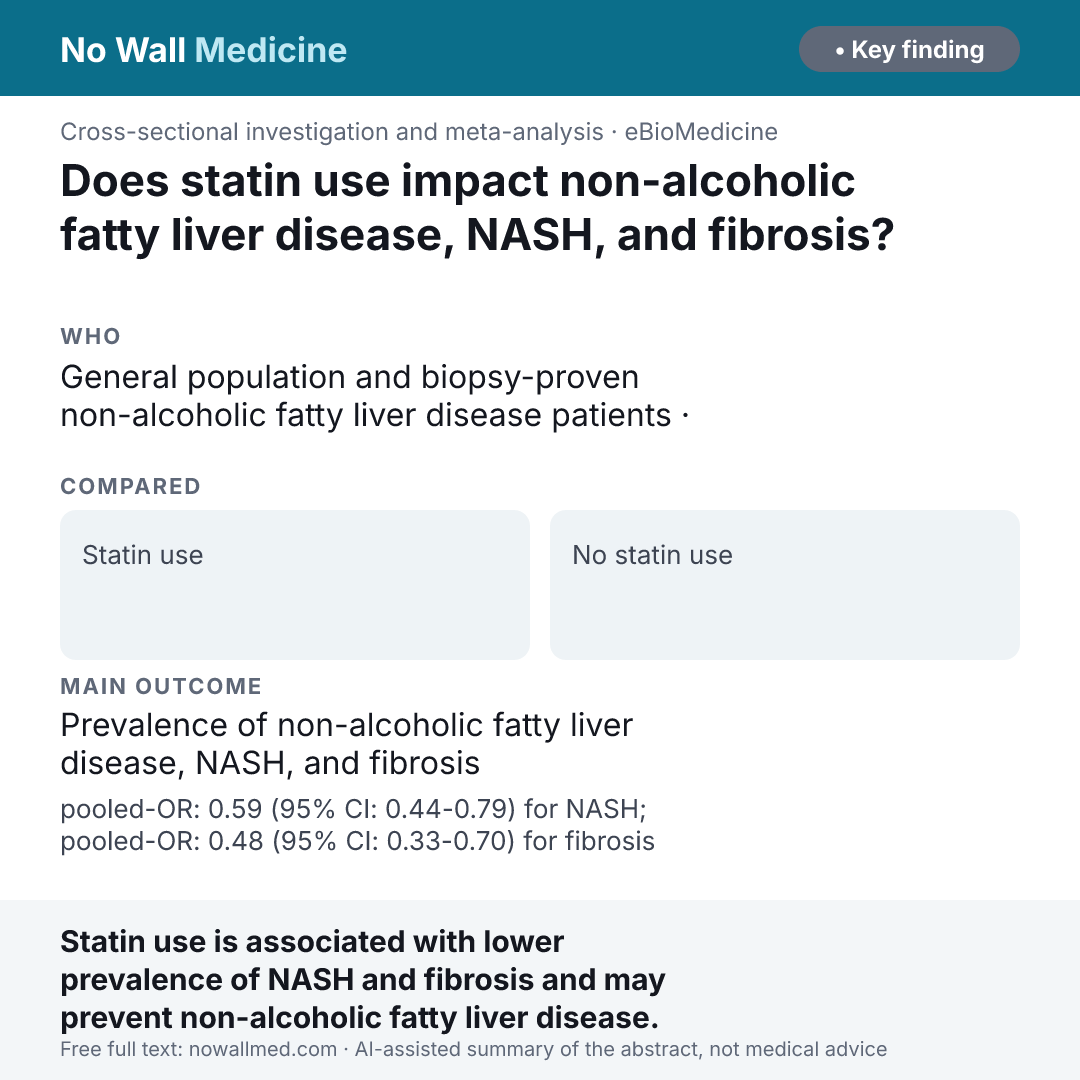
Does statin use impact non-alcoholic fatty liver disease, NASH, and fibrosis?
Who
General population and biopsy-proven non-alcoholic fatty liver disease patients · Rotterdam Study and PERSONS cohort
Compared
Statin use
No statin use
Main outcome
Prevalence of non-alcoholic fatty liver disease, NASH, and fibrosis
Result: pooled-OR: 0.59 (95% CI: 0.44-0.79) for NASH; pooled-OR: 0.48 (95% CI: 0.33-0.70) for fibrosis
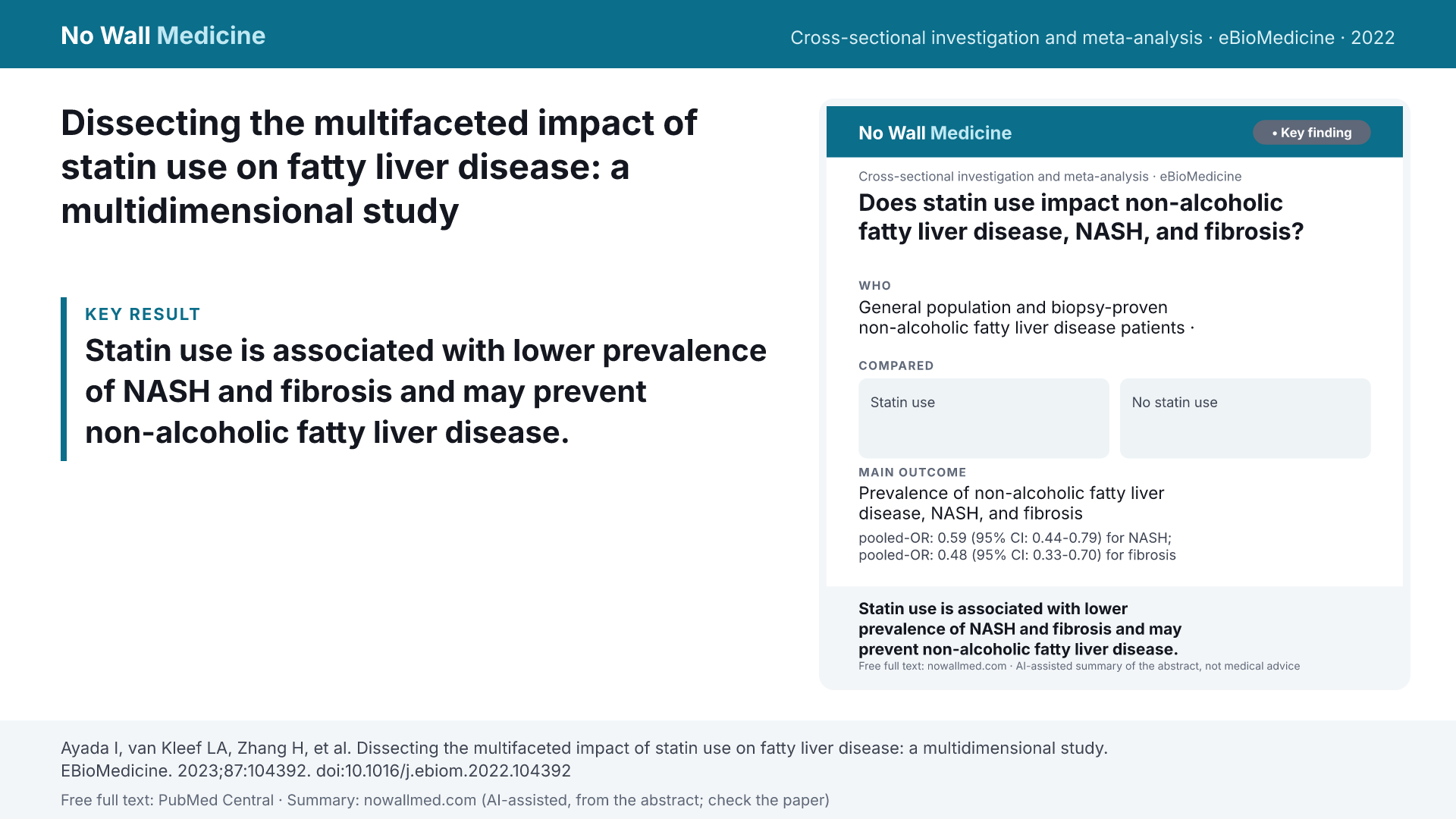
Bottom line: Statin use is associated with lower prevalence of NASH and fibrosis and may prevent non-alcoholic fatty liver disease.
Funded by: ZonMw, KWF, NWO, SLO, DGXII, RIDE, Erasmus MC
eBioMedicine · 2022-12-08 · Save PNG
Clinical question: Does statin use impact non-alcoholic fatty liver disease, NASH, and fibrosis?
Abstract
Background
Statin use could benefit patients with non-alcoholic fatty liver disease (NAFLD), but the evidence is segmented and inconclusive. This multidimensional study comprehensively investigated the potential benefits and mechanism-of-action of statins in NAFLD. Methods
A cross-sectional investigation was performed within the Rotterdam Study (general population; n = 4.576) and the PERSONS cohort (biopsy-proven NAFLD patients; n = 569). Exclusion criteria were secondary causes for steatosis and insufficient data on alcohol, dyslipidemia or statin use. Associations of statin use with NAFLD (among entire general population), fibrosis and NASH (among NAFLD individuals and patients) were quantified. These results were pooled with available literature in meta-analysis. Last, we assessed statins' anti-lipid and anti-inflammatory effects in 3D cultured human liver organoids and THP-1 macrophages, respectively. Findings
Statin use was inversely associated with NAFLD in the Rotterdam study compared to participants with untreated dyslipidemia. In the PERSONS cohort, statin use was inversely associated with NASH, but not with fibrosis. The meta-analysis included 7 studies and indicated a not significant inverse association for statin use with NAFLD (pooled-Odds Ratio: 0.69, 95% Confidence Interval: 0.46-1.01) and significant inverse associations with NASH (pooled-OR: 0.59, 95% CI: 0.44-0.79) and fibrosis (pooled-OR: 0.48, 95% CI: 0.33-0.70). In vitro, statins significantly reduced lipid droplet accumulation in human liver organoids and downregulated expression of pro-inflammatory cytokines in macrophages. Interpretation
Pooled results demonstrated that statin use was associated with a lower prevalence of NASH and fibrosis and might prevent NAFLD. This may be partially attributed to the anti-lipid and anti-inflammatory characteristics of statins. Given their under-prescription, adequate prescription of statins may limit the disease burden of NAFLD. Funding
ZonMw, KWF, NWO, SLO, DGXII, RIDE, National and regional government, Erasmus MC and Erasmus University.
Subject terms
Headline, design, result, key points, caveat and citation as plain text.
Cite this article
Ayada I, van Kleef LA, Zhang H, et al. Dissecting the multifaceted impact of statin use on fatty liver disease: a multidimensional study. EBioMedicine. 2023;87:104392. doi:10.1016/j.ebiom.2022.104392
Spotted a mistake? Suggest a correction