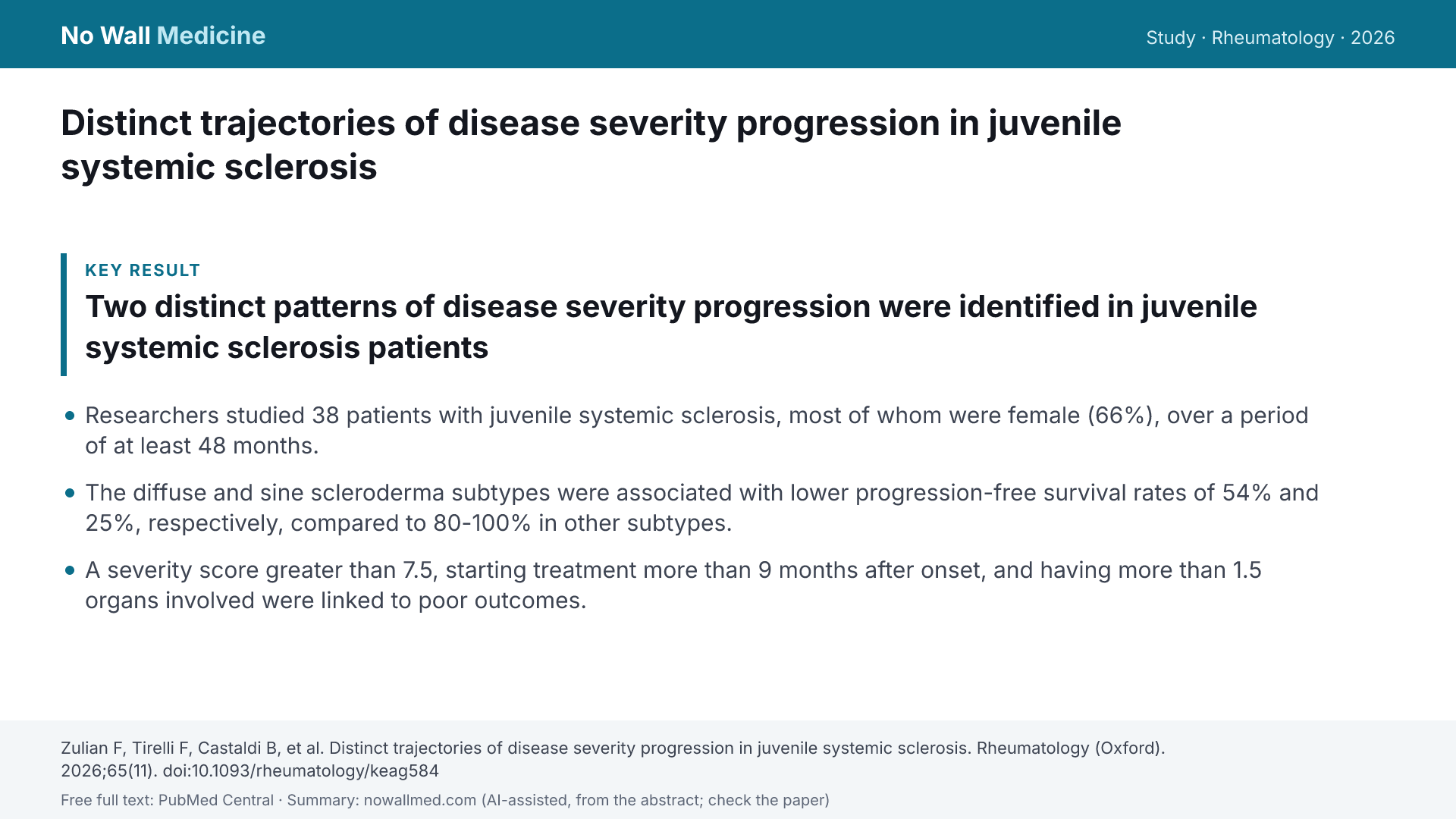
Two distinct patterns of disease severity progression were identified in juvenile systemic sclerosis patients
Distinct trajectories of disease severity progression in juvenile systemic sclerosis
Why it matters: It is difficult to define phenotypic classification and disease progression in juvenile systemic sclerosis because the disease often presents with overlapping features.
Key points
- Researchers studied 38 patients with juvenile systemic sclerosis, most of whom were female (66%), over a period of at least 48 months.
- The diffuse and sine scleroderma subtypes were associated with lower progression-free survival rates of 54% and 25%, respectively, compared to 80-100% in other subtypes.
- A severity score greater than 7.5, starting treatment more than 9 months after onset, and having more than 1.5 organs involved were linked to poor outcomes.
Study type: Observational study: it can show a link, but not prove that one thing causes another.
Headline and key points written with AI from the paper’s abstract, with every number checked against it. Read the paper before relying on them.
Was this summary helpful?
Subject terms
Headline, design, result, key points, caveat and citation as plain text.
Cite this article
Zulian F, Tirelli F, Castaldi B, et al. Distinct trajectories of disease severity progression in juvenile systemic sclerosis. Rheumatology (Oxford). 2026;65(11). doi:10.1093/rheumatology/keag584
Spotted a mistake? Suggest a correction