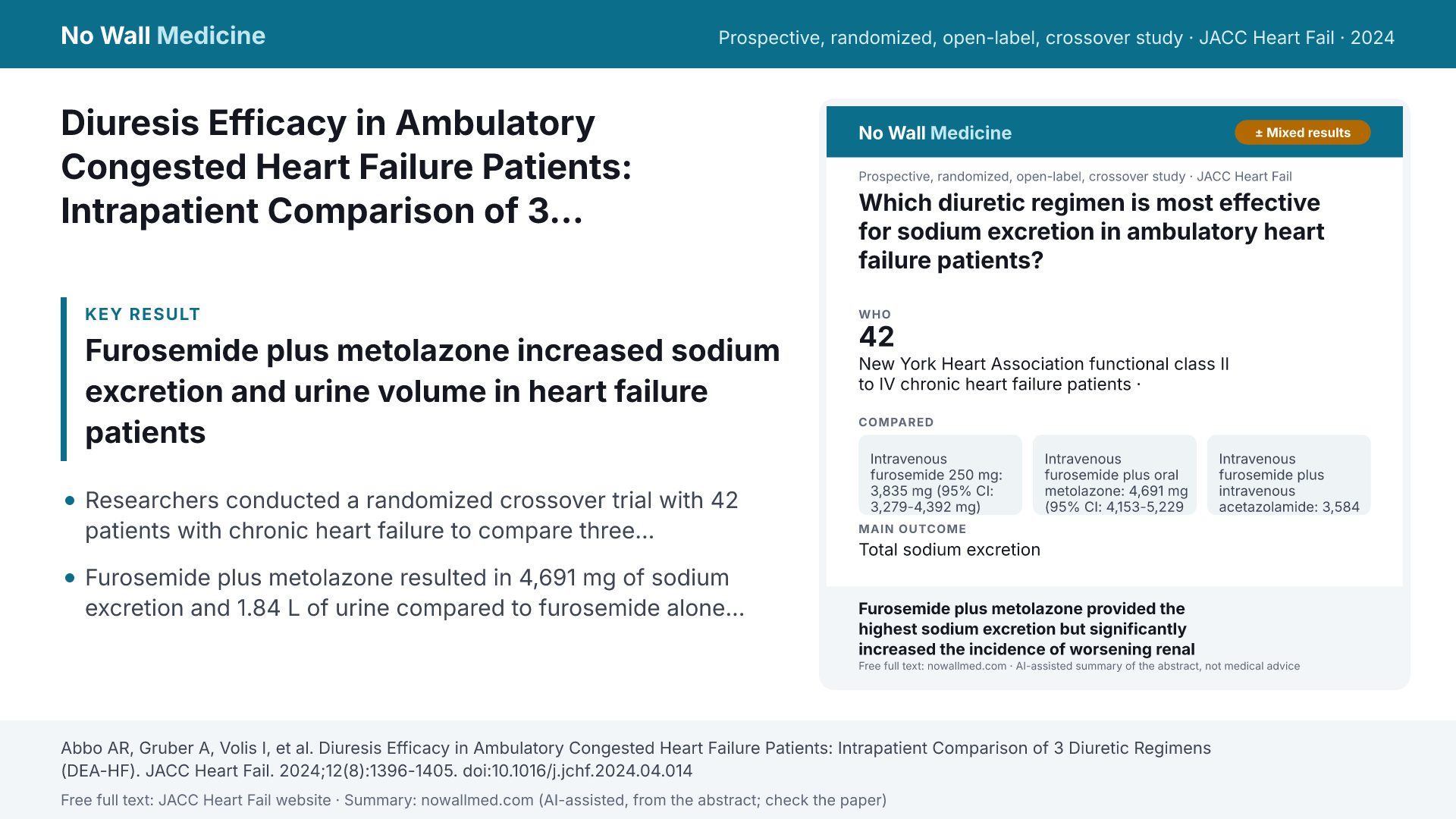
Furosemide plus metolazone increased sodium excretion and urine volume in heart failure patients
Diuresis Efficacy in Ambulatory Congested Heart Failure Patients: Intrapatient Comparison of 3 Diuretic Regimens (DEA-HF)
Prospective, randomized, open-label, crossover studyMixed results
Which diuretic regimen is most effective for sodium excretion in ambulatory heart failure patients?
Who
42
New York Heart Association functional class II to IV chronic heart failure patients · Ambulatory day-care unit
Compared
Intravenous furosemide 250 mg: 3,835 mg (95% CI: 3,279-4,392 mg)
Intravenous furosemide plus oral metolazone: 4,691 mg (95% CI: 4,153-5,229 mg)
Intravenous furosemide plus intravenous acetazolamide: 3,584 mg (95% CI: 3,020-4,148 mg)
Main outcome
Total sodium excretion
Bottom line: Furosemide plus metolazone provided the highest sodium excretion but significantly increased the incidence of worsening renal function.
JACC Heart Fail · 2024-05-11Download image
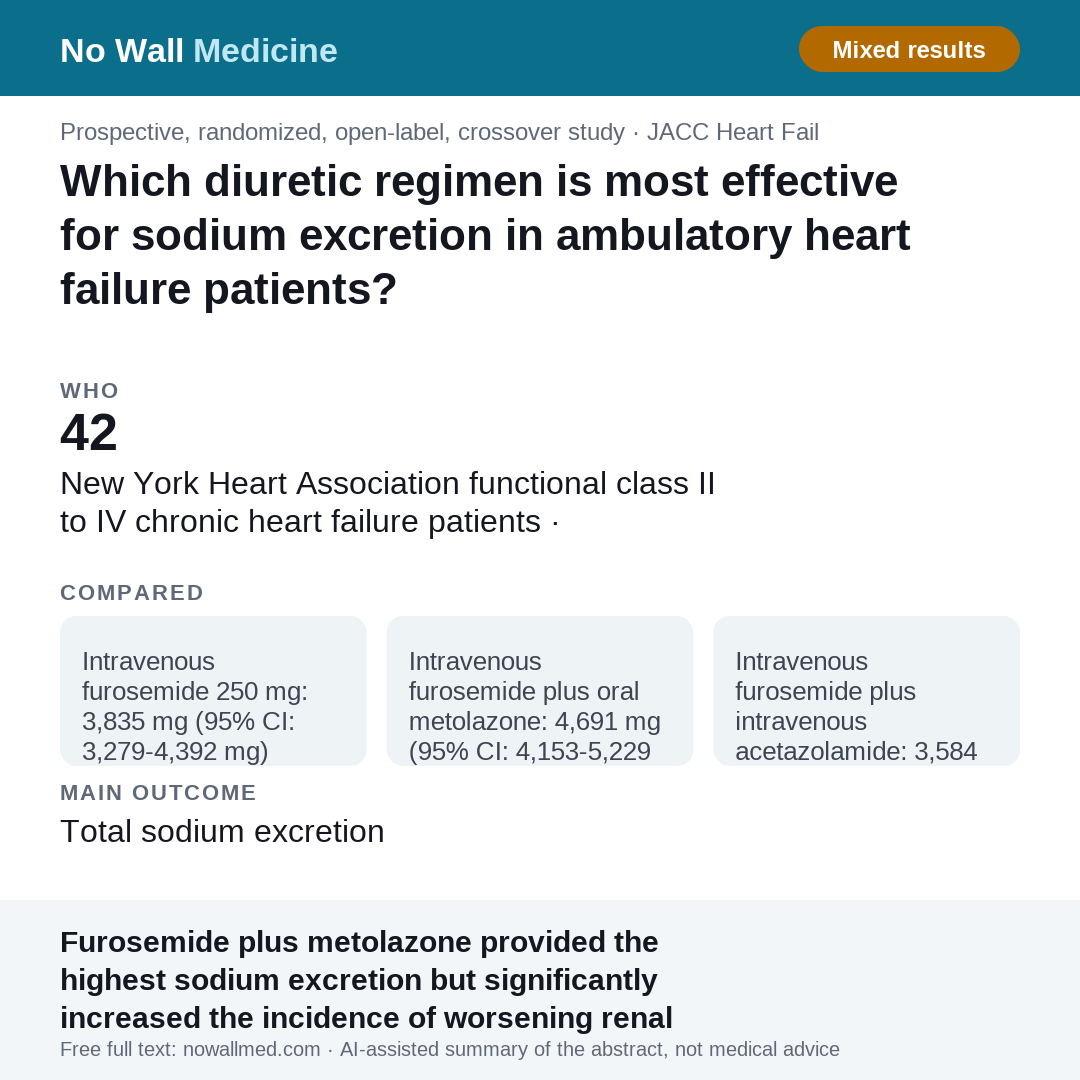
Clinical question: Which diuretic regimen is most effective for sodium excretion in ambulatory heart failure patients?
Why it matters: Evidence is limited regarding the efficacy and safety of different diuretic regimens in patients with ambulatory, congestion-refractory, chronic heart failure.
Key points
- Researchers conducted a randomized crossover trial with 42 patients with chronic heart failure to compare three different diuretic regimens.
- Furosemide plus metolazone resulted in 4,691 mg of sodium excretion and 1.84 L of urine compared to furosemide alone and furosemide plus acetazolamide.
- The addition of metolazone was associated with a higher incidence of worsening kidney function at 39% compared to 16% for furosemide alone and 2.6% for furosemide plus acetazolamide.
Headline and key points written with AI from the paper’s abstract, with every number checked against it. Read the paper before relying on them.
Was this summary helpful?
Subject terms
Cite this article
Abbo AR, Gruber A, Volis I, Aronson D, Girerd N, Lund Kristensen S. Diuresis Efficacy in Ambulatory Congested Heart Failure Patients: Intrapatient Comparison of 3 Diuretic Regimens (DEA-HF). JACC Heart Fail. 2024. doi:10.1016/j.jchf.2024.04.014
Spotted a mistake? Suggest a correction