Furosemide diuretic therapy was associated with lower fluid accumulation in patients on mechanical ventilation
Diuretics decrease fluid balance in patients on invasive mechanical ventilation: the randomized-controlled single blind, IRIHS study
Multicenter, single-blind, randomized-controlled studyBenefit found
Does a diuretic strategy decrease fluid balance in patients on invasive mechanical ventilation?
Who
166
Patients with fluid overload on invasive mechanical ventilation · Multicenter
Compared
diuretic (furosemide): 1.4 [- 2.5 to 4.5] kg
control group: 6.4 [0.5-11.2] kg
Main outcome
weight variation from reference weight to successful extubation
Result: mean difference = - 4.8 95% CI [- 7.3 to - 2.5]
Bottom line: Protocolized diuretic therapy reduced fluid accumulation and was well tolerated in patients receiving mechanical ventilation.
Crit Care · 2021-03-10Download image
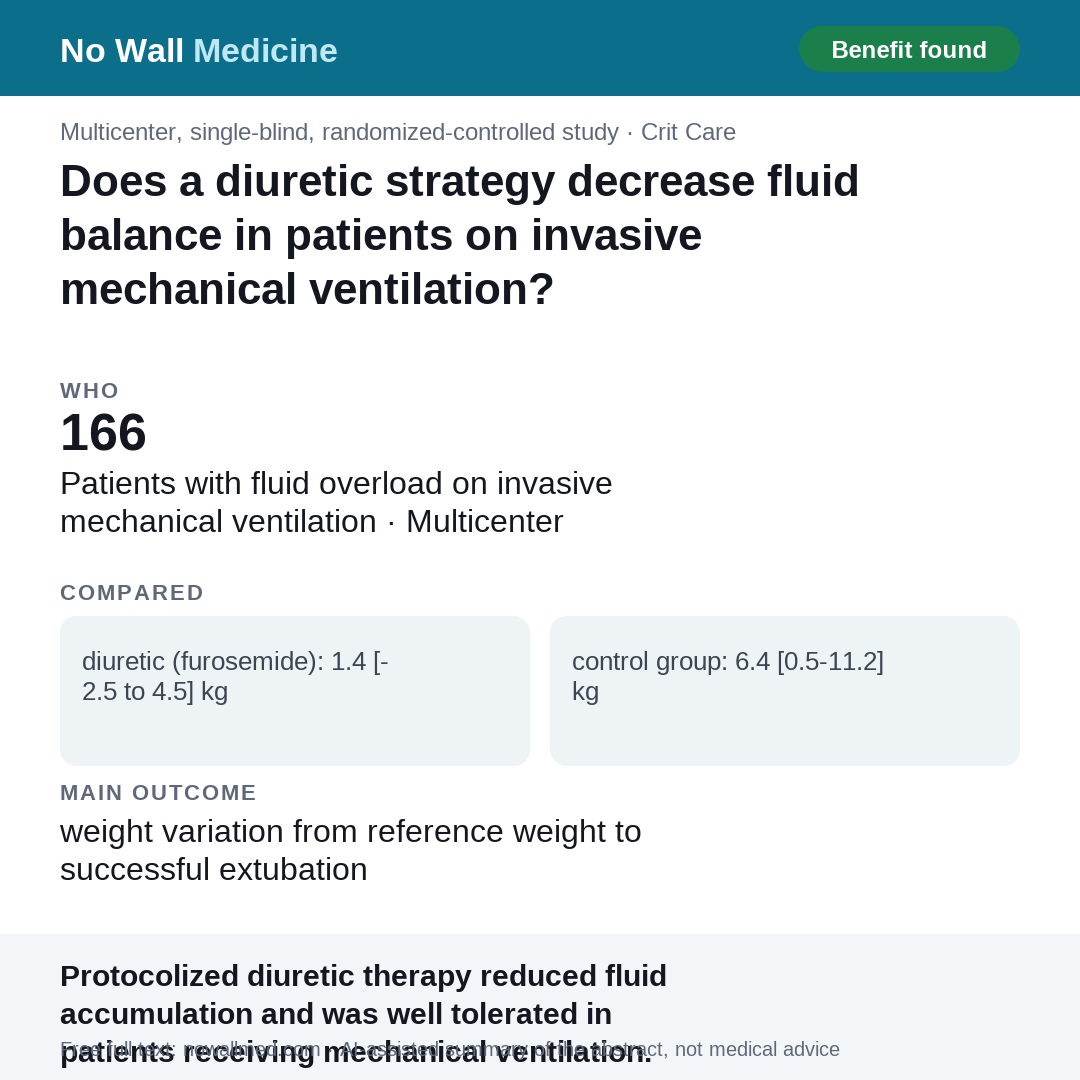
Clinical question: Does a diuretic strategy decrease fluid balance in patients on invasive mechanical ventilation?
Why it matters: It was unknown if a diuretic strategy could effectively manage positive fluid balance in critically ill patients requiring mechanical ventilation.
Key points
- Researchers studied 166 patients on invasive mechanical ventilation, comparing a diuretic group to a control group.
- The diuretic group had a fluid balance of 1.4 [-2.5 to 4.5] kg compared to 6.4 [0.5-11.2] kg in the control group.
- Acute kidney injury, a sudden loss of kidney function, occurred in 59.7% of the diuretic group versus 75.3% of the control group.
Headline and key points written with AI from the paper’s abstract, with every number checked against it. Read the paper before relying on them.
Was this summary helpful?
Abstract
Background
Fluid overload has been associated with increased morbidity and mortality in critically ill patients. The goal of this study was to assess the efficacy and safety of a diuretic strategy to overcome positive fluid balance in patients on invasive mechanical ventilation. Methods
Design: Multicenter, single-blind, randomized-controlled study. Patients were randomized into a diuretic (furosemide) or a control group. Patients were eligible in case of fluid overload defined as in-ICU weight increase ≥ 3%, invasive mechanical ventilation (FiO2 ≤ 60% and PEEP ≤ 10 cm H2O on inclusion) and hemodynamic stabilization. The primary outcome was fluid balance, defined as weight variation from reference weight to successful extubation. The main secondary outcome was the safety of diuretic. Results
171 patients were randomized. After 5 exclusions, 166 patients were included in the analysis: 77 in the diuretic and 89 in the control group. Fluid balance was 1.4 [- 2.5 to 4.5] kg in the diuretic and 6.4 [0.5-11.2] kg in the control group (p < 0.001). In the multiple imputation analysis, fluid balance was significantly decreased in the diuretic group (mean difference = - 4.8 95% CI [- 7.3 to - 2.5], p < 0.001). Eleven (14%) patients died in the diuretic group and 16 (18%) patients in the control group (p = 0.5). There was a worsening of Acute Kidney Injury in 67 (75.3%) patients of the control group versus 46 (59.7%) patients in the diuretic group (p = 0.03). Conclusions
In this multicenter randomized-controlled study, protocolized diuretic therapy reduced fluid accumulation in patients receiving mechanical ventilation and was well tolerated with a favorable safety profile. Trial registration NCT02345681, Registered January 26 2015, Prospectively registered, https://clinicaltrials.gov/ct2/show/NCT02345681?term=02345681&draw=2&rank=1 .
Abstract reproduced under the article’s CC BY licence.
Subject terms
Cite this article
Cinotti R, Lascarrou JB, Azais MA, Colin G, Quenot JP, Mahé PJ. Diuretics decrease fluid balance in patients on invasive mechanical ventilation: the randomized-controlled single blind, IRIHS study. Crit Care. 2021. doi:10.1186/s13054-021-03509-5
Spotted a mistake? Suggest a correction
Top studies every Monday
The week’s key trials and guidelines in your specialties, plus any topics you follow. By email, free.
Get the weekly digest