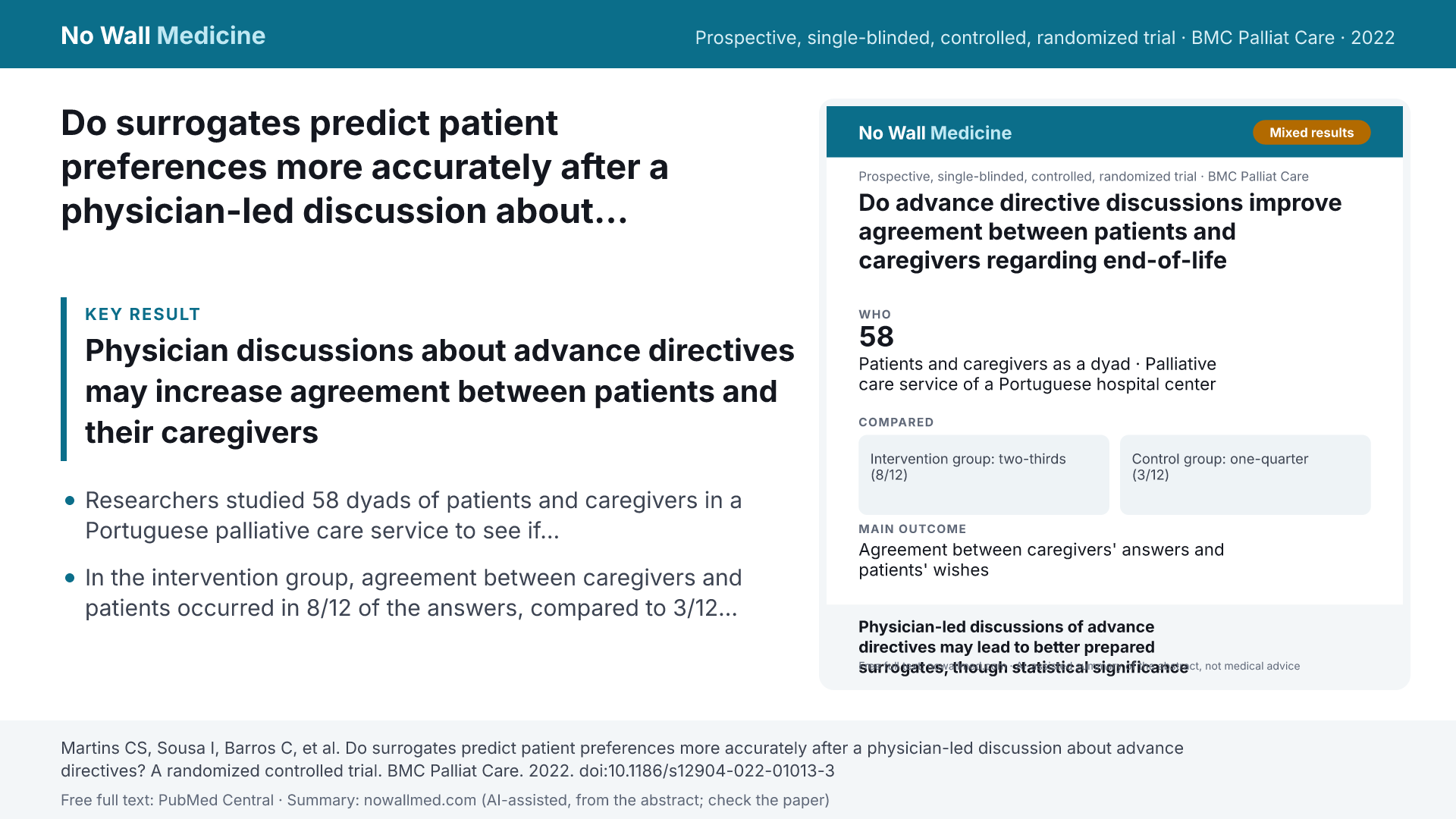
Do surrogates predict patient preferences more accurately after a physician-led discussion about advance directives? A randomized controlled trial
Key result: Physician discussions about advance directives may increase agreement between patients and their caregivers
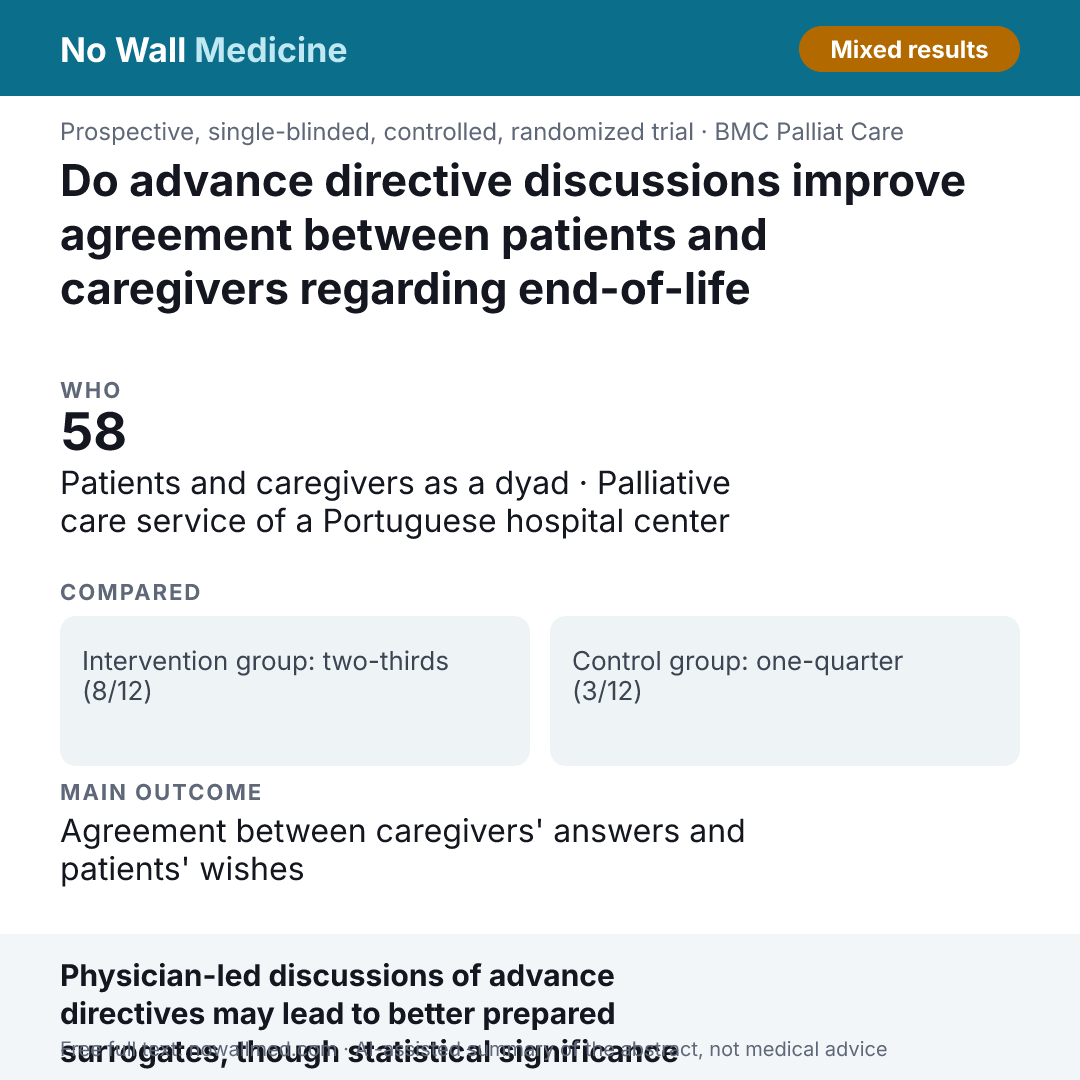
Prospective, single-blinded, controlled, randomized trialMixed results
Do advance directive discussions improve agreement between patients and caregivers regarding end-of-life preferences?
Who
58
Patients and caregivers as a dyad · Palliative care service of a Portuguese hospital center
Compared
Intervention group: two-thirds (8/12)
Control group: one-quarter (3/12)
Main outcome
Agreement between caregivers' answers and patients' wishes
Bottom line: Physician-led discussions of advance directives may lead to better prepared surrogates, though statistical significance was not obtained.
BMC Palliat Care · 2022-07-12 · Save PNG
Key points
- Researchers studied 58 dyads of patients and caregivers in a Portuguese palliative care service to see if physician-led discussions improved agreement on end-of-life preferences.
- In the intervention group, agreement between caregivers and patients occurred in 8/12 of the answers, compared to 3/12 in the control group.
- The difference in agreement between the two groups did not reach statistical significance.
Discussion prompts
- Would these patients look like yours? Who was left out?
- Is the main outcome one that matters to patients?
- Is the difference large enough to change what you do?
Cite: Martins CS, Sousa I, Barros C, et al. Do surrogates predict patient preferences more accurately after a physician-led discussion about advance directives? A randomized controlled trial. BMC Palliat Care. 2022. doi:10.1186/s12904-022-01013-3
Free full text: PubMed Central · Summary and visual abstract: nowallmed.com/a/do-surrogates-predict-patient-preferences-more-accurately-after-a-j855un/ (AI-assisted from the abstract; check the paper before relying on it).