Educational intervention did not substantially reduce doctors accepting incentives from pharmaceutical company representatives
Doctors taking bribes from pharmaceutical companies is common and not substantially reduced by an educational intervention: a pragmatic randomised controlled trial in Pakistan
Pragmatic randomised controlled trialNo clear difference
Does a multifaceted educational intervention reduce doctors accepting pharmaceutical incentives?
Who
419
Doctors running for-profit, primary-care clinics · Karachi, Pakistan
Compared
32.3%Intervention group
41.9%Control group
Main outcome
Proportion of participants agreeing to accept incentives for prescribing
Result: odds ratio 0.70 (95% CI 0.40 to 1.20)
Bottom line: Educational interventions alone did not substantially reduce doctors accepting pharmaceutical incentives in Karachi, Pakistan.
BMJ Glob Health · 2025-01-15Download image
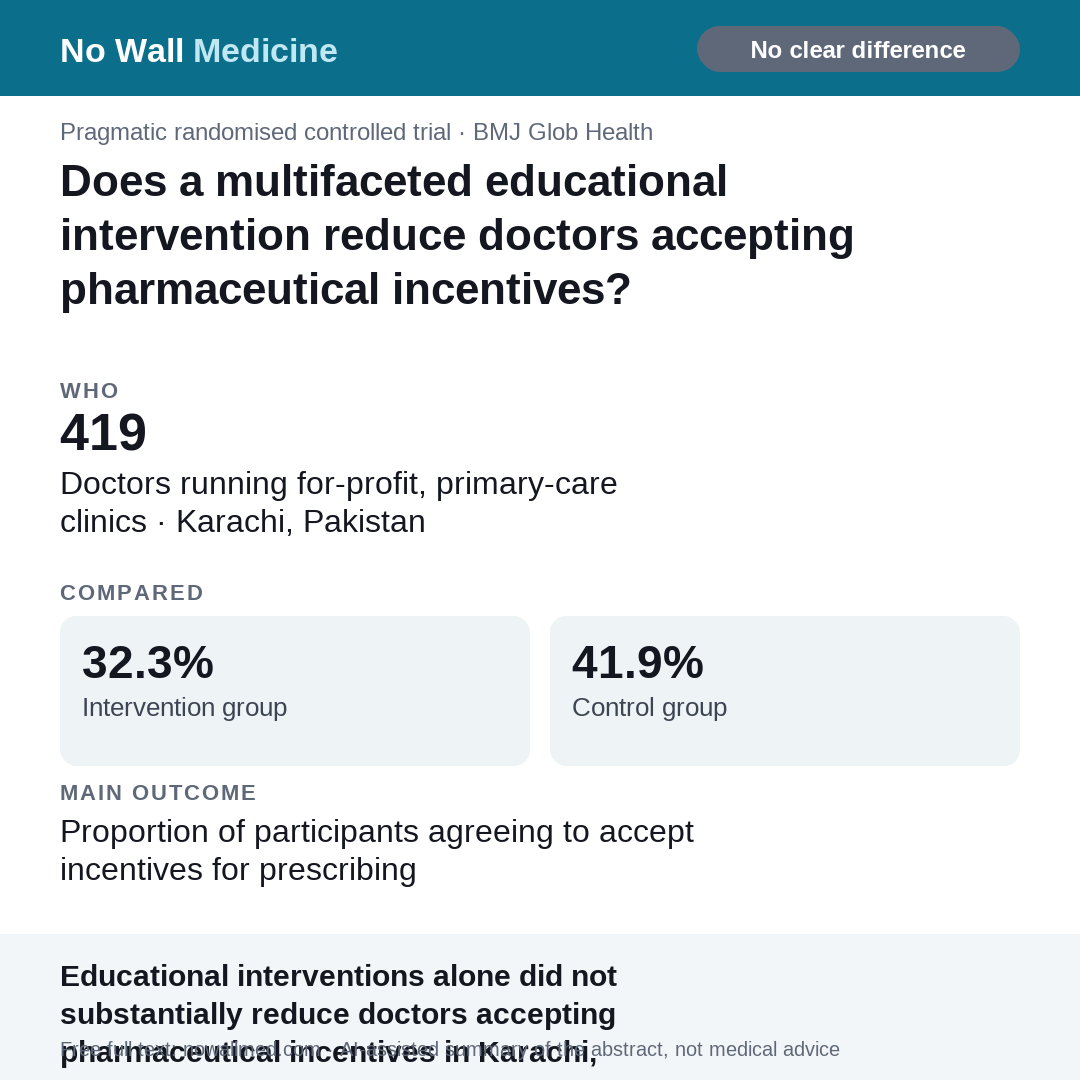
Clinical question: Does a multifaceted educational intervention reduce doctors accepting pharmaceutical incentives?
Why it matters: It was unknown if a multifaceted educational intervention could reduce incentive-linked prescribing, where healthcare providers accept incentives from pharmaceutical companies for prescribing specific medicines.
Key points
- Researchers studied 419 doctors in Karachi, Pakistan, who were randomly assigned to receive either an ethical prescribing seminar or a placebo seminar.
- After 3 months, 41.9% of control group doctors agreed to accept incentives compared to 32.3% of intervention group doctors.
- Adjusting for age, sex, and clinic district showed no evidence that the educational intervention impacted the primary outcome (p=0.192).
Headline and key points written with AI from the paper’s abstract, with every number checked against it. Read the paper before relying on them.
Was this summary helpful?
Abstract
Introduction
Incentive-linked prescribing, which is when healthcare providers accept incentives from pharmaceutical companies for prescribing promoted medicines, is a form of bribery that harms patients and health systems globally. We developed a novel method using data collectors posing as pharmaceutical company sales representatives to evaluate private doctors' engagement in incentive-linked prescribing and the impact of a multifaceted educational intervention on reducing this practice in Karachi, Pakistan. Methods
We made a sampling frame of all doctors running for-profit, primary-care clinics and randomly allocated participants to control and intervention groups (1:1). The intervention group received a multifaceted seminar on ethical prescribing and reinforcement messages over 6 weeks. The control group attended a seminar without mention of ethical prescribing. The primary outcome was the proportion of participants agreeing to accept incentives in exchange for prescribing promoted medicines from data collectors posing as pharmaceutical company representatives, 3 months after the seminars. Results
We enrolled 419 of 440 eligible participants. Of 210 participants randomly allocated to the intervention group, 135 (64%) attended the intervention seminar and of 209 participants allocated to the control group, 132 (63%) attended the placebo seminar. The primary outcome was assessed in 130 (96%) and 124 (94%) of intervention and control participants, respectively. No participants detected the covert data collectors. 52 control group doctors (41.9%) agreed to accept incentives as compared with 42 intervention group doctors (32.3%). After adjusting for doctors' age, sex and clinic district, there was no evidence of the intervention's impact on the primary outcome (OR 0.70 [95% CI 0.40 to 1.20], p=0.192). Conclusions
This first study to covertly assess deal-making between doctors and pharmaceutical company representatives demonstrated that the practice is strikingly widespread in the study setting and suggested that substantial reductions are unlikely to be achieved by educational interventions alone. Our novel method provides an opportunity to generate evidence on deal-making between doctors and pharmaceutical companies elsewhere.
Abstract reproduced under the article’s CC BY licence.
Subject terms
Cite this article
Khan M, Noor MN, Rahman-Shepherd A, Siddiqui AR, Khan SS, van der Mark N. Doctors taking bribes from pharmaceutical companies is common and not substantially reduced by an educational intervention: a pragmatic randomised controlled trial in Pakistan. BMJ Glob Health. 2025. doi:10.1136/bmjgh-2024-016055
Spotted a mistake? Suggest a correction
Top studies every Monday
The week’s key trials and guidelines in your specialties, plus any topics you follow. By email, free.
Get the weekly digest