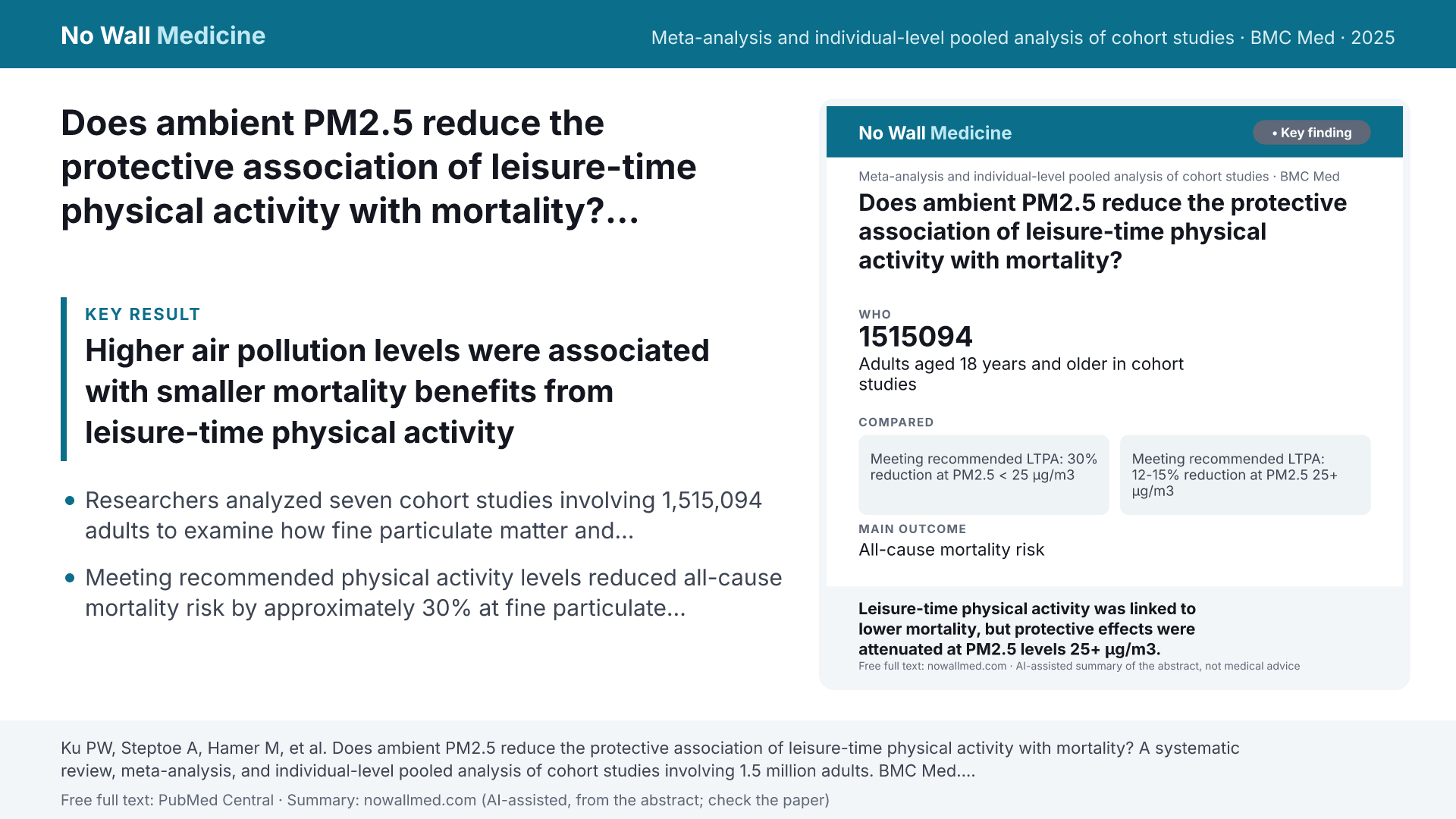
Higher air pollution levels were associated with smaller mortality benefits from leisure-time physical activity
Does ambient PM2.5 reduce the protective association of leisure-time physical activity with mortality? A systematic review, meta-analysis, and individual-level pooled analysis of cohort studies involving 1.5 million adults
Meta-analysis and individual-level pooled analysis of cohort studiesKey finding
Does ambient PM2.5 reduce the protective association of leisure-time physical activity with mortality?
Who
1515094
Adults aged 18 years and older in cohort studies
Compared
Meeting recommended LTPA: 30% reduction at PM2.5 < 25 μg/m3
Meeting recommended LTPA: 12-15% reduction at PM2.5 25+ μg/m3
Main outcome
All-cause mortality risk
Result: HR 0.30 (95% CI 0.25-0.37) at PM2.5 < 10 μg/m3
Bottom line: Leisure-time physical activity was linked to lower mortality, but protective effects were attenuated at PM2.5 levels 25+ μg/m3.
BMC Med · 2025-11-28 · Save PNG
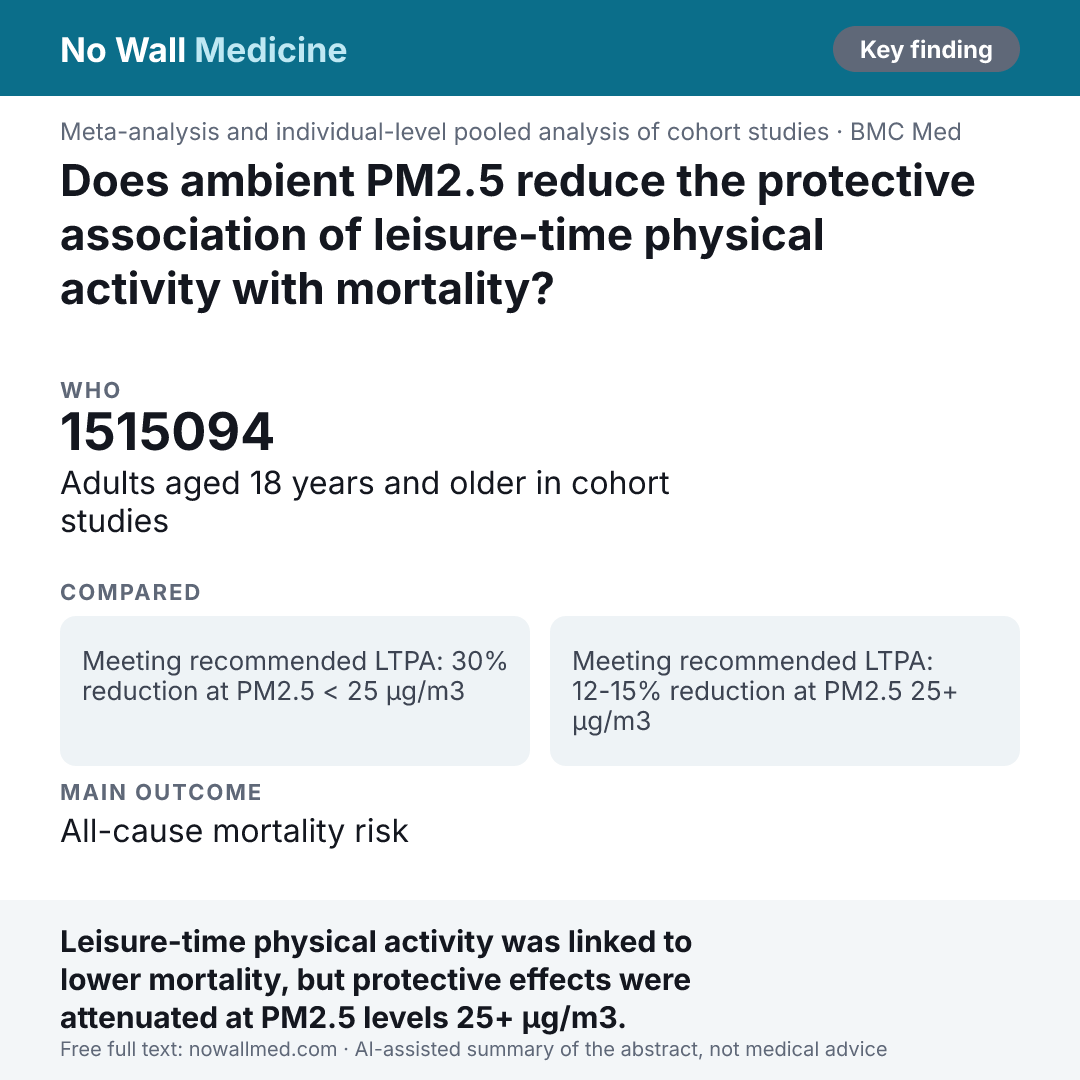
Clinical question: Does ambient PM2.5 reduce the protective association of leisure-time physical activity with mortality?
Key points
- Researchers analyzed seven cohort studies involving 1,515,094 adults to examine how fine particulate matter and physical activity relate to death.
- Meeting recommended physical activity levels reduced all-cause mortality risk by approximately 30% at fine particulate matter levels below 25 μg/m3, but only 12-15% at levels of 25 μg/m3 or higher.
- The protective effects of physical activity were attenuated at fine particulate matter levels of 25 μg/m3 or higher for all studied outcomes.
Headline and key points written with AI from the paper’s abstract, with every number checked against it. Read the paper before relying on them.
Was this summary helpful?
Subject terms
Headline, design, result, key points, caveat and citation as plain text.
Cite this article
Ku PW, Steptoe A, Hamer M, et al. Does ambient PM2.5 reduce the protective association of leisure-time physical activity with mortality? A systematic review, meta-analysis, and individual-level pooled analysis of cohort studies involving 1.5 million adults. BMC Med. 2025;23(1):647. doi:10.1186/s12916-025-04496-y
Spotted a mistake? Suggest a correction