Deidentified wearable device data carries high risk of reidentification according to systematic review
Does deidentification of data from wearable devices give us a false sense of security? A systematic review
Systematic reviewHarm found
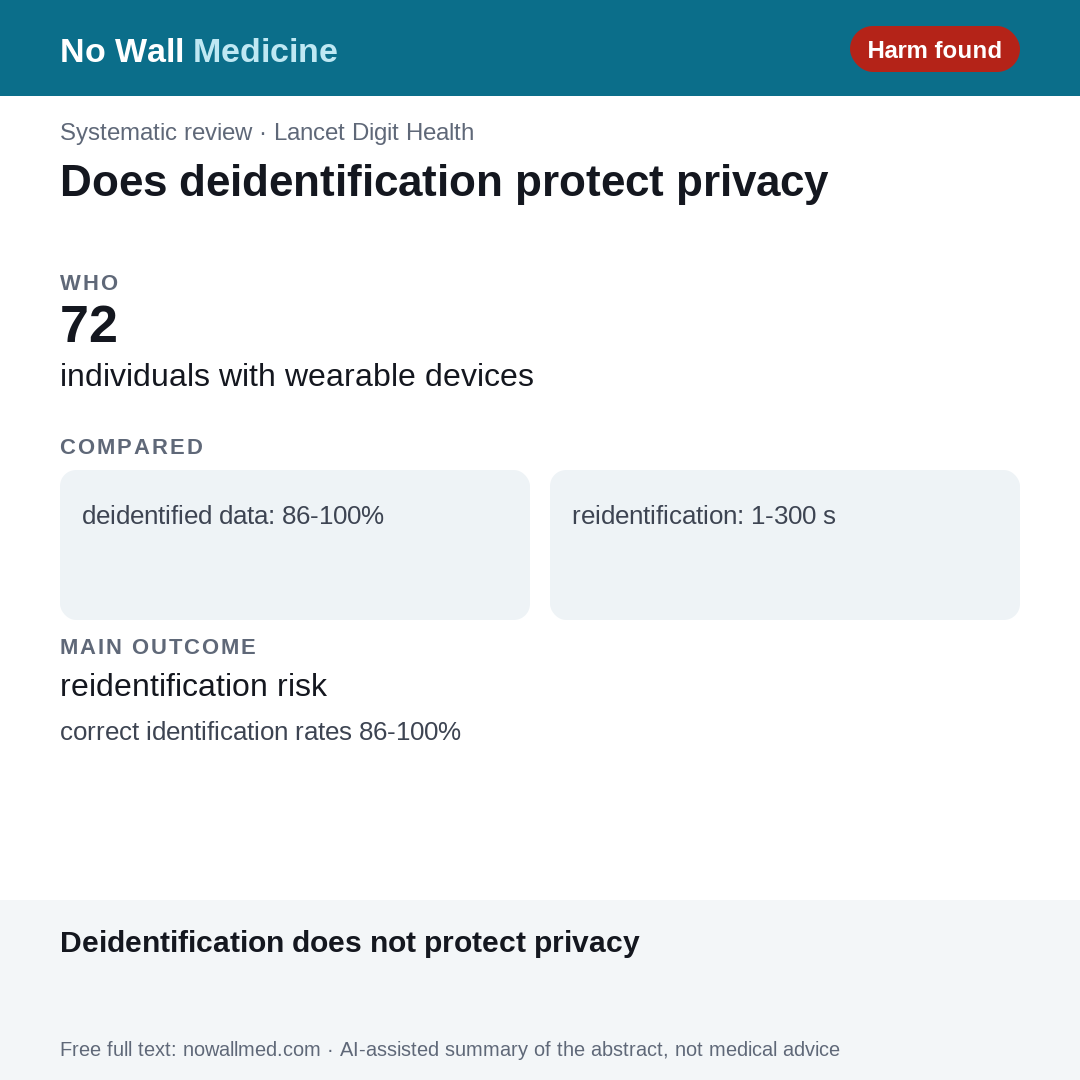
Does deidentification protect privacy
Who
72
individuals with wearable devices
Compared
deidentified data: 86-100%
reidentification: 1-300 s
Main outcome
reidentification risk
Result: correct identification rates 86-100%
Bottom line: Deidentification does not protect privacy
Lancet Digit Health · 2023-02-14Download image
Why it matters: It is unknown whether removing personal identifiers from wearable device datasets is sufficient to protect the privacy of individuals.
Key points
- Researchers reviewed 72 studies that examined the ability to reidentify, identify, or authenticate individuals using data from wearable devices.
- Correct identification rates were typically 86-100%, which indicates a high risk of reidentification from deidentified datasets.
- Reidentification was possible using as little as 1-300 s of recording from sensors like electrocardiograms, which are generally not considered to generate identifiable information.
Headline and key points written with AI from the paper’s abstract, with every number checked against it. Read the paper before relying on them.
Was this summary helpful?
Abstract
Wearable devices have made it easier to generate and share data collected on individuals. This systematic review seeks to investigate whether deidentifying data from wearable devices is sufficient to protect the privacy of individuals in datasets. We searched Web of Science, IEEE Xplore Digital Library, PubMed, Scopus, and the ACM Digital Library on Dec 6, 2021 (PROSPERO registration number CRD42022312922). We also performed manual searches in journals of interest until April 12, 2022. Although our search strategy had no language restrictions, all retrieved studies were in English. We included studies showing reidentification, identification, or authentication with data from wearable devices. Our search retrieved 17 625 studies, and 72 studies met our inclusion criteria. We designed a custom assessment tool for study quality and risk of bias assessments. 64 studies were classified as high quality and eight as moderate quality, and we did not detect any bias in any of the included studies. Correct identification rates were typically 86-100%, indicating a high risk of reidentification. Additionally, as little as 1-300 s of recording were required to enable reidentification from sensors that are generally not thought to generate identifiable information, such as electrocardiograms. These findings call for concerted efforts to rethink methods for data sharing to promote advances in research innovation while preventing the loss of individual privacy.
Abstract reproduced under the article’s CC BY NC ND licence.
Subject terms
Cite this article
Chikwetu L, Miao Y, Woldetensae MK, Bell D, Goldenholz DM, Dunn J. Does deidentification of data from wearable devices give us a false sense of security? A systematic review. Lancet Digit Health. 2023. doi:10.1016/S2589-7500(22)00234-5
Spotted a mistake? Suggest a correction
Top studies every Monday
The week’s key trials and guidelines in your specialties, plus any topics you follow. By email, free.
Get the weekly digest