Triglyceride-glucose index is associated with higher cardiovascular risks in patients with coronary heart disease
Does diabetes status modify the association between the triglyceride-glucose index and major adverse cardiovascular events in patients with coronary heart disease? A systematic review and meta-analysis of longitudinal cohort studies
Systematic review and meta-analysisBenefit found
Does diabetes status modify the association between triglyceride-glucose index and major adverse cardiovascular events?
Who
173851
Patients with coronary heart disease
Compared
Diabetic patients: categorical HR 1.98 (95% CI 1.61-2.43)
Nondiabetic patients: categorical HR 1.65 (95% CI 1.33-2.05)
Main outcome
Major adverse cardiovascular events
Bottom line: Higher triglyceride-glucose index is associated with increased cardiovascular risk in both diabetic and nondiabetic coronary heart disease patients.
Limitation: further high-quality prospective studies are warranted to confirm these associations
Cardiovasc Diabetol · 2025-08-04Download image
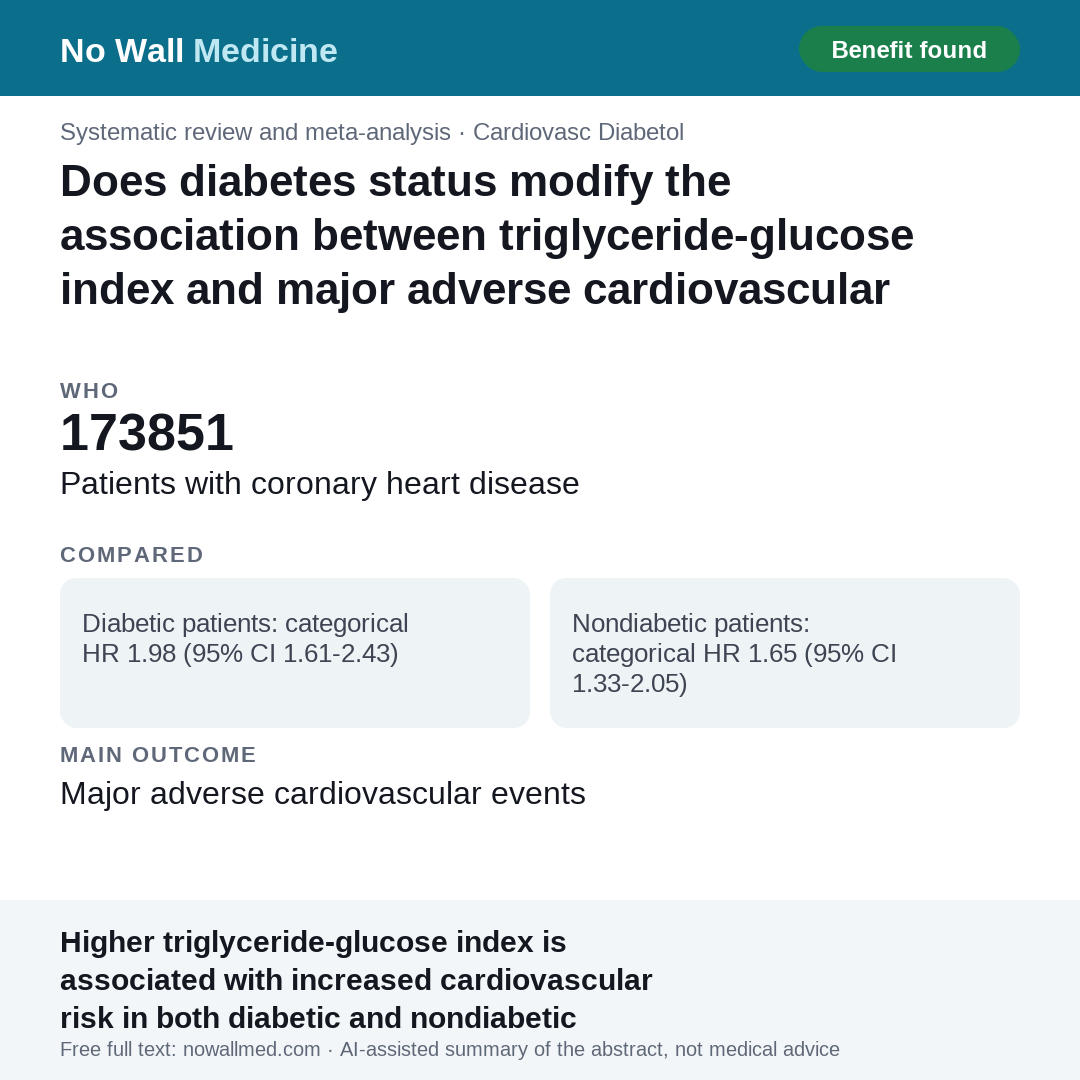
Clinical question: Does diabetes status modify the association between triglyceride-glucose index and major adverse cardiovascular events?
Why it matters: It is unclear if diabetes status changes how the triglyceride-glucose index relates to major adverse cardiovascular events in patients with coronary heart disease.
Key points
- Researchers analyzed 36 longitudinal cohort studies involving 173,851 participants with coronary heart disease, including 119,232 with diabetes and 54,619 without diabetes.
- In diabetic patients, a higher triglyceride-glucose index, a marker for insulin resistance, was associated with increased risks for major adverse cardiovascular events (HR = 1.98, 95% CI 1.61-2.43).
- In nondiabetic patients, a higher index was associated with increased risks for major adverse cardiovascular events (HR = 1.65, 95% CI 1.33-2.05) but not nonfatal stroke.
Headline and key points written with AI from the paper’s abstract, with every number checked against it. Read the paper before relying on them.
Topics
Cite this article
Xu S, Zhang Z, Li J, Ding Y, Chen Y, Zhou Y. Does diabetes status modify the association between the triglyceride-glucose index and major adverse cardiovascular events in patients with coronary heart disease? A systematic review and meta-analysis of longitudinal cohort studies. Cardiovasc Diabetol. 2025. doi:10.1186/s12933-025-02890-7
Spotted a mistake? Suggest a correction
Top studies every Monday
The week’s key trials and guidelines in your specialties, by email. Free.
Get the weekly digest