Lack of improvement after 4 weeks of medication predicts treatment failure in obsessive-compulsive disorder
Does early non-improvement predict treatment failure in pharmacotherapy for obsessive-compulsive disorder? A diagnostic test accuracy meta-analysis with individual participant data
Random-effects bivariate diagnostic accuracy meta-analysisBenefit found
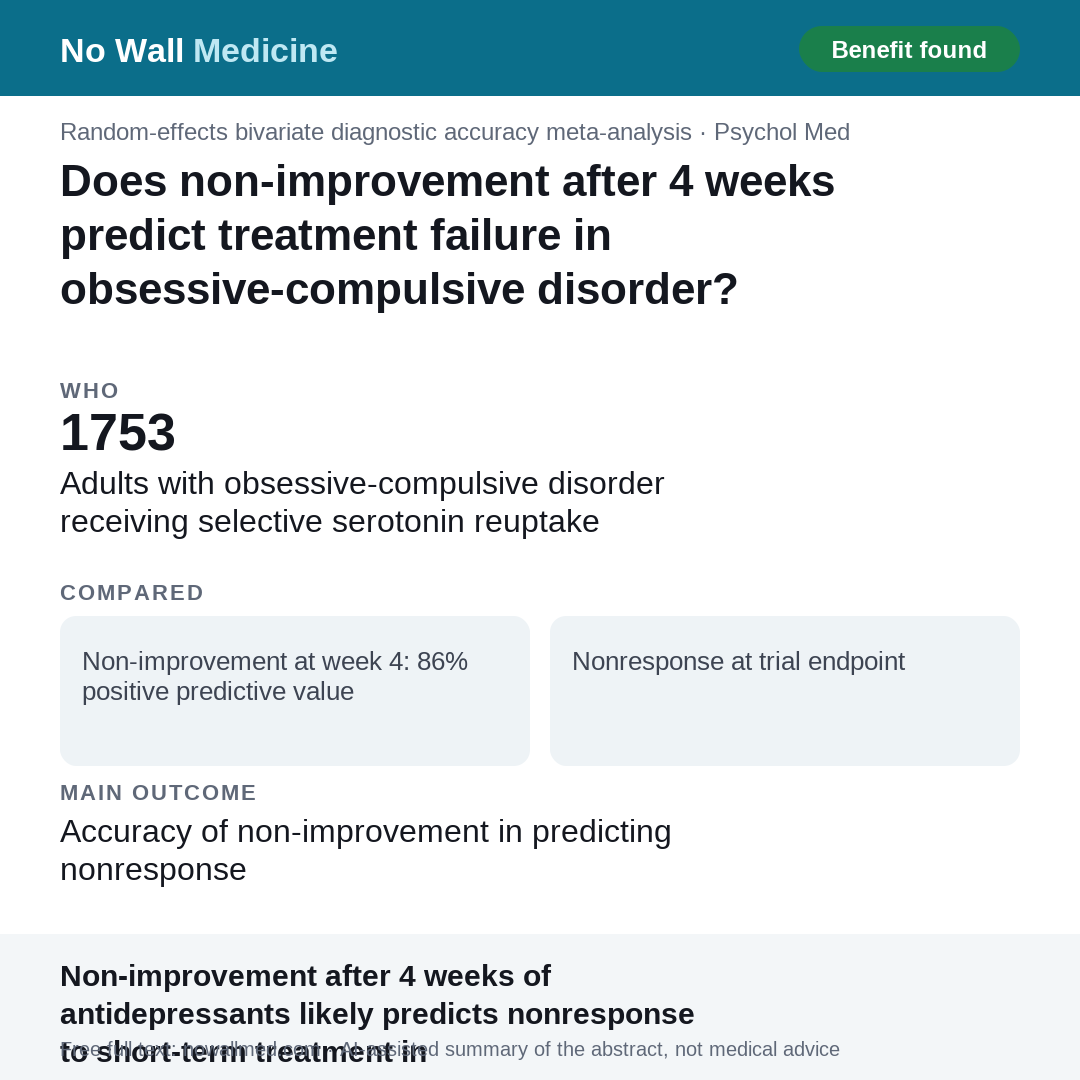
Does non-improvement after 4 weeks predict treatment failure in obsessive-compulsive disorder?
Who
1753
Adults with obsessive-compulsive disorder receiving selective serotonin reuptake inhibitors or clomipramine · Industry-sponsored short-term trials
Compared
Non-improvement at week 4: 86% positive predictive value
Nonresponse at trial endpoint
Main outcome
Accuracy of non-improvement in predicting nonresponse
Result: positive predictive value 86% (95% CI 83-88%)
Bottom line: Non-improvement after 4 weeks of antidepressants likely predicts nonresponse to short-term treatment in obsessive-compulsive disorder.
Funded by: Industry-sponsored
Psychol Med · 2025-08-15Download image
Clinical question: Does non-improvement after 4 weeks predict treatment failure in obsessive-compulsive disorder?
Why it matters: It is uncertain what the earliest reliable indication of treatment failure is for patients using antidepressant medication for obsessive-compulsive disorder.
Key points
- Researchers analyzed individual patient data from 11 studies involving 1,753 adults with obsessive-compulsive disorder receiving antidepressant medications.
- Non-improvement after 4 weeks had a positive predictive value of 86% for nonresponse at the end of the trial.
- The predictive accuracy of non-improvement was significantly higher in men compared to women.
Headline and key points written with AI from the paper’s abstract, with every number checked against it. Read the paper before relying on them.
Topics
Cite this article
Cohen S, Zantvoord JB, de Boer T, Mattila T, van Wingen G, Denys D. Does early non-improvement predict treatment failure in pharmacotherapy for obsessive-compulsive disorder? A diagnostic test accuracy meta-analysis with individual participant data. Psychol Med. 2025. doi:10.1017/S0033291725101335
Spotted a mistake? Suggest a correction