Providing liver stiffness advice and video stories was associated with reduced alcohol consumption
Does knowledge of liver fibrosis affect high-risk drinking behaviour (KLIFAD): an open-label pragmatic feasibility randomised controlled trial
Open-label pragmatic feasibility randomised controlled trialBenefit found
Does knowledge of liver fibrosis affect high-risk drinking behaviour?
Who
184
Adults 18+ years presenting with a primary alcohol problem · Three community alcohol services
Compared
43.9%Usual care
54.9%Usual care and KLIFAD Intervention
Main outcome
Reduced or stop drinking
Bottom line: The KLIFAD intervention is feasible and may improve engagement and reduce alcohol consumption.
Funded by: National Institute for Health and Care Research
eClinicalMedicine · 2023-06-30Download image
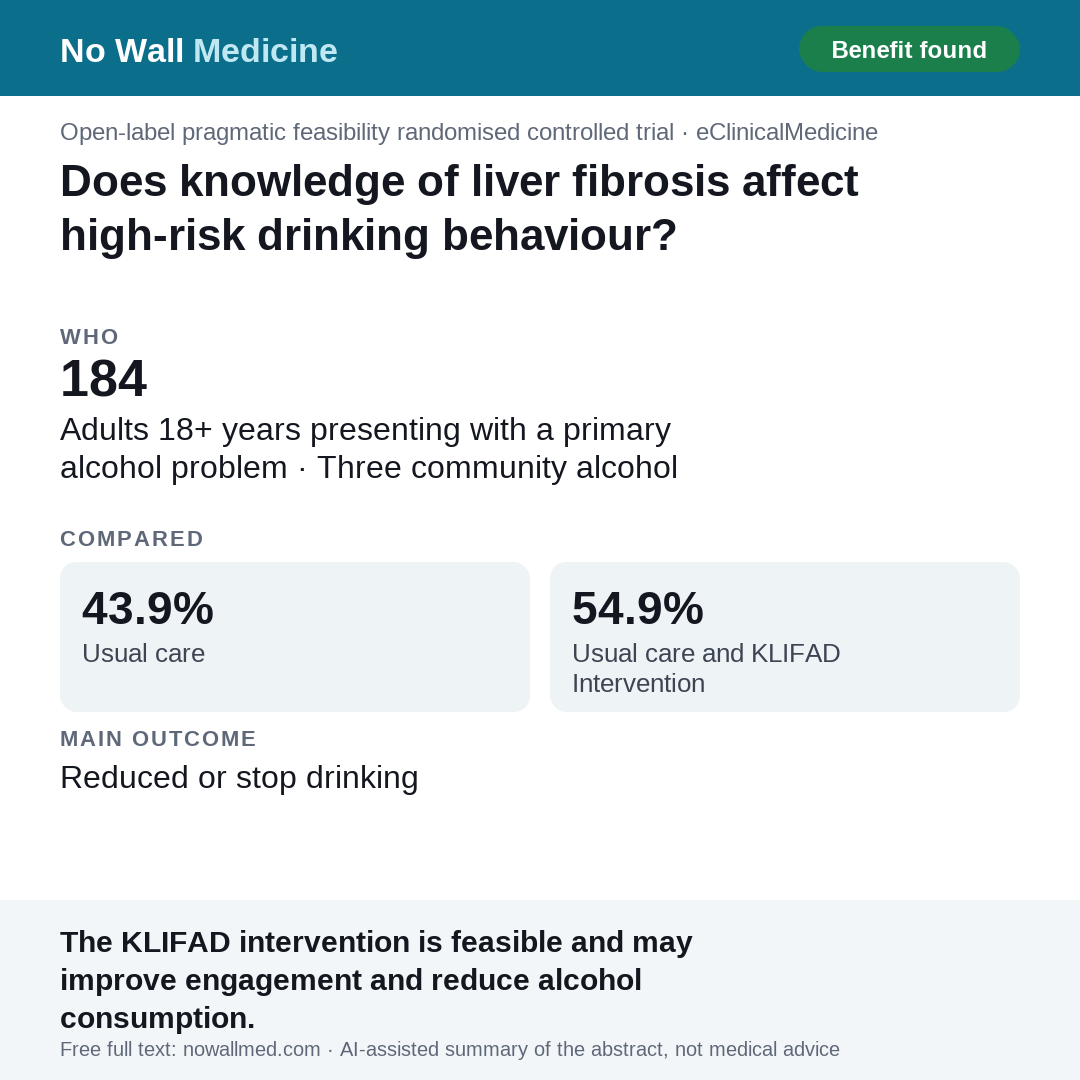
Clinical question: Does knowledge of liver fibrosis affect high-risk drinking behaviour?
Why it matters: It is unknown if providing advice based on transient elastography, a non-invasive way to measure liver stiffness, can change drinking behavior in community alcohol services.
Key points
- Researchers conducted a feasibility trial with 184 adults presenting with primary alcohol problems, comparing usual care to usual care plus liver stiffness advice and video stories.
- At six months, 54.9% of the intervention group reduced or stopped drinking compared to 43.9% in the control group.
- The intervention group was more likely to reduce their Alcohol Use Disorders Identification Test category at 71.7% compared to 61.8% in the control group.
Limitation the authors note: The study was a feasibility trial with a small sample size of 184 randomized participants and a low follow-up rate of 87 participants.
Headline and key points written with AI from the paper’s abstract, with every number checked against it. Read the paper before relying on them.
Was this summary helpful?
Cite this article
Subhani M, Enki DG, Knight H, Jones KA, Sprange K, Rennick-Egglestone S. Does knowledge of liver fibrosis affect high-risk drinking behaviour (KLIFAD): an open-label pragmatic feasibility randomised controlled trial. eClinicalMedicine. 2023. doi:10.1016/j.eclinm.2023.102069
Spotted a mistake? Suggest a correction
Top studies every Monday
The week’s key trials and guidelines in your specialties, plus any topics you follow. By email, free.
Get the weekly digest