Repeated annual influenza vaccination was associated with lower vaccine effectiveness against several virus types
Does repeated influenza vaccination attenuate effectiveness? A systematic review and meta-analysis
Systematic review and meta-analysisMixed results
Does repeated influenza vaccination attenuate vaccine effectiveness?
Who
People vaccinated against influenza A(H1N1)pdm09, A(H3N2), or B
Compared
Vaccination in both seasons: lower protection
Current season only
Main outcome
Vaccine effectiveness attenuation
Result: ΔVE for influenza A(H1N1)pdm09 -9% (95% CI -16 to -1), A(H3N2) -18% (-26 to -11), B -7% (-14 to 0)
Bottom line: Repeated vaccination attenuates effectiveness, but two consecutive years still provide better protection than no vaccination.
Limitation: Low certainty of evidence for the estimated effects.
Funded by: WHO and the US National Institutes of Health
Lancet Respir Med · 2022-09-21Download image
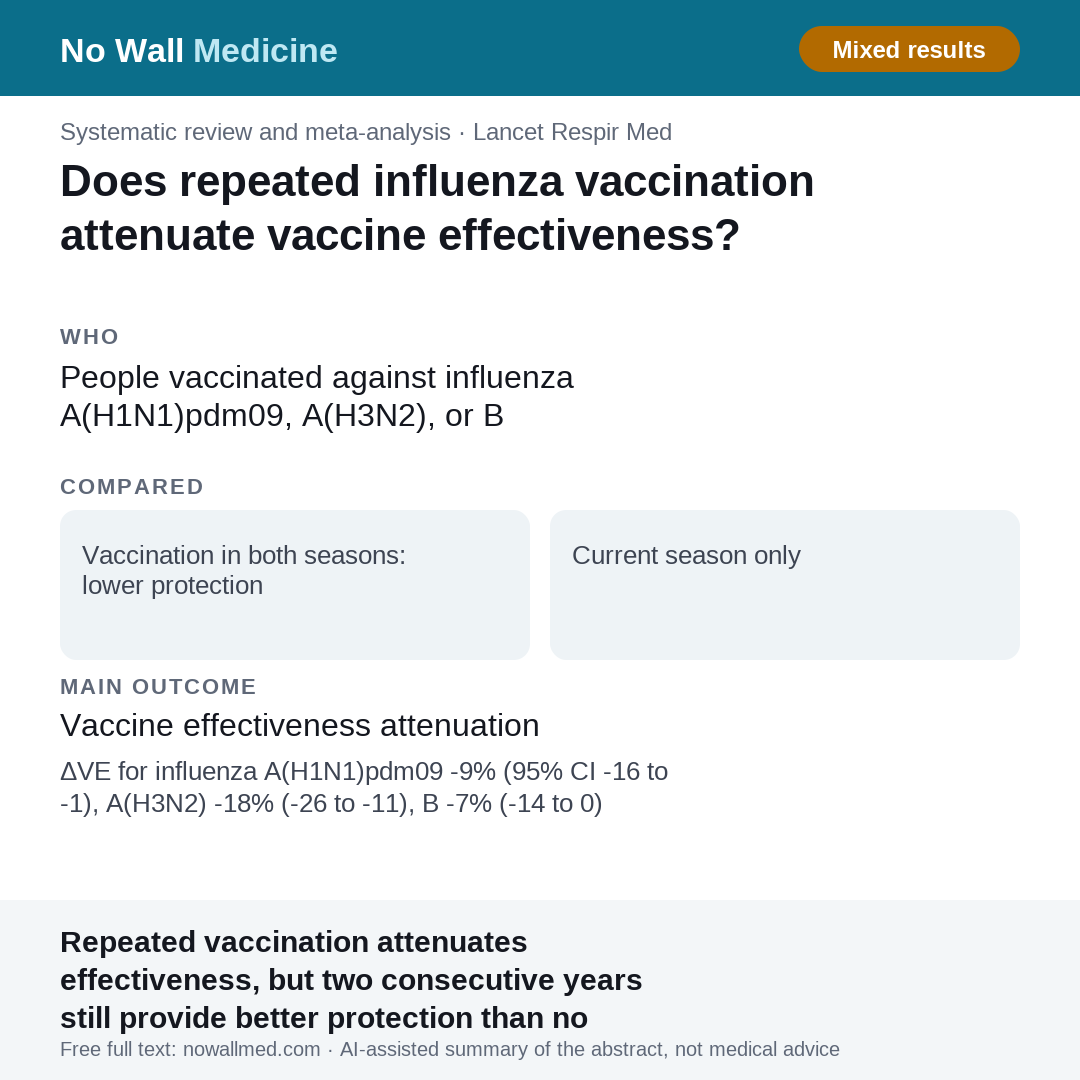
Clinical question: Does repeated influenza vaccination attenuate vaccine effectiveness?
Why it matters: It is unknown if receiving influenza vaccines in consecutive years reduces the effectiveness of the vaccine compared to receiving it only in the current season.
Key points
- Researchers analyzed 83 studies and 41 meta-analyses comparing current season, previous season, both seasons, and no vaccination groups.
- Vaccination in both seasons was associated with a -9% difference in effectiveness for influenza A(H1N1)pdm09, -18% for influenza A(H3N2), and -7% for influenza B.
- Despite the lower effectiveness from repeated doses, vaccination in both seasons was associated with better protection than no vaccination.
Headline and key points written with AI from the paper’s abstract, with every number checked against it. Read the paper before relying on them.
Was this summary helpful?
Abstract
Background
Influenza vaccines require annual readministration; however, several reports have suggested that repeated vaccination might attenuate the vaccine's effectiveness. We aimed to estimate the reduction in vaccine effectiveness associated with repeated influenza vaccination. Methods
In this systematic review and meta-analysis, we searched MEDLINE, EMBASE, and CINAHL Complete databases for articles published from Jan 1, 2016, to June 13, 2022, and Web of Science for studies published from database inception to June 13, 2022. For studies published before Jan 1, 2016, we consulted published systematic reviews. Two reviewers (EJ-G and EJR) independently screened, extracted data using a data collection form, assessed studies' risk of bias using the Risk Of Bias In Non-Randomized Studies of Interventions (ROBINS-I) and evaluated the weight of evidence by Grading of Recommendations Assessment, Development, and Evaluation (GRADE). We included observational studies and randomised controlled trials that reported vaccine effectiveness against influenza A(H1N1)pdm09, influenza A(H3N2), or influenza B using four vaccination groups: current season; previous season; current and previous seasons; and neither season (reference). For each study, we calculated the absolute difference in vaccine effectiveness (ΔVE) for current season only and previous season only versus current and previous season vaccination to estimate attenuation associated with repeated vaccination. Pooled vaccine effectiveness and ∆VE were calculated by season, age group, and overall. This study is registered with PROSPERO, CRD42021260242. Findings
We identified 4979 publications, selected 681 for full review, and included 83 in the systematic review and 41 in meta-analyses. ΔVE for vaccination in both seasons compared with the current season was -9% (95% CI -16 to -1, I2=0%; low certainty) for influenza A(H1N1)pdm09, -18% (-26 to -11, I2=7%; low certainty) for influenza A(H3N2), and -7% (-14 to 0, I2=0%; low certainty) for influenza B, indicating lower protection with consecutive vaccination. However, for all types, A subtypes and B lineages, vaccination in both seasons afforded better protection than not being vaccinated. Interpretation
Our estimates suggest that, although vaccination in the previous year attenuates vaccine effectiveness, vaccination in two consecutive years provides better protection than does no vaccination. The estimated effects of vaccination in the previous year are concerning and warrant additional investigation, but are not consistent or severe enough to support an alternative vaccination regimen at this time. Funding
WHO and the US National Institutes of Health.
Abstract reproduced under the article’s CC BY licence.
Subject terms
Cite this article
Jones-Gray E, Robinson EJ, Kucharski AJ, Fox A, Sullivan SG. Does repeated influenza vaccination attenuate effectiveness? A systematic review and meta-analysis. Lancet Respir Med. 2022. doi:10.1016/S2213-2600(22)00266-1
Spotted a mistake? Suggest a correction
Top studies every Monday
The week’s key trials and guidelines in your specialties, plus any topics you follow. By email, free.
Get the weekly digest