Symptom duration does not significantly change treatment response in axial spondyloarthritis patients
Does symptom duration impact on treatment response in axial spondyloarthritis? A meta-analysis of randomized controlled trials
Meta-analysis of 11 randomized controlled trialsNo clear difference
Does symptom duration impact treatment response in axial spondyloarthritis?
Who
3272
Adult patients with axial spondyloarthritis
Compared
Early axial spondyloarthritis (≤2 years): RR 2.04 (95% CI, 1.48-2.84)
Established disease: RR 2.28 (95% CI, 1.65-3.15)
Main outcome
ASAS40 response
Result: RRR 0.89 (95% CI, 0.63-1.26)
Bottom line: Symptom duration does not significantly impact the efficacy of biologic disease-modifying antirheumatic drugs in axial spondyloarthritis.
Limitation: No studies involving targeted synthetic disease-modifying antirheumatic drugs met the eligibility criteria.
Rheumatology · 2025-07-11Download image
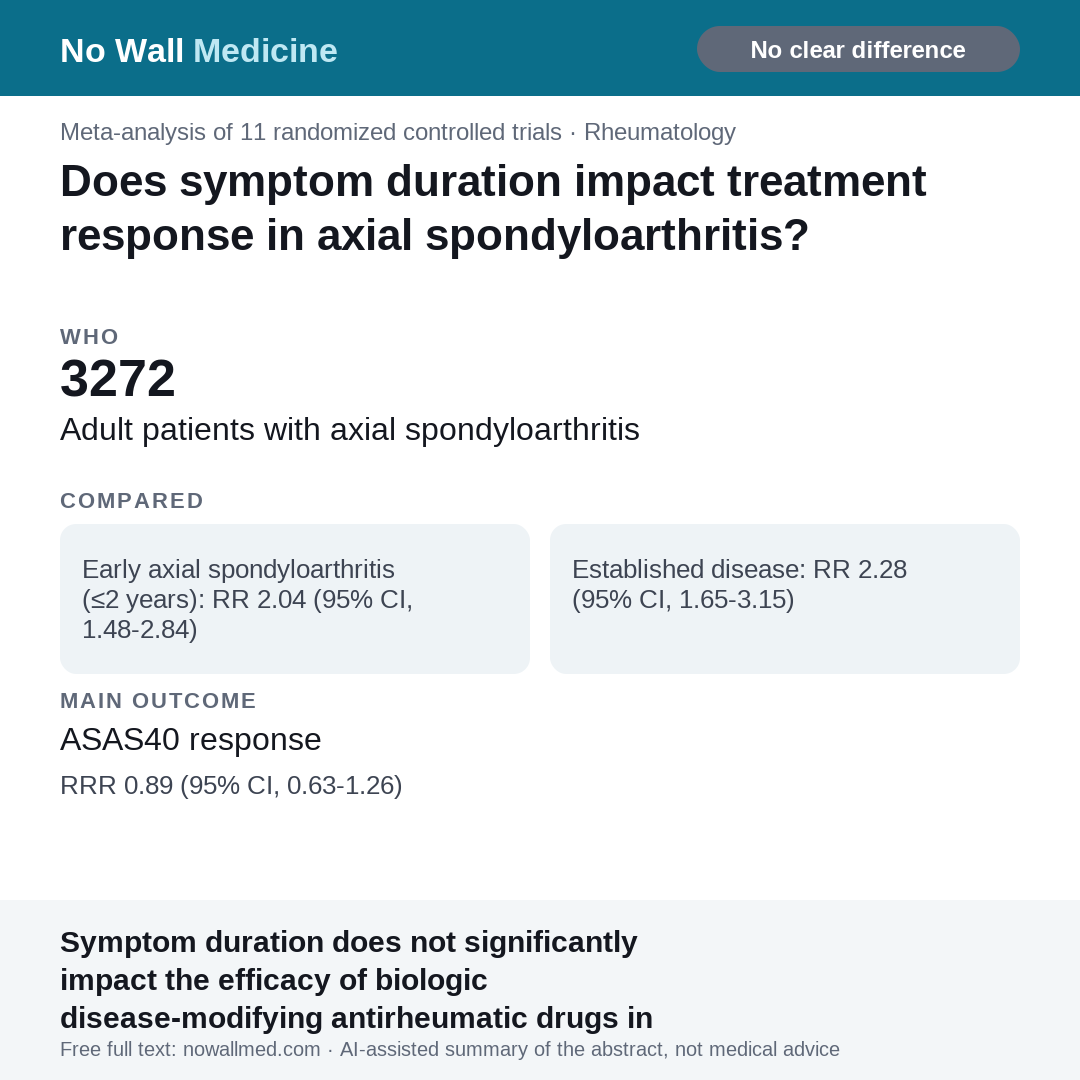
Clinical question: Does symptom duration impact treatment response in axial spondyloarthritis?
Why it matters: The ASAS consensus defines early axial spondyloarthritis as having symptoms for 2 years or less based on expert opinion rather than clinical evidence.
Key points
- Researchers analyzed 11 randomized controlled trials involving 3272 adult patients with axial spondyloarthritis to compare treatment responses between those with shorter and longer symptom durations.
- At a 2-year threshold, the relative risk for ASAS40 response—a measure of 40% improvement in symptoms—was 2.04 in early disease and 2.28 in established disease, with no statistical significance.
- No significant differences in efficacy were found across other symptom duration thresholds between 3 and 5 years for various disease activity and quality of life outcomes.
Headline and key points written with AI from the paper’s abstract, with every number checked against it. Read the paper before relying on them.
Topics
Cite this article
Benavent D, Navarro-Compán V, Capelusnik D, Ramiro S. Does symptom duration impact on treatment response in axial spondyloarthritis? A meta-analysis of randomized controlled trials. Rheumatology. 2025. doi:10.1093/rheumatology/keaf382
Spotted a mistake? Suggest a correction
Top studies every Monday
The week’s key trials and guidelines in your specialties, plus any topics you follow. By email, free.
Get the weekly digest