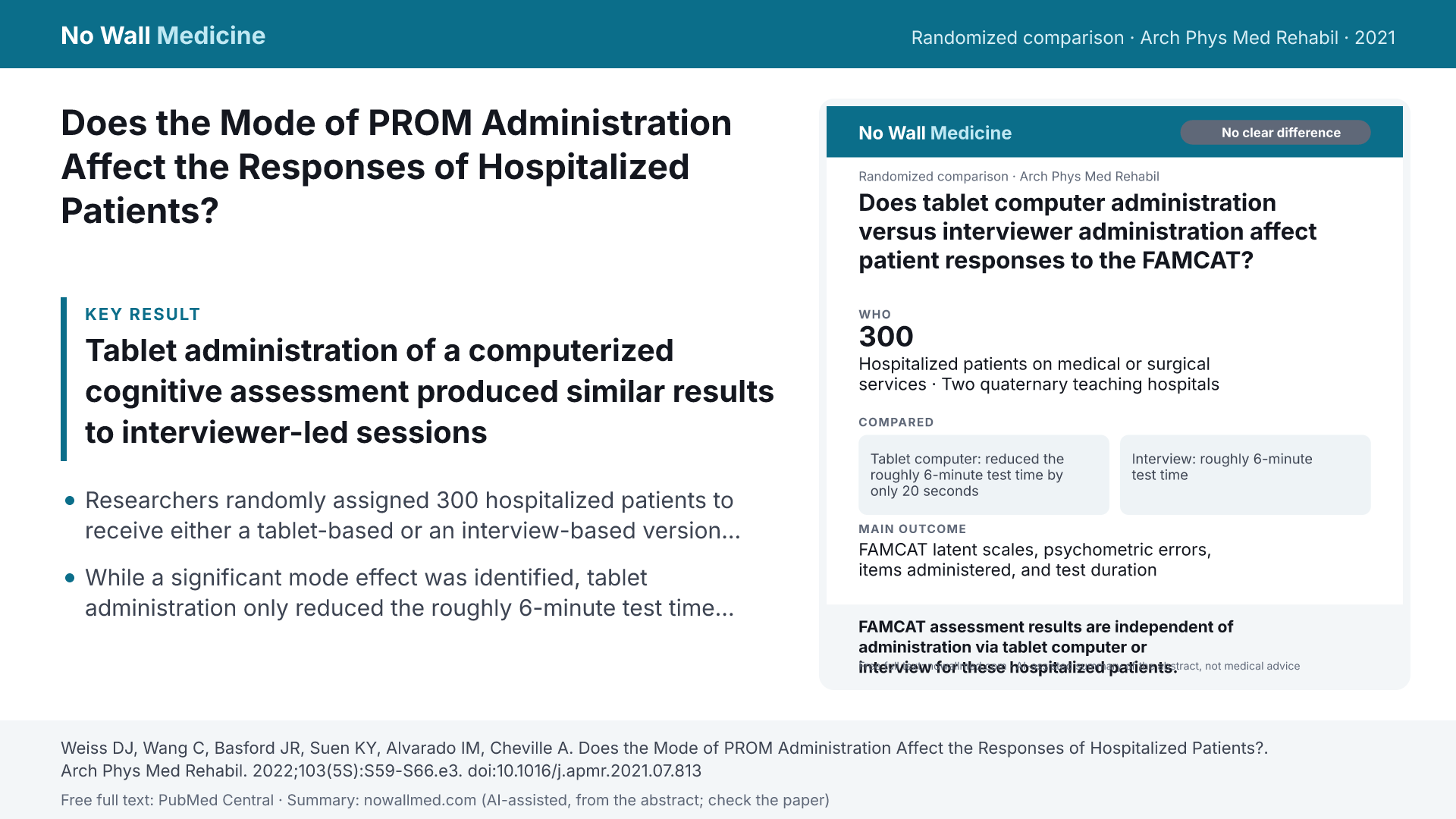
Tablet administration of a computerized cognitive assessment produced similar results to interviewer-led sessions
Does the Mode of PROM Administration Affect the Responses of Hospitalized Patients?
Randomized comparisonNo clear difference
Does tablet computer administration versus interviewer administration affect patient responses to the FAMCAT?
Who
300
Hospitalized patients on medical or surgical services · Two quaternary teaching hospitals in the Upper Midwest
Compared
Tablet computer: reduced the roughly 6-minute test time by only 20 seconds
Interview: roughly 6-minute test time
Main outcome
FAMCAT latent scales, psychometric errors, items administered, and test duration
Bottom line: FAMCAT assessment results are independent of administration via tablet computer or interview for these hospitalized patients.
Limitation: Assessments of 4 individuals in each group were interrupted by clinical care and excluded
Arch Phys Med Rehabil · 2021-10-01 · Save PNG
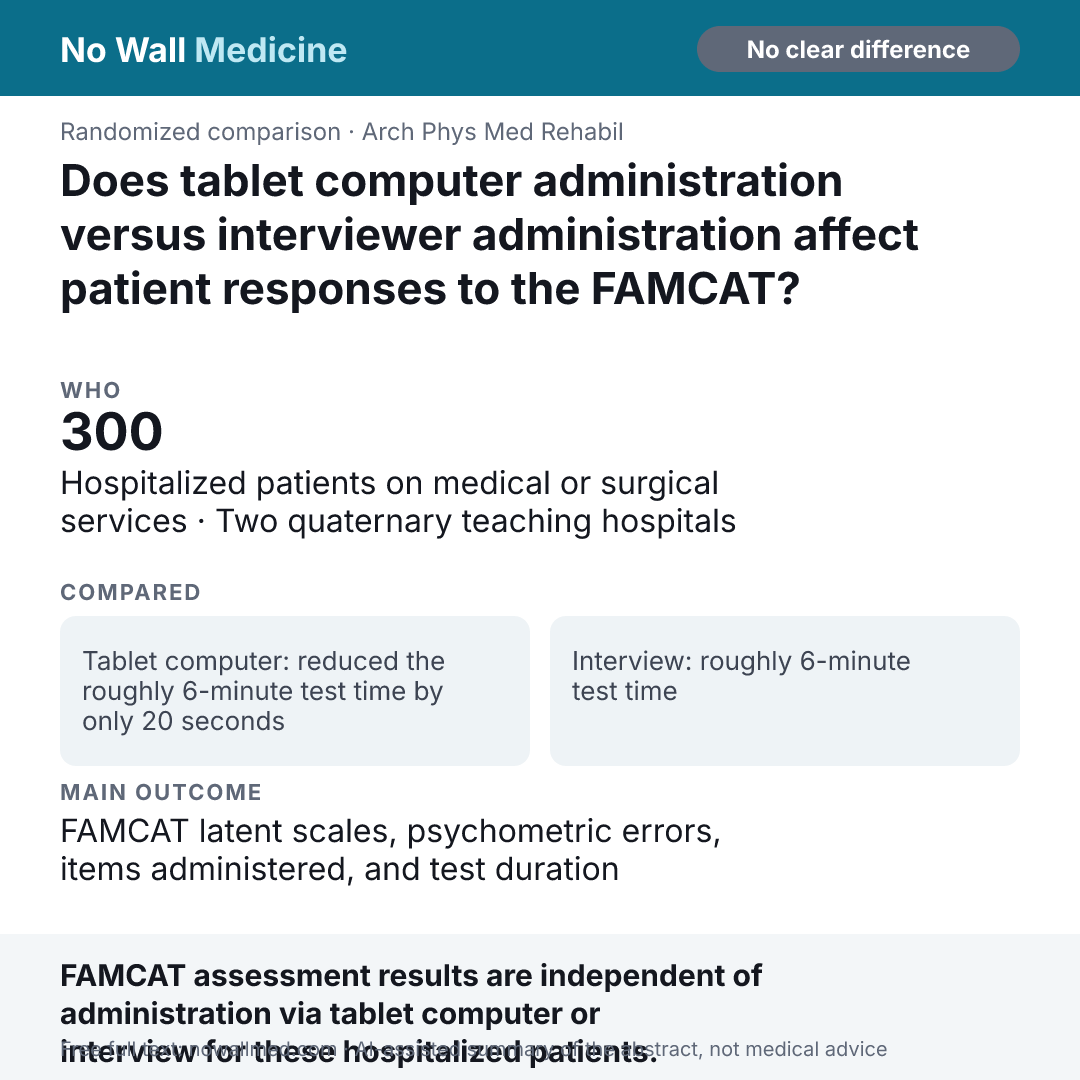
Clinical question: Does tablet computer administration versus interviewer administration affect patient responses to the FAMCAT?
Key points
- Researchers randomly assigned 300 hospitalized patients to receive either a tablet-based or an interview-based version of the Functional Assessment in Acute Care Multidimensional Computerized Adaptive Test.
- While a significant mode effect was identified, tablet administration only reduced the roughly 6-minute test time by 20 seconds.
- The assessment results for applied cognition, daily activity, and basic mobility were independent of whether a tablet or an interviewer was used.
Headline and key points written with AI from the paper’s abstract, with every number checked against it. Read the paper before relying on them.
Was this summary helpful?
Subject terms
Headline, design, result, key points, caveat and citation as plain text.
Cite this article
Weiss DJ, Wang C, Basford JR, Suen KY, Alvarado IM, Cheville A. Does the Mode of PROM Administration Affect the Responses of Hospitalized Patients?. Arch Phys Med Rehabil. 2022;103(5S):S59-S66.e3. doi:10.1016/j.apmr.2021.07.813
Spotted a mistake? Suggest a correction