Specific symptoms and eye movement signs help identify concussion in children and adolescents
Does This Child Have a Concussion?: The Rational Clinical Examination Systematic Review
Systematic review and meta-analysis of 23 studiesMixed results
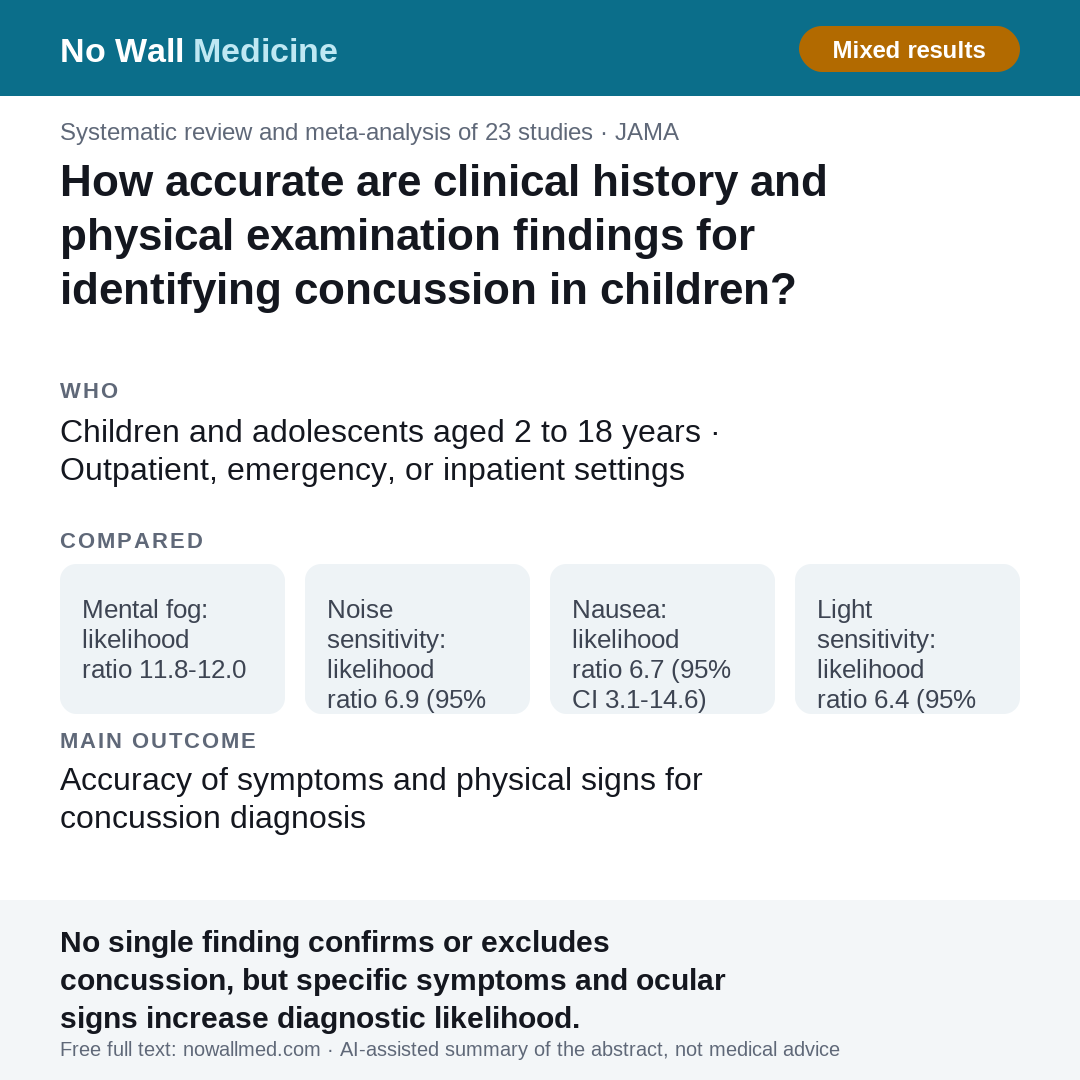
How accurate are clinical history and physical examination findings for identifying concussion in children?
Who
Children and adolescents aged 2 to 18 years · Outpatient, emergency, or inpatient settings
Compared
Mental fog: likelihood ratio 11.8-12.0
Noise sensitivity: likelihood ratio 6.9 (95% CI 3.6-13.1)
Nausea: likelihood ratio 6.7 (95% CI 3.1-14.6)
Light sensitivity: likelihood ratio 6.4 (95% CI 2.1-19.7)
Main outcome
Accuracy of symptoms and physical signs for concussion diagnosis
Bottom line: No single finding confirms or excludes concussion, but specific symptoms and ocular signs increase diagnostic likelihood.
Limitation: Included studies were observational with level 4 evidence and case-control design.
JAMA · 2026-04-06Download image
Clinical question: How accurate are clinical history and physical examination findings for identifying concussion in children?
Why it matters: Clinicians need to know which clinical history and physical examination findings accurately identify concussion in pediatric patients following a plausible injury.
Key points
- Researchers reviewed 23 observational studies involving children and adolescents aged 2 to 18 years to evaluate the accuracy of clinical exams for concussion.
- Mental fog, noise sensitivity, nausea, and light sensitivity were the most useful symptoms for increasing the likelihood of a concussion diagnosis.
- Abnormal eye movements like near-point convergence and smooth pursuits increased the likelihood of concussion, but none had a sensitivity higher than 0.40.
Limitation the authors note: The included studies were case-control designs with level 4 evidence.
Headline and key points written with AI from the paper’s abstract, with every number checked against it. Read the paper before relying on them.
Cite this article
Shah SN, Chizuk HM, Fong HF, Hannon M, Mannix RC. Does This Child Have a Concussion?: The Rational Clinical Examination Systematic Review. JAMA. 2026. doi:10.1001/jama.2026.1233
Spotted a mistake? Suggest a correction