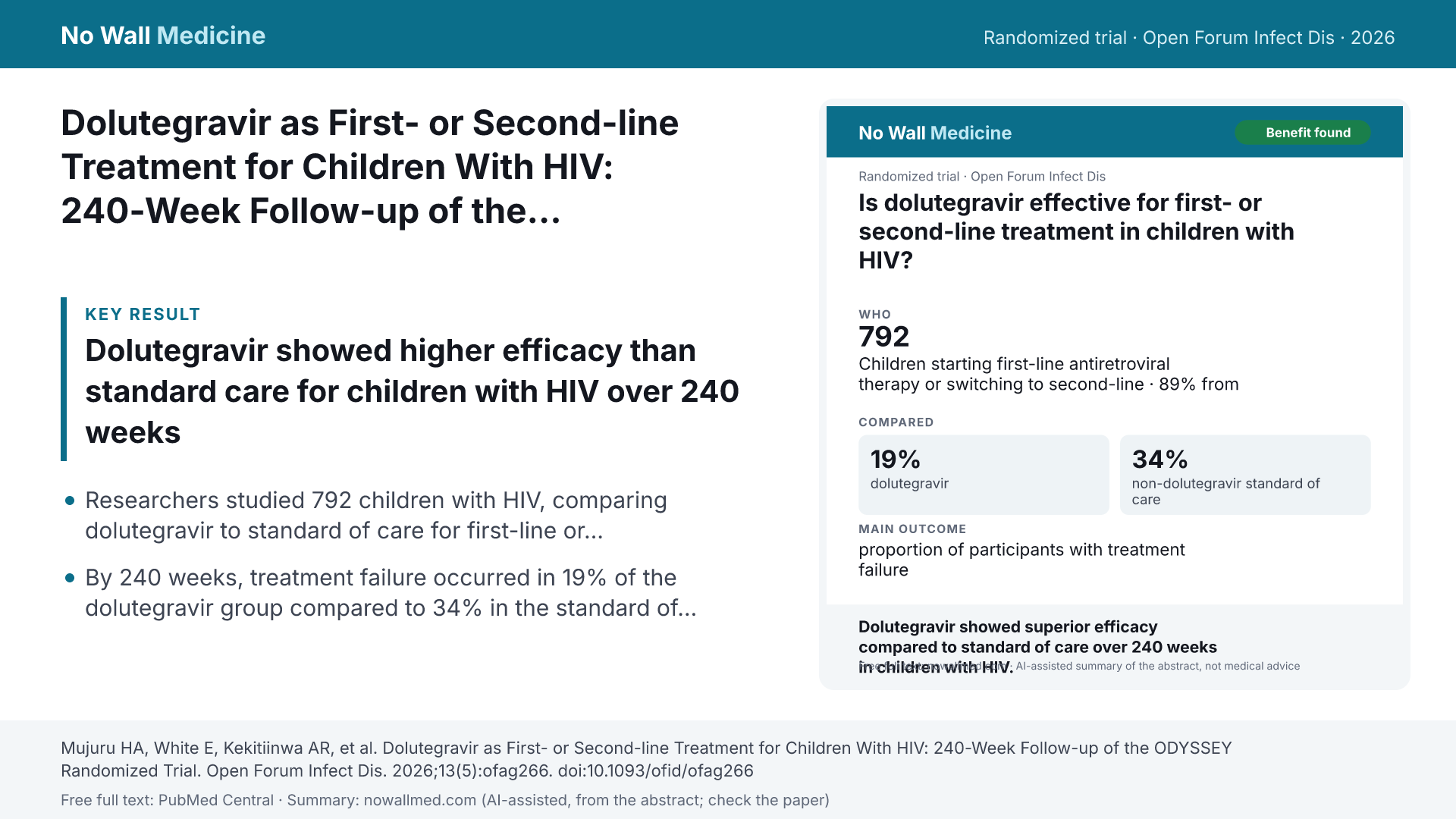
Dolutegravir showed higher efficacy than standard care for children with HIV over 240 weeks
Dolutegravir as First- or Second-line Treatment for Children With HIV: 240-Week Follow-up of the ODYSSEY Randomized Trial
Randomized trialBenefit found
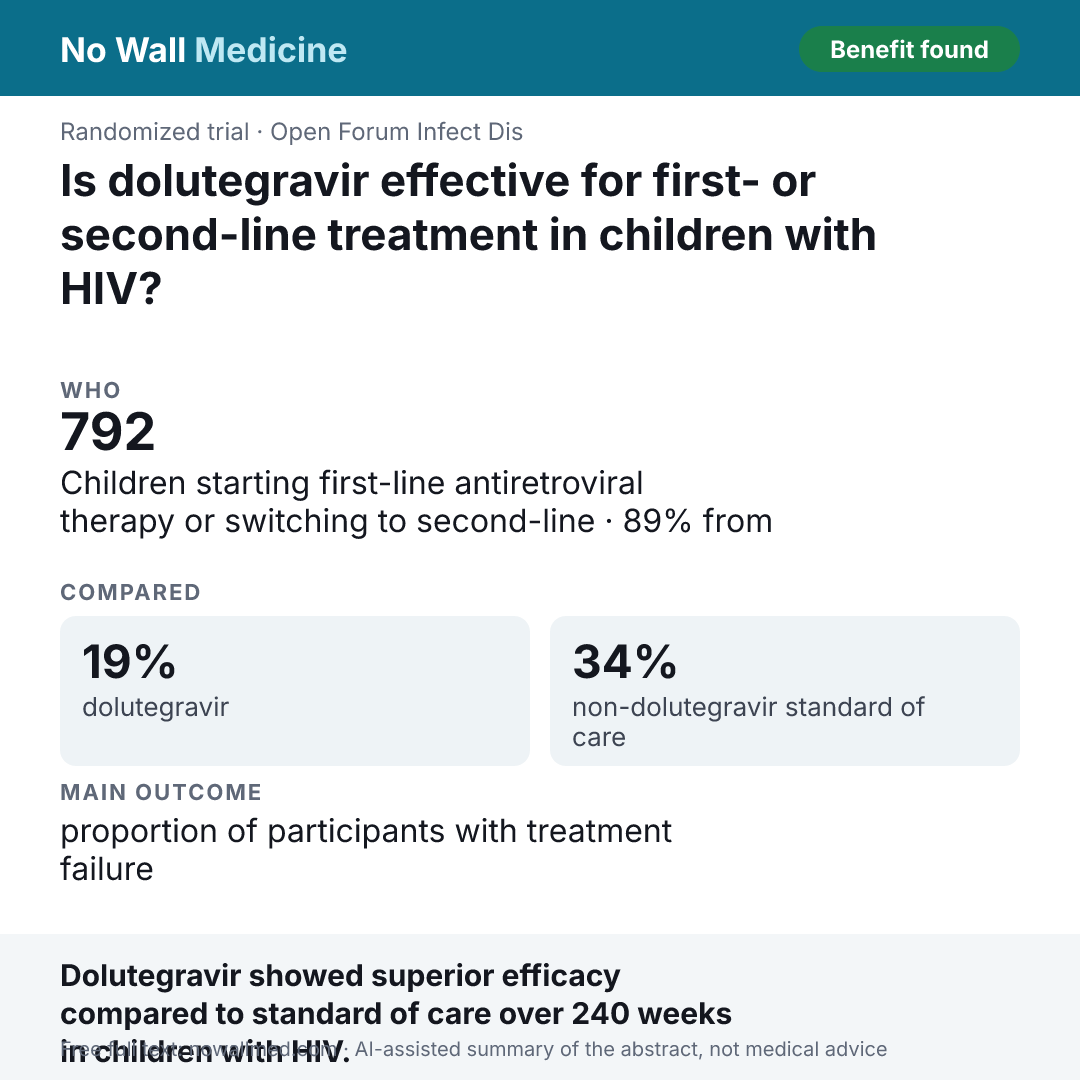
Is dolutegravir effective for first- or second-line treatment in children with HIV?
Who
792
Children starting first-line antiretroviral therapy or switching to second-line · 89% from Africa
Compared
19%dolutegravir
34%non-dolutegravir standard of care
Main outcome
proportion of participants with treatment failure
Result: difference -15% (95% CI, -21% to -9%)
Bottom line: Dolutegravir showed superior efficacy compared to standard of care over 240 weeks in children with HIV.
Open Forum Infect Dis · 2026-05-05 · Save PNG
Clinical question: Is dolutegravir effective for first- or second-line treatment in children with HIV?
Why it matters: The World Health Organization recommends dolutegravir as an anchor drug, but long-term data on its efficacy in children were needed.
In absolute numbers
dolutegravir: 19% · non-dolutegravir standard of care: 34% → a difference of 15 percentage points, so about 7 people would need the treatment for 1 more to benefit (number needed to treat) over the trial’s follow-up.
Worked out by us from the two group results above, not reported by the authors. Check the paper for the exact outcome and timing.
Key points
- Researchers studied 792 children with HIV, comparing dolutegravir to standard of care for first-line or second-line treatment.
- By 240 weeks, treatment failure occurred in 19% of the dolutegravir group compared to 34% in the standard of care group.
- The proportions of serious adverse events or grade 3 or higher adverse events were similar between the two treatment groups.
Headline and key points written with AI from the paper’s abstract, with every number checked against it. Read the paper before relying on them.
Was this summary helpful?
Headline, design, result, key points, caveat and citation as plain text.
Cite this article
Mujuru HA, White E, Kekitiinwa AR, et al. Dolutegravir as First- or Second-line Treatment for Children With HIV: 240-Week Follow-up of the ODYSSEY Randomized Trial. Open Forum Infect Dis. 2026;13(5):ofag266. doi:10.1093/ofid/ofag266
Spotted a mistake? Suggest a correction