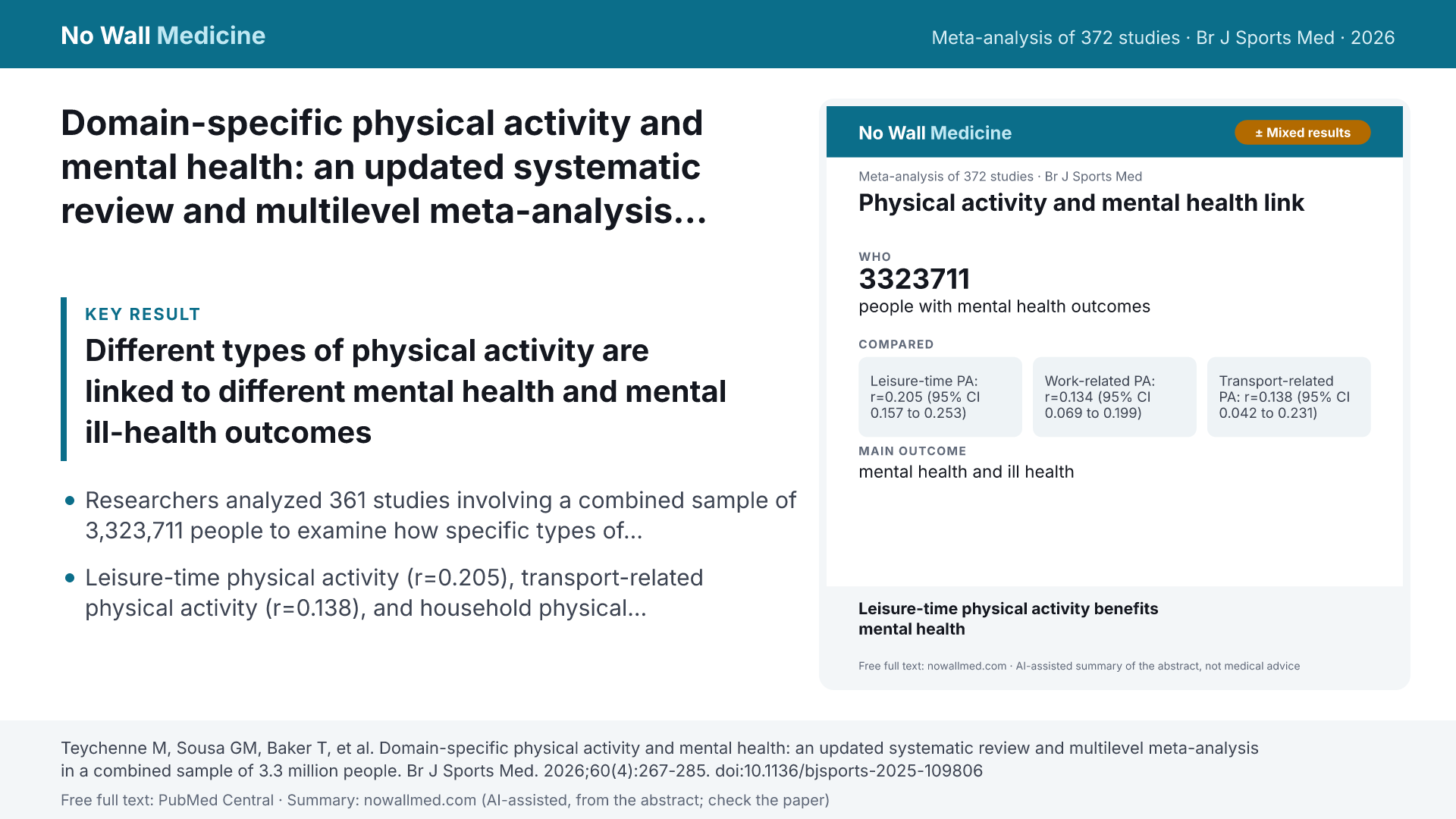
Domain-specific physical activity and mental health: an updated systematic review and multilevel meta-analysis in a combined sample of 3.3 million people
Key result: Different types of physical activity are linked to different mental health and mental ill-health outcomes
Key points
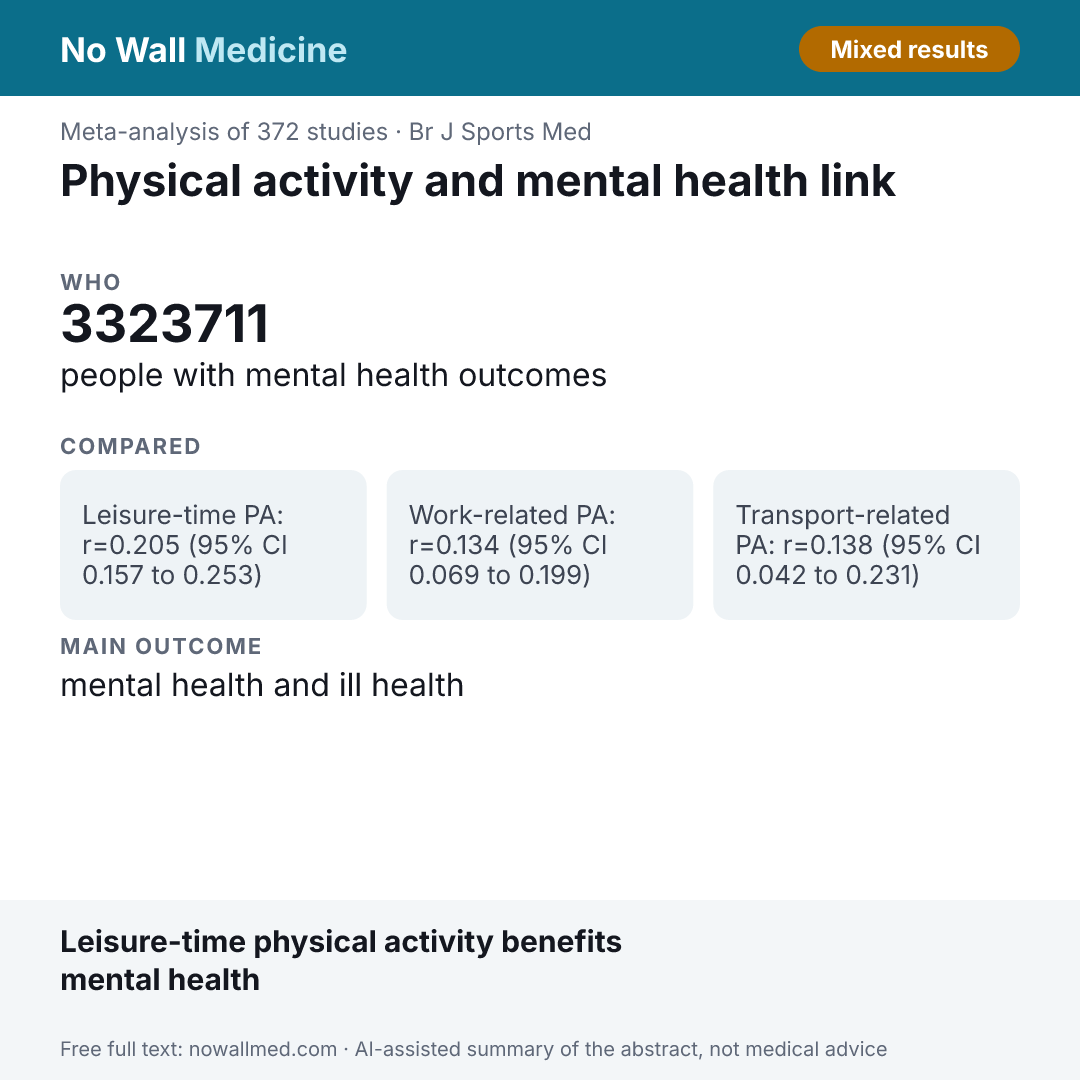
- Researchers analyzed 361 studies involving a combined sample of 3,323,711 people to examine how specific types of physical activity relate to mental health.
- Leisure-time physical activity (r=0.205), transport-related physical activity (r=0.138), and household physical activity (r=0.096) were positively associated with mental health.
- Leisure-time physical activity (r=-0.149) and school sport (r=-0.096) were inversely associated with mental ill-health, while work-related physical activity (r=0.134) was positively associated with mental ill-health.
Why it matters: The relationship between mental health and physical activity may change depending on the specific setting or domain in which the activity occurs.
Discussion prompts
- Would these patients look like yours? Who was left out?
- Is the main outcome one that matters to patients?
- Is the difference large enough to change what you do?
Cite: Teychenne M, Sousa GM, Baker T, et al. Domain-specific physical activity and mental health: an updated systematic review and multilevel meta-analysis in a combined sample of 3.3 million people. Br J Sports Med. 2026;60(4):267-285. doi:10.1136/bjsports-2025-109806
Free full text: PubMed Central · Summary and visual abstract: nowallmed.com/a/domain-specific-physical-activity-and-mental-health-an-updated-1j1x380/ (AI-assisted from the abstract; check the paper before relying on it).