Electrical nerve stimulation shows potential for patients with sleep apnoea who cannot use CPAP machines
Domiciliary transcutaneous electrical stimulation in patients with obstructive sleep apnoea and limited adherence to continuous positive airway pressure therapy: a single-centre, open-label, randomised, controlled phase III trial
Single-centre, open-label, randomised, controlled phase III trialMixed results
Does domiciliary transcutaneous electrical stimulation control sleep apnoea in patients with limited continuous positive airway pressure adherence?
Who
56
Patients with obstructive sleep apnoea and limited continuous positive airway pressure adherence · Guy's & St Thomas' NHS Foundation Trust, UK
Compared
TESLA
Usual care
Main outcome
Change in apnoea-hypopnoea index at 3 months
Result: unadjusted difference -11.5 (95% CI -20.7; -2.3) h-1; adjusted difference -7.0 (-15.7; 1.8) h-1
Bottom line: TESLA may safely improve sleep outcomes, though adjusted results for apnoea-hypopnoea index change were not statistically significant.
Limitation: Pandemic-related limitations of the amended protocol
Funded by: British Lung Foundation and King's Clinical Trials Unit
eClinicalMedicine · 2023-08-03Download image
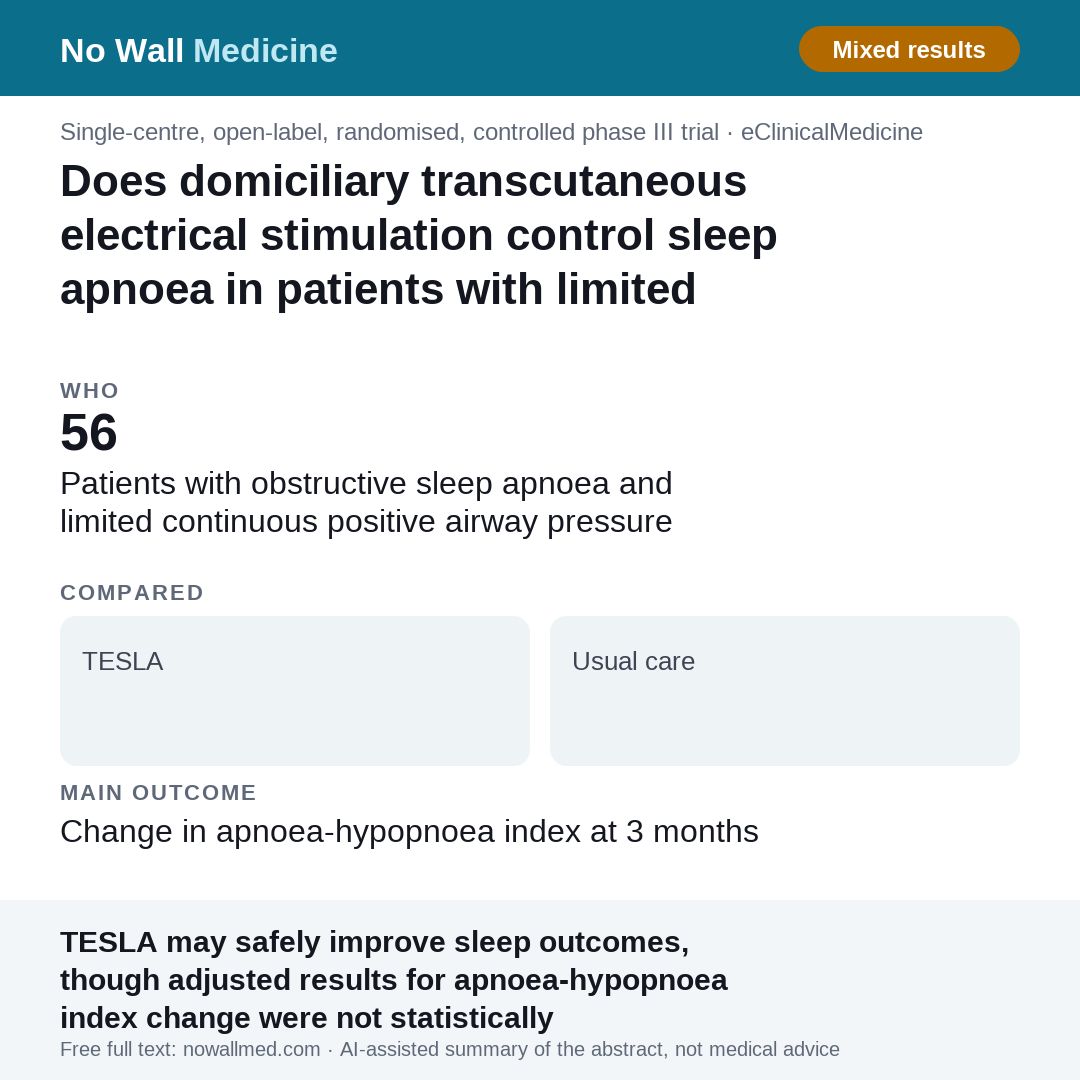
Clinical question: Does domiciliary transcutaneous electrical stimulation control sleep apnoea in patients with limited continuous positive airway pressure adherence?
Why it matters: It is unknown if transcutaneous electrical stimulation can effectively manage sleep apnoea for patients who do not use continuous positive airway pressure therapy as prescribed.
Key points
- Researchers studied 56 patients with obstructive sleep apnoea and low adherence to continuous positive airway pressure therapy, comparing electrical stimulation to usual care.
- After a median of 3.0 months, the unadjusted difference in the apnoea-hypopnoea index—a measure of breathing pauses during sleep—was -11.5 (95% CI -20.7; -2.3) h-1.
- When adjusted for baseline values, the difference in the apnoea-hypopnoea index was -7.0 (-15.7; 1.8) h-1, which was not statistically significant (p = 0.12).
Limitation the authors note: The authors noted pandemic-related limitations of the amended protocol.
Headline and key points written with AI from the paper’s abstract, with every number checked against it. Read the paper before relying on them.
Was this summary helpful?
Cite this article
Ratneswaran D, Cheng M, Nasser E, Madula R, Pengo M, Hope K. Domiciliary transcutaneous electrical stimulation in patients with obstructive sleep apnoea and limited adherence to continuous positive airway pressure therapy: a single-centre, open-label, randomised, controlled phase III trial. eClinicalMedicine. 2023. doi:10.1016/j.eclinm.2023.102112
Spotted a mistake? Suggest a correction
Top studies every Monday
The week’s key trials and guidelines in your specialties, plus any topics you follow. By email, free.
Get the weekly digest