Donanemab slowed Alzheimer's disease progression more effectively in patients with lower levels of tau protein
Donanemab treatment effect by baseline tau burden and disease severity: Observations from the TRAILBLAZER-ALZ 2 trial
TRAILBLAZER-ALZ 2 trialBenefit found
How does donanemab affect clinical decline across different Alzheimer's disease stages?
Who
Participants with Alzheimer's disease
Compared
Donanemab
Placebo
Main outcome
Clinical Dementia Rating Scale Sum of Boxes score
Bottom line: Donanemab slowed disease progression, with the greatest benefit in participants treated at earlier disease stages.
Alzheimers Dement · 2026-06-11Download image
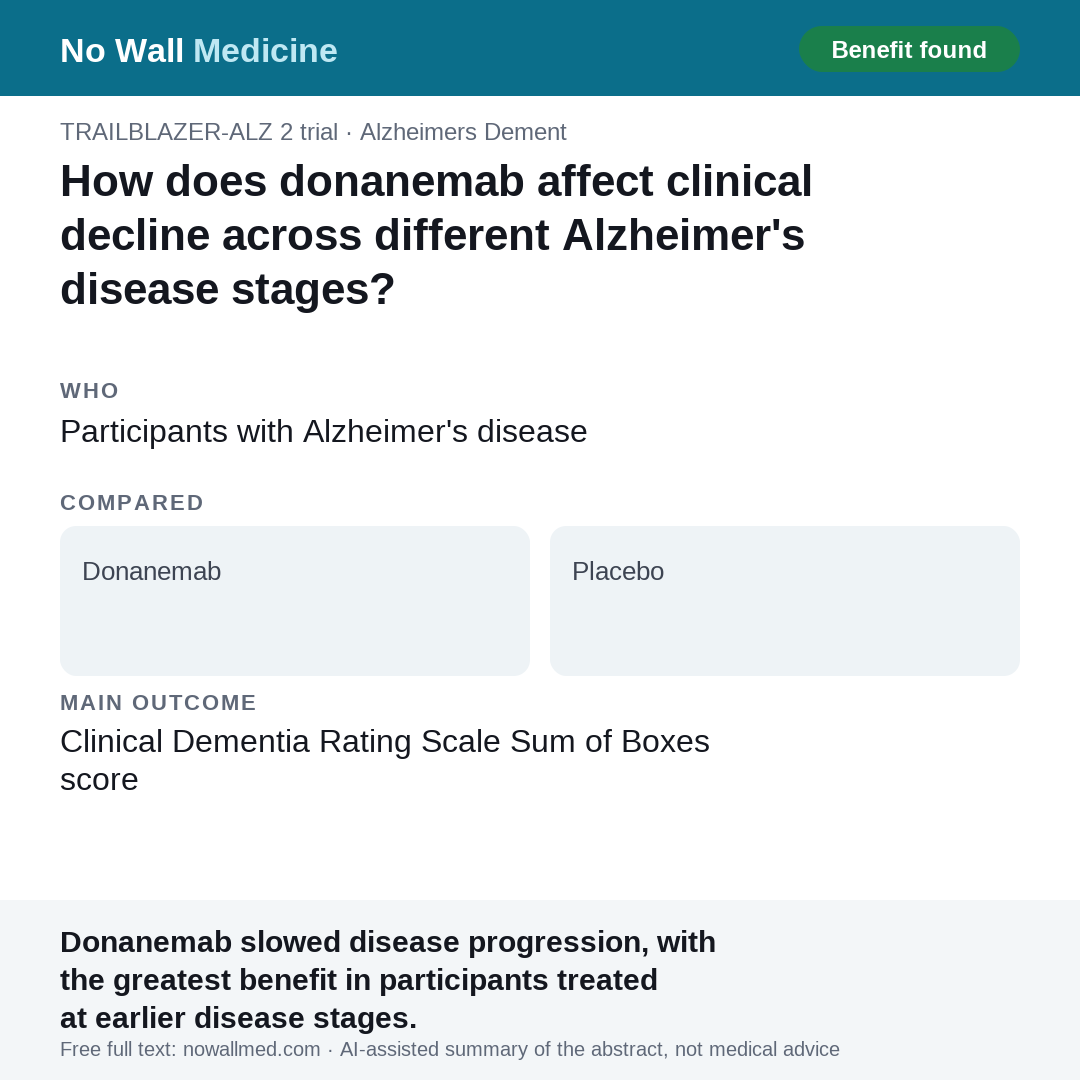
Clinical question: How does donanemab affect clinical decline across different Alzheimer's disease stages?
Why it matters: It is unclear how the effectiveness of disease-modifying therapies changes based on the specific stage of Alzheimer's disease and the amount of tau protein present.
Key points
- Researchers analyzed how donanemab affected the Clinical Dementia Rating Scale Sum of Boxes score across different stages of Alzheimer's disease.
- Participants with lower baseline tau PET and plasma P-tau217 levels showed greater slowing of disease progression compared to those with higher levels.
- Treating patients at the 25th percentile of predicted disease progression delayed decline by 60% over 76 weeks, compared to 33% and 17% at higher percentiles.
Headline and key points written with AI from the paper’s abstract, with every number checked against it. Read the paper before relying on them.
Topics
Cite this article
Raket LL, Lu M, Evans CD, Zimmer JA, Sparks J, Collins EC. Donanemab treatment effect by baseline tau burden and disease severity: Observations from the TRAILBLAZER-ALZ 2 trial. Alzheimers Dement. 2026. doi:10.1002/alz.71577
Spotted a mistake? Suggest a correction