Dose-dependent effect of carbohydrate restriction for type 2 diabetes management: a systematic review and dose-response meta-analysis of randomized controlled trials
Systematic review and dose-response meta-analysisBenefit found
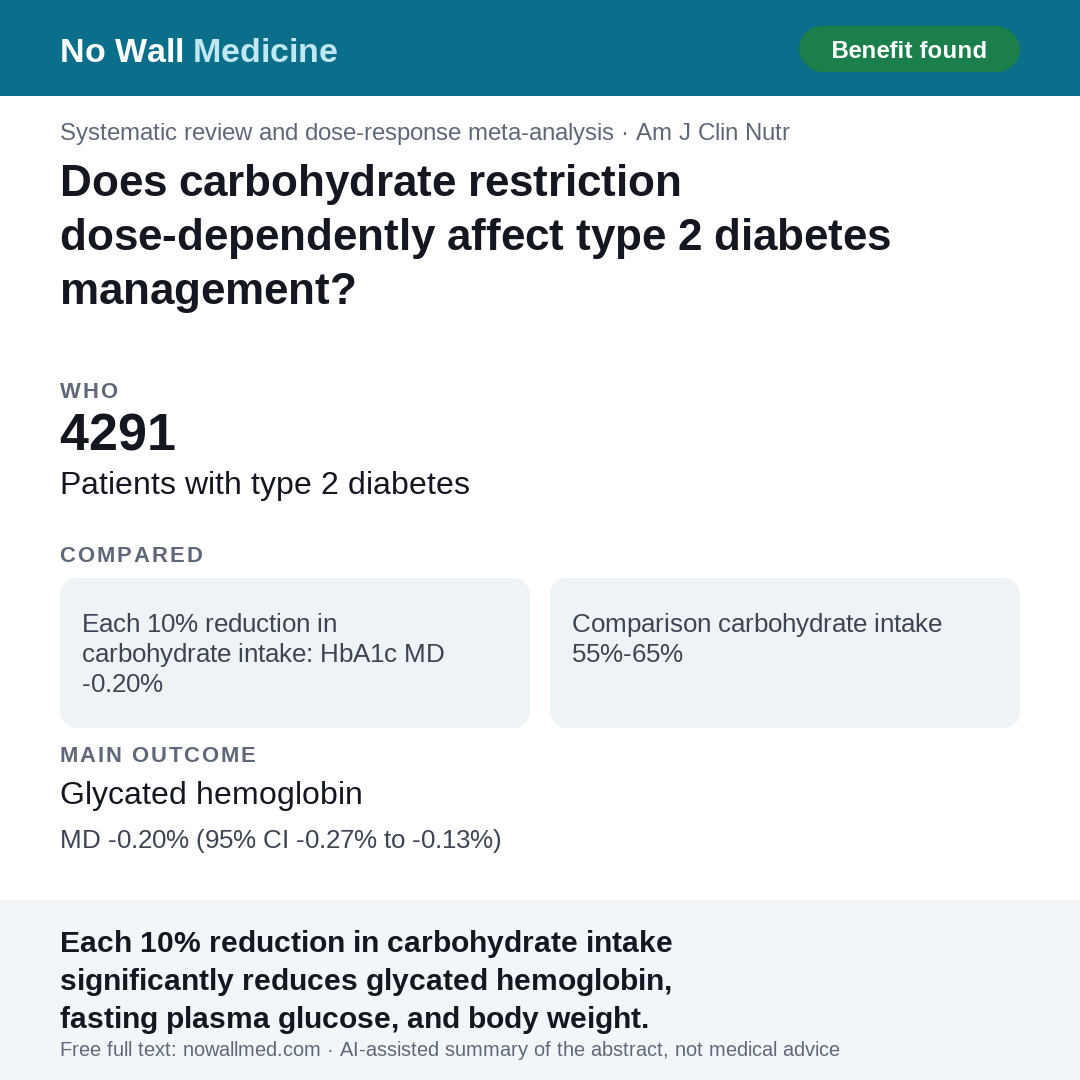
Does carbohydrate restriction dose-dependently affect type 2 diabetes management?
Who
4291
Patients with type 2 diabetes
Compared
Each 10% reduction in carbohydrate intake: HbA1c MD -0.20%
Comparison carbohydrate intake 55%-65%
Main outcome
Glycated hemoglobin
Result: MD -0.20% (95% CI -0.27% to -0.13%)
Bottom line: Each 10% reduction in carbohydrate intake significantly reduces glycated hemoglobin, fasting plasma glucose, and body weight.
Am J Clin Nutr · 2022-05-11Download image
Clinical question: Does carbohydrate restriction dose-dependently affect type 2 diabetes management?
Abstract
Background
Carbohydrate restriction is effective for type 2 diabetes management. Objectives
We aimed to evaluate the dose-dependent effect of carbohydrate restriction in patients with type 2 diabetes. Methods
We systematically searched PubMed, Scopus, and Web of Science to May 2021 for randomized controlled trials evaluating the effect of a carbohydrate-restricted diet (≤45% total calories) in patients with type 2 diabetes. The primary outcome was glycated hemoglobin (HbA1c). Secondary outcomes included fasting plasma glucose (FPG); body weight; serum total, LDL, and HDL cholesterol; triglyceride (TG); and systolic blood pressure (SBP). We performed random-effects dose-response meta-analyses to estimate mean differences (MDs) for a 10% decrease in carbohydrate intake. Results
Fifty trials with 4291 patients were identified. At 6 months, compared with a carbohydrate intake between 55%-65% and through a maximum reduction down to 10%, each 10% reduction in carbohydrate intake reduced HbA1c (MD, -0.20%; 95% CI, -0.27% to -0.13%), FPG (MD, -0.34 mmol/L; 95% CI, -0.56 to -0.12 mmol/L), and body weight (MD, -1.44 kg; 95% CI, -1.82 to -1.06 kg). There were also reductions in total cholesterol, LDL cholesterol, TG, and SBP. Levels of HbA1c, FPG, body weight, TG, and SBP decreased linearly with the decrease in carbohydrate intake from 65% to 10%. A U-shaped effect was seen for total cholesterol and LDL cholesterol, with the greatest reduction at 40%. At 12 months, a linear reduction was seen for HbA1c and TG. A U-shaped effect was seen for body weight, with the greatest reduction at 35%. Conclusions
Carbohydrate restriction can exert a significant and important reduction on levels of cardiometabolic risk factors in patients with type 2 diabetes. Levels of most cardiometabolic outcomes decreased linearly with the decrease in carbohydrate intake. U-shaped effects were seen for total cholesterol and LDL cholesterol at 6 months and for body weight at 12 months.
Subject terms
Cite this article
Jayedi A, Zeraattalab-Motlagh S, Jabbarzadeh B, Hosseini Y, Jibril AT, Shahinfar H. Dose-dependent effect of carbohydrate restriction for type 2 diabetes management: a systematic review and dose-response meta-analysis of randomized controlled trials. Am J Clin Nutr. 2022. doi:10.1093/ajcn/nqac066
Spotted a mistake? Suggest a correction
Top studies every Monday
The week’s key trials and guidelines in your specialties, plus any topics you follow. By email, free.
Get the weekly digest