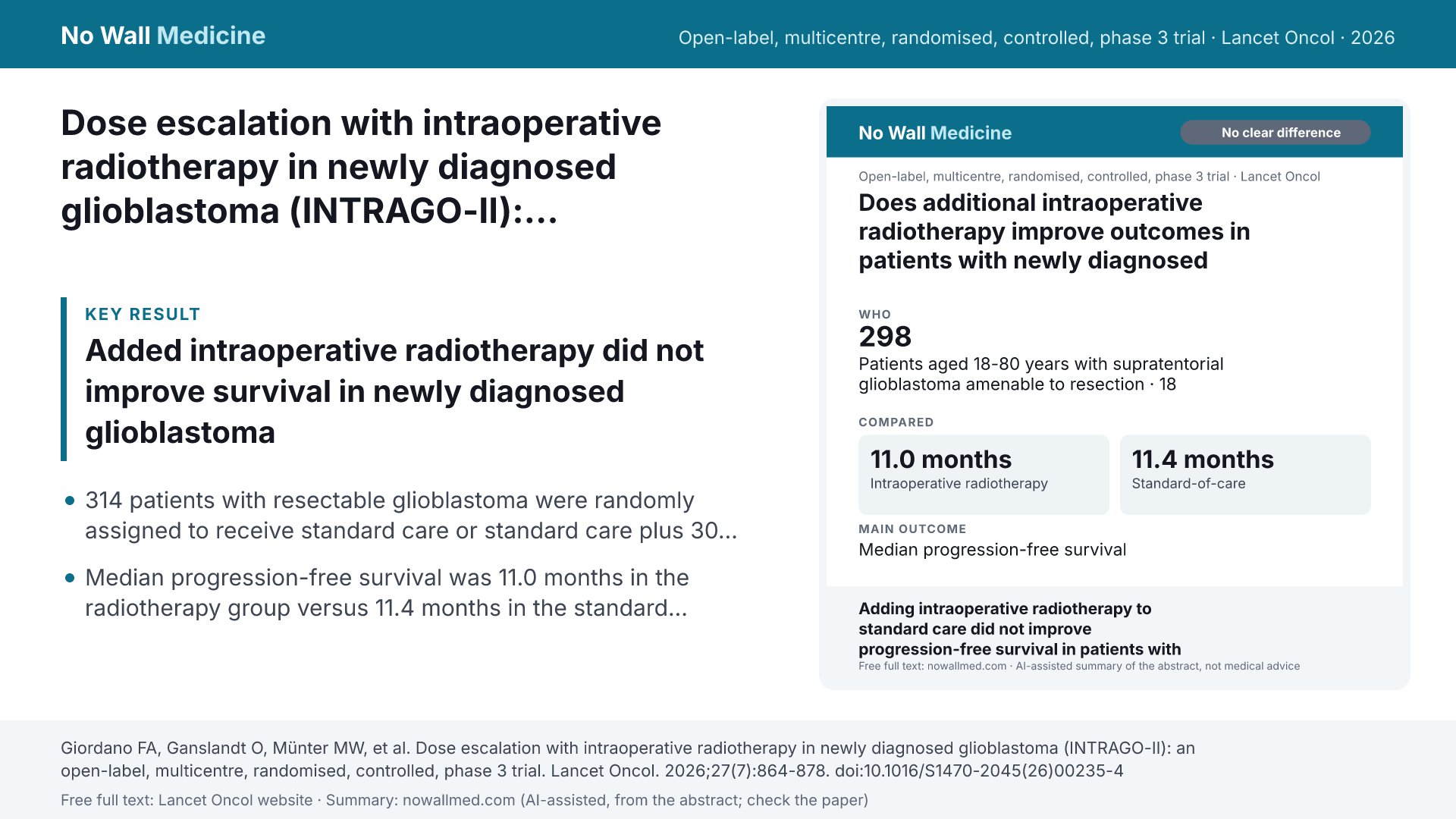
Dose escalation with intraoperative radiotherapy in newly diagnosed glioblastoma (INTRAGO-II): an open-label, multicentre, randomised, controlled, phase 3 trial
Key result: Added intraoperative radiotherapy did not improve survival in newly diagnosed glioblastoma
Key points
- 314 patients with resectable glioblastoma were randomly assigned to receive standard care or standard care plus 30 Gy intraoperative radiotherapy.
- Median progression-free survival was 11.0 months in the radiotherapy group versus 11.4 months in the standard care group, a difference that was not statistically significant.
- Serious adverse events occurred in 65% of the radiotherapy group and 53% of the standard care group, with more seizures and radiation necrosis in the radiotherapy group.
Why it matters: Most glioblastomas recur locally despite standard treatment, so it was unclear if adding precise intraoperative radiation would improve outcomes.
Limitation the authors note: Data on race and ethnicity were not collected.
Discussion prompts
- Would these patients look like yours? Who was left out?
- Is the main outcome one that matters to patients?
- Is the difference large enough to change what you do?
Cite: Giordano FA, Ganslandt O, Münter MW, et al. Dose escalation with intraoperative radiotherapy in newly diagnosed glioblastoma (INTRAGO-II): an open-label, multicentre, randomised, controlled, phase 3 trial. Lancet Oncol. 2026;27(7):864-878. doi:10.1016/S1470-2045(26)00235-4
Free full text: Lancet Oncol website · Summary and visual abstract: nowallmed.com/a/dose-escalation-with-intraoperative-radiotherapy-in-newly-diagnosed-tczc5c/ (AI-assisted from the abstract; check the paper before relying on it).