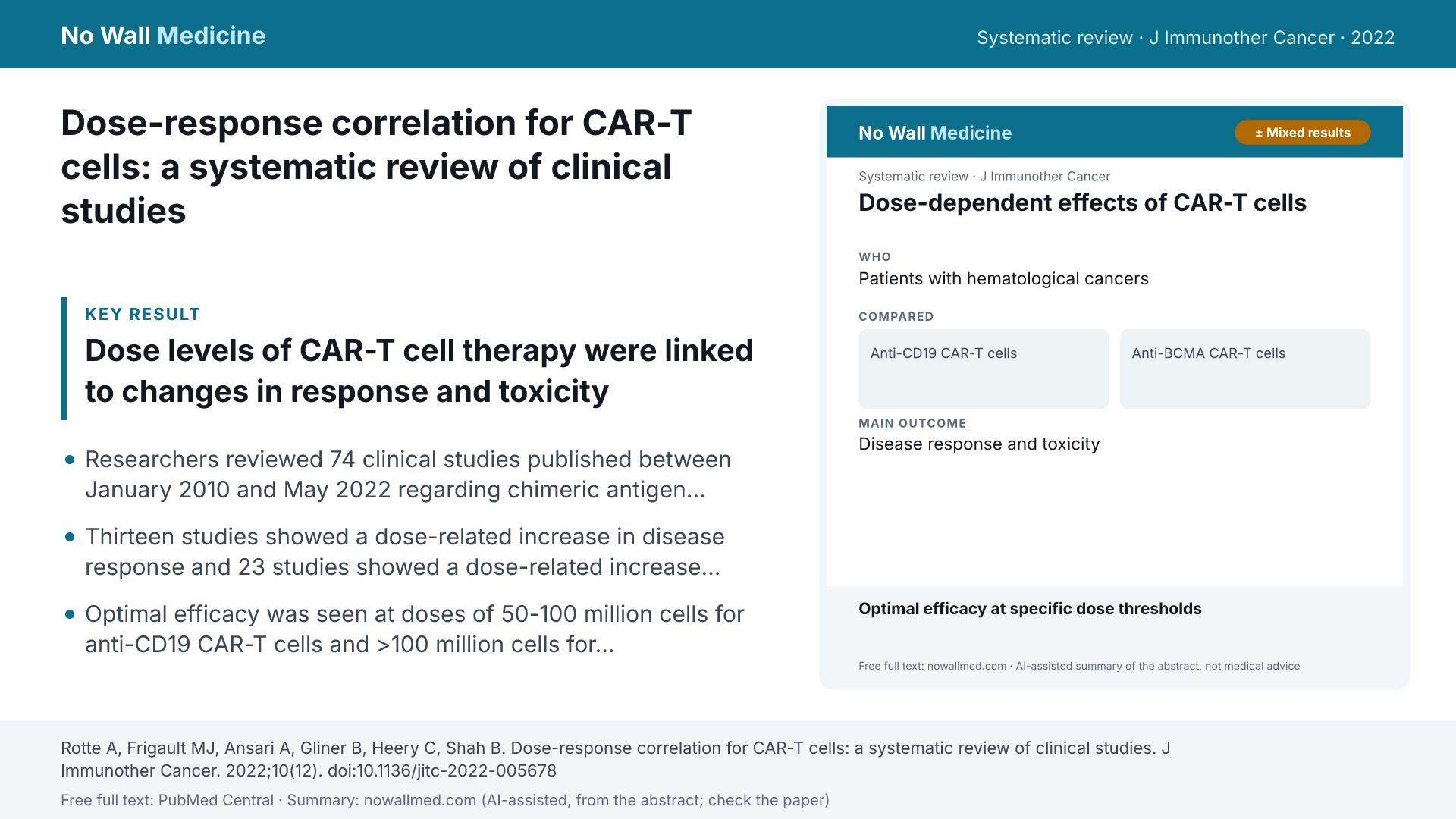
Dose levels of CAR-T cell therapy were linked to changes in response and toxicity
Dose-response correlation for CAR-T cells: a systematic review of clinical studies
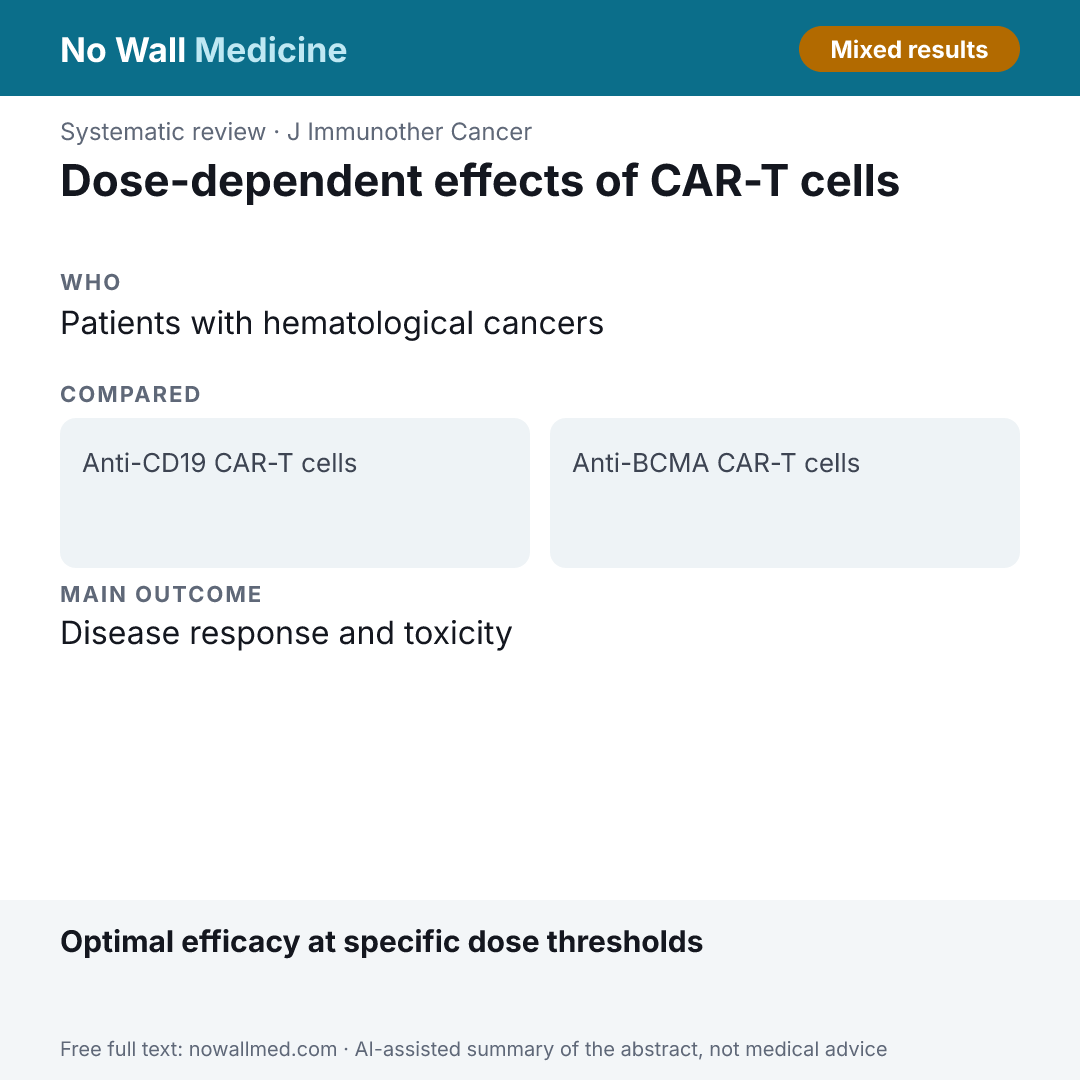
Systematic reviewMixed results
Dose-dependent effects of CAR-T cells
Who
Patients with hematological cancers
Compared
Anti-CD19 CAR-T cells
Anti-BCMA CAR-T cells
Main outcome
Disease response and toxicity
Bottom line: Optimal efficacy at specific dose thresholds
J Immunother Cancer · 2022-12-22 · Save PNG
Key points
- Researchers reviewed 74 clinical studies published between January 2010 and May 2022 regarding chimeric antigen receptor (CAR) T cell therapies for blood cancers.
- Thirteen studies showed a dose-related increase in disease response and 23 studies showed a dose-related increase in toxicity across a median of three dose levels.
- Optimal efficacy was seen at doses of 50-100 million cells for anti-CD19 CAR-T cells and >100 million cells for anti-BCMA CAR-T cells.
Headline and key points written with AI from the paper’s abstract, with every number checked against it. Read the paper before relying on them.
Was this summary helpful?
Abstract
The potential of chimeric antigen receptor (CAR) T cells to successfully treat hematological cancers is widely recognized. Multiple CAR-T cell therapies are currently under clinical development, with most in early stage, during which dose selection is a key goal. The objective of this review is to address the question of dose-dependent effects on response and/or toxicity from available CAR-T cell clinical trial data. For that purpose, systematic literature review of studies published between January 2010 and May 2022 was performed on PubMed and Embase to search clinical studies that evaluated CAR-T cells for hematological cancers. Studies published in English were considered. Studies in children (age <18 years), solid tumors, bispecific CAR-T cells and CAR-T cell cocktails were excluded. As a result, a total of 74 studies met the inclusion criteria. Thirty-nine studies tested multiple dose levels of CAR-T cells with at least >1 patient at each dose level. Thirteen studies observed dose-related increase in disease response and 23 studies observed dose-related increase in toxicity across a median of three dose levels. Optimal clinical efficacy was seen at doses 50-100 million cells for anti-CD19 CAR-T cells and >100 million cells for anti-BCMA CAR-T cells in majority of studies. The findings suggest, for a given construct, there exists a dose at which a threshold of optimal efficacy occurs. Dose escalation may reveal increasing objective response rates (ORRs) until that threshold is reached. However, when ORR starts to plateau despite increasing dose, further dose escalation is unlikely to result in improved ORR but is likely to result in higher incidence and/or severity of mechanistically related adverse events.
Abstract reproduced under the article’s CC BY NC licence.
Subject terms
Headline, design, result, key points, caveat and citation as plain text.
Cite this article
Rotte A, Frigault MJ, Ansari A, Gliner B, Heery C, Shah B. Dose-response correlation for CAR-T cells: a systematic review of clinical studies. J Immunother Cancer. 2022;10(12). doi:10.1136/jitc-2022-005678
Spotted a mistake? Suggest a correction