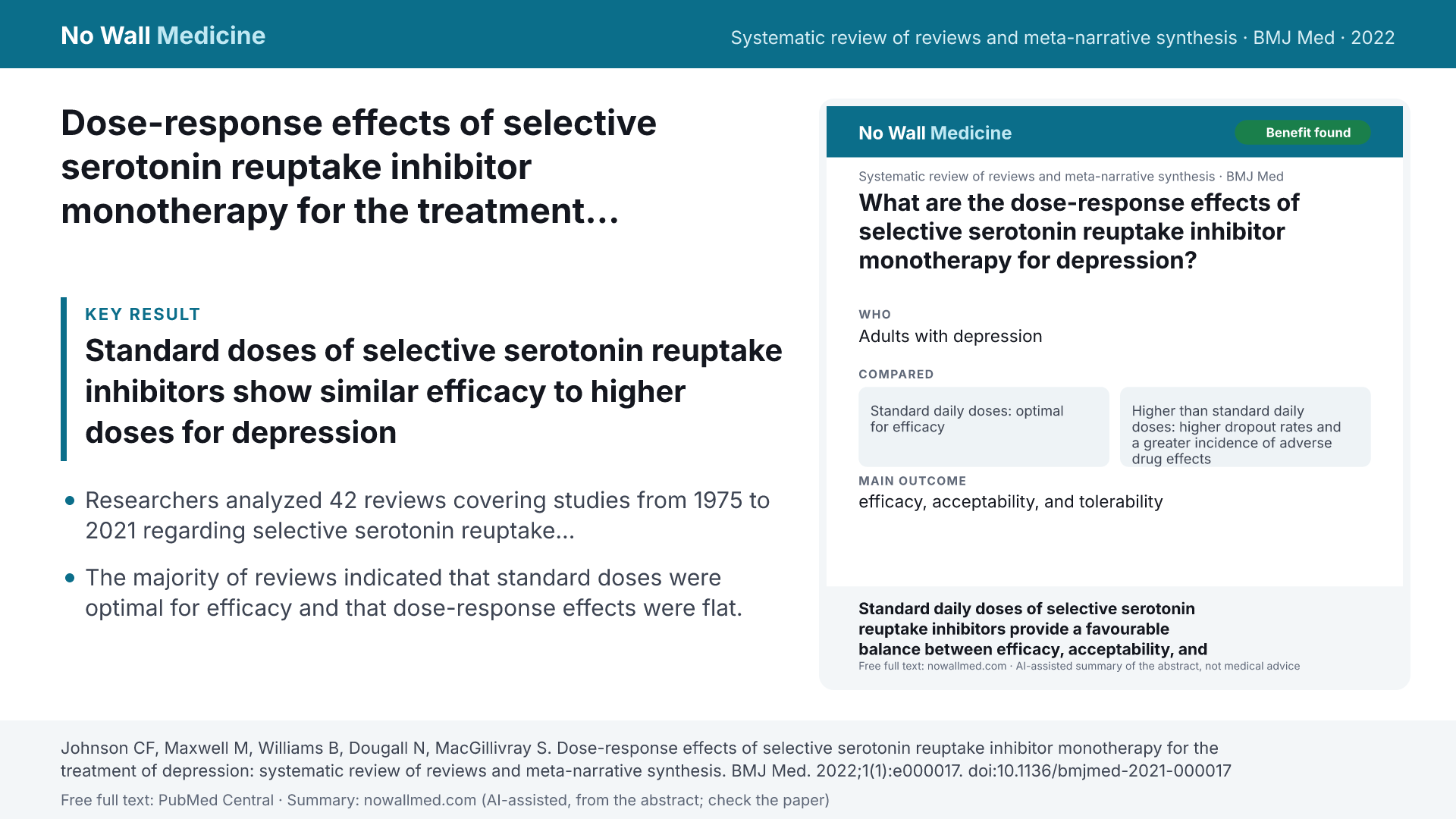
Standard doses of selective serotonin reuptake inhibitors show similar efficacy to higher doses for depression
Dose-response effects of selective serotonin reuptake inhibitor monotherapy for the treatment of depression: systematic review of reviews and meta-narrative synthesis
Systematic review of reviews and meta-narrative synthesisBenefit found
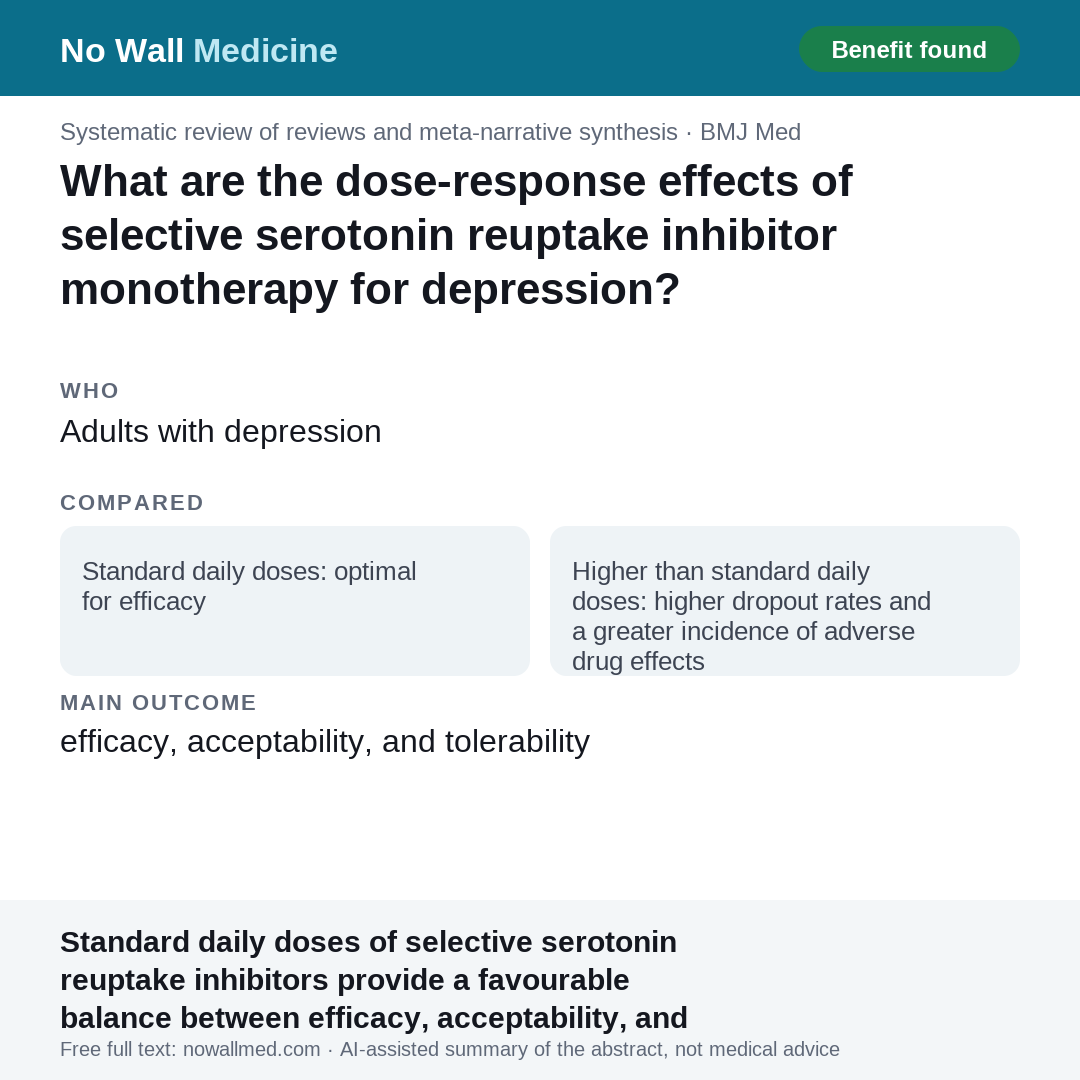
What are the dose-response effects of selective serotonin reuptake inhibitor monotherapy for depression?
Who
Adults with depression
Compared
Standard daily doses: optimal for efficacy
Higher than standard daily doses: higher dropout rates and a greater incidence of adverse drug effects
Main outcome
efficacy, acceptability, and tolerability
Bottom line: Standard daily doses of selective serotonin reuptake inhibitors provide a favourable balance between efficacy, acceptability, and tolerability.
Limitation: High degree of heterogeneity due to methodological diversity in included reviews.
BMJ Med · 2022-12-01Download image
Clinical question: What are the dose-response effects of selective serotonin reuptake inhibitor monotherapy for depression?
Why it matters: It was unclear how varying the doses of selective serotonin reuptake inhibitors affects the effectiveness, acceptability, and tolerability of depression treatments.
Key points
- Researchers analyzed 42 reviews covering studies from 1975 to 2021 regarding selective serotonin reuptake inhibitor monotherapy for adult depression.
- The majority of reviews indicated that standard doses were optimal for efficacy and that dose-response effects were flat.
- Higher than standard daily doses were associated with higher dropout rates and a greater incidence of adverse drug effects like nausea and fatigue.
Limitation the authors note: The majority of reviews included data from studies with a duration of 12 weeks or less.
Headline and key points written with AI from the paper’s abstract, with every number checked against it. Read the paper before relying on them.
Was this summary helpful?
Abstract
Objective
To assess and clarify the relations between selective serotonin reuptake inhibitor (SSRI) dose efficacy, acceptability (early treatment discontinuation (dropouts)), and tolerability (reported adverse drug effects), and critically evaluate methods previously used to examine SSRI dose-response effects for the treatment of depression in adults. Design
Systematic review of reviews and meta-narrative synthesis. Data sources
Embase, Medline, PsycINFO, Scopus, and the Cochrane Collaboration library, from 1975 to December 2021. Reference lists of national depression treatment guidelines were systemically searched by hand. Eligibility criteria for selecting studies
Reviews assessing SSRI monotherapy dose-response effects for the treatment of depression in adults (age ≥18 years) reporting efficacy, acceptability, or tolerability. Reviews meeting inclusion criteria had a high degree of heterogeneity, due to methodological diversity; therefore, a meta-narrative synthesis approach was applied. Standard daily doses were defined as 20 mg citalopram, fluoxetine, paroxetine; 50 mg sertraline; and 10 mg escitalopram. Risk of bias was assessed using the Risk of Bias in Systematic Reviews tool, in line with Cochrane recommendations. Results
The search identified 9138 records; 387 full text reports were assessed for eligibility, 42 of which matched the inclusion criteria. The majority, 83% (n=35), of reviews included data for studies with a duration of ≤12 weeks (ie, the acute phase of depression treatment). Of 39 reviews assessing efficacy, the majority (n=26) indicated that individual SSRIs and SSRI class demonstrated flat dose-response effects; standard doses were optimal for efficacy. Acceptability or tolerability were assessed in 28 reviews. Higher than standard daily doses were associated with higher dropout rates and a greater incidence of adverse drug effects (eg, nausea, sexual dysfunction, fatigue, anxiety). Despite a range of methods being reported, there was an overall consensus regarding SSRI dose related efficacy, dropouts, and adverse drug effects. Conclusion
Standard daily doses of SSRIs for the treatment of depression in adults provide a favourable balance between efficacy, acceptability, and tolerability. Patients are encouraged to talk to their prescriber or community pharmacist if they experience adverse effects or have any concerns about their drug treatments.
Abstract reproduced under the article’s CC BY NC licence.
Cite this article
Johnson CF, Maxwell M, Williams B, Dougall N, MacGillivray S. Dose-response effects of selective serotonin reuptake inhibitor monotherapy for the treatment of depression: systematic review of reviews and meta-narrative synthesis. BMJ Med. 2022. doi:10.1136/bmjmed-2021-000017
Spotted a mistake? Suggest a correction
Top studies every Monday
The week’s key trials and guidelines in your specialties, plus any topics you follow. By email, free.
Get the weekly digest