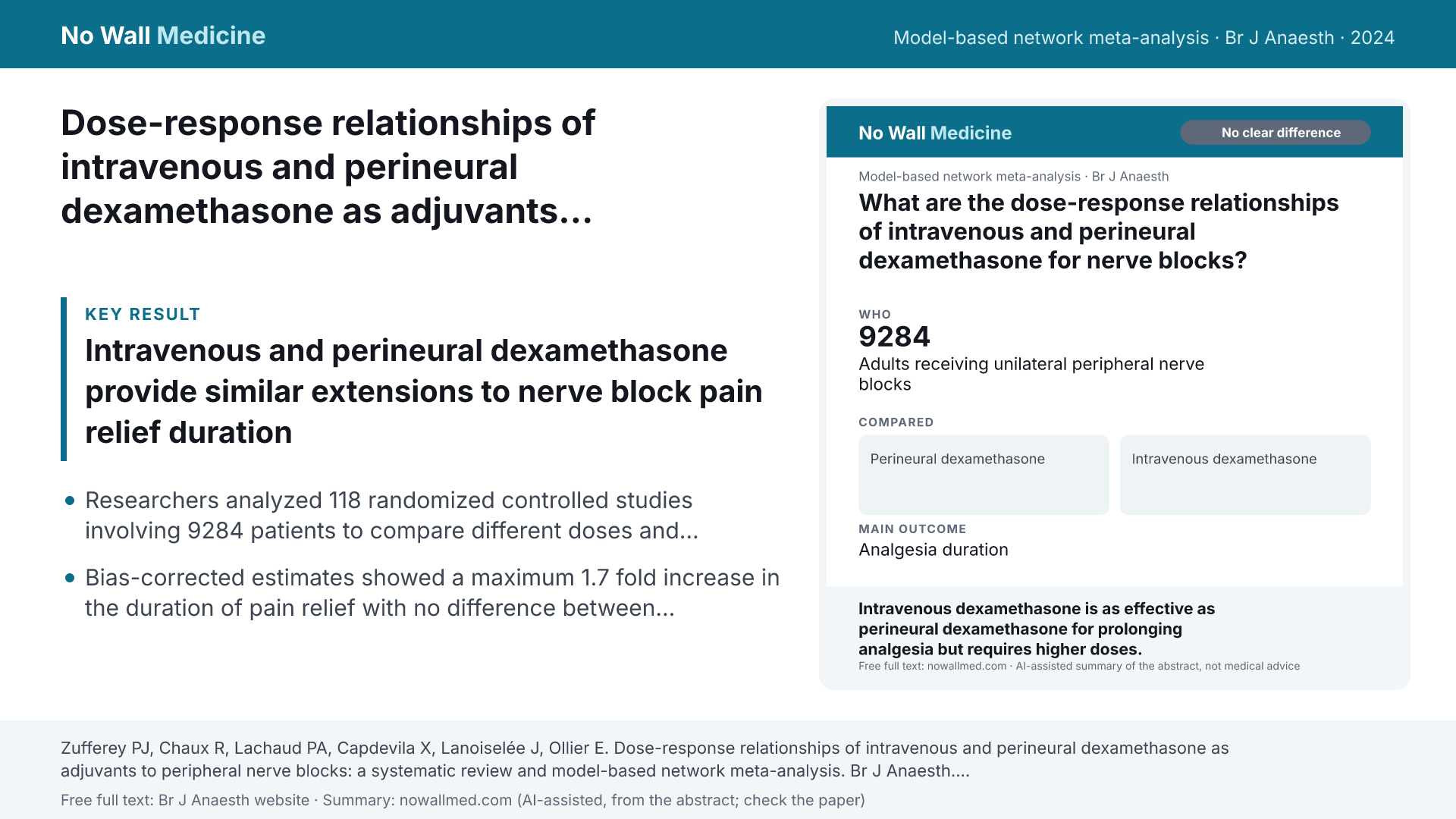
Intravenous and perineural dexamethasone provide similar extensions to nerve block pain relief duration
Dose-response relationships of intravenous and perineural dexamethasone as adjuvants to peripheral nerve blocks: a systematic review and model-based network meta-analysis
Model-based network meta-analysisNo clear difference
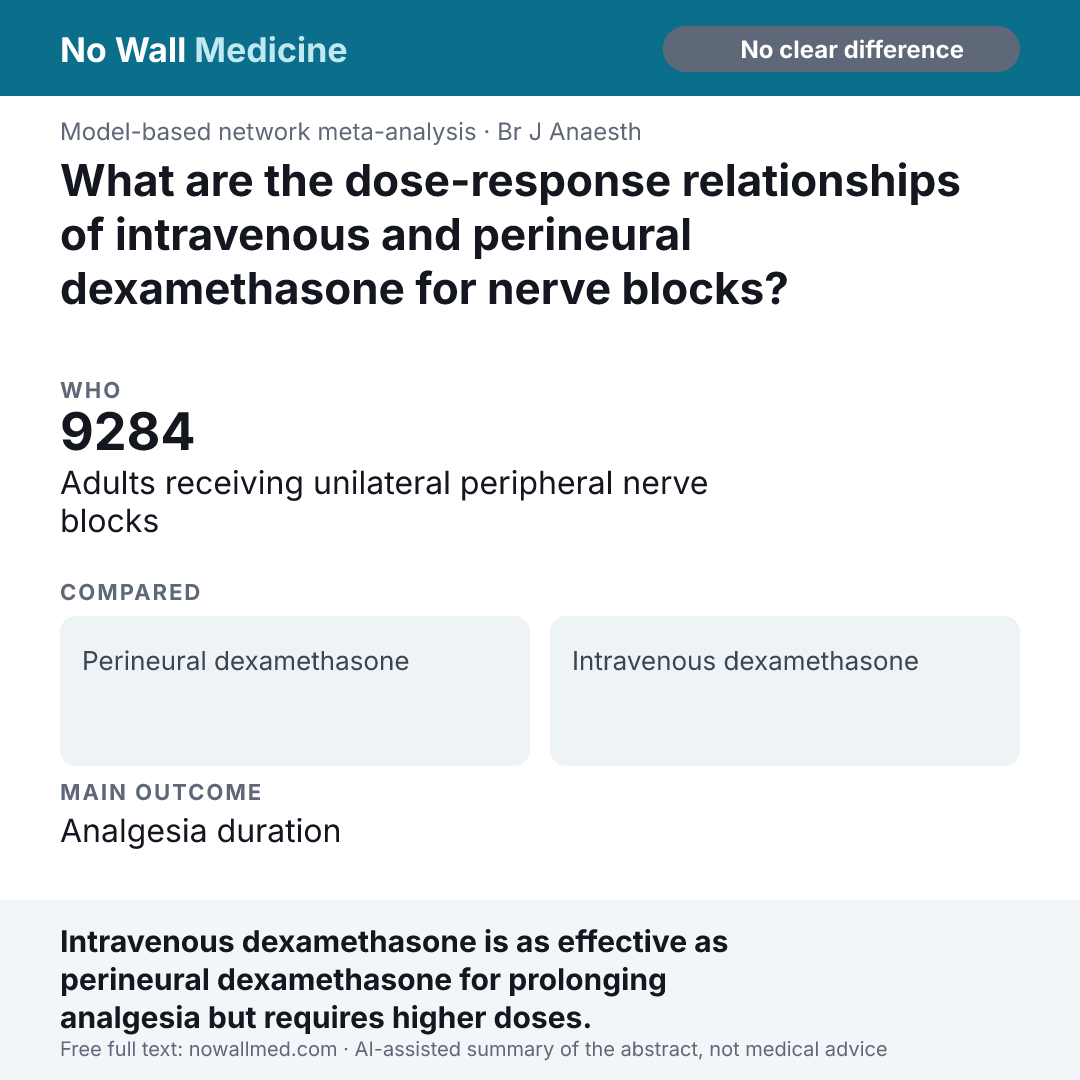
What are the dose-response relationships of intravenous and perineural dexamethasone for nerve blocks?
Who
9284
Adults receiving unilateral peripheral nerve blocks
Compared
Perineural dexamethasone
Intravenous dexamethasone
Main outcome
Analgesia duration
Result: maximum fold increase in analgesia duration of 1.7 (95% CrI 1.4-1.9)
Bottom line: Intravenous dexamethasone is as effective as perineural dexamethasone for prolonging analgesia but requires higher doses.
Limitation: Observational nature of dose-response relationships and quality of included studies.
Br J Anaesth · 2024-01-27 · Save PNG
Clinical question: What are the dose-response relationships of intravenous and perineural dexamethasone for nerve blocks?
Key points
- Researchers analyzed 118 randomized controlled studies involving 9284 patients to compare different doses and routes of dexamethasone for nerve block pain relief.
- Bias-corrected estimates showed a maximum 1.7 fold increase in the duration of pain relief with no difference between the intravenous and perineural administration routes.
- Simulations suggested 4 mg of perineural dexamethasone increased mean analgesia duration from 11.1 h to 16.5 h, while 8 mg of intravenous dexamethasone showed a similar effect.
Limitation the authors note: The evidence is limited by the observational nature of the dose-response relationships and the quality of the included studies.
Headline and key points written with AI from the paper’s abstract, with every number checked against it. Read the paper before relying on them.
Was this summary helpful?
Subject terms
Headline, design, result, key points, caveat and citation as plain text.
Cite this article
Zufferey PJ, Chaux R, Lachaud PA, Capdevila X, Lanoiselée J, Ollier E. Dose-response relationships of intravenous and perineural dexamethasone as adjuvants to peripheral nerve blocks: a systematic review and model-based network meta-analysis. Br J Anaesth. 2024;132(5):1122-1132. doi:10.1016/j.bja.2023.12.021
Spotted a mistake? Suggest a correction