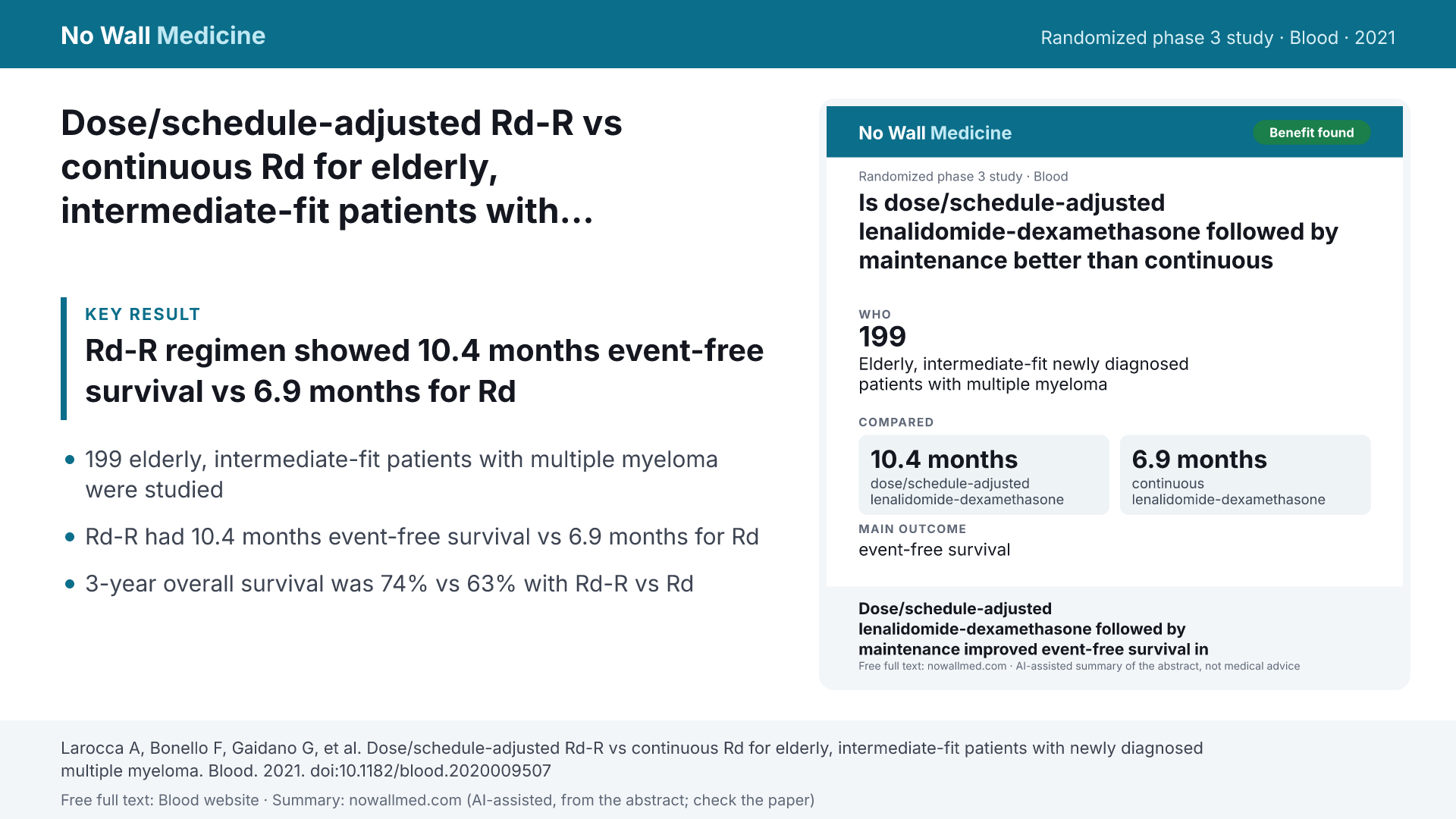
Dose/schedule-adjusted Rd-R vs continuous Rd for elderly, intermediate-fit patients with newly diagnosed multiple myeloma
Key result: Rd-R regimen showed 10.4 months event-free survival vs 6.9 months for Rd
Randomized phase 3 studyBenefit found
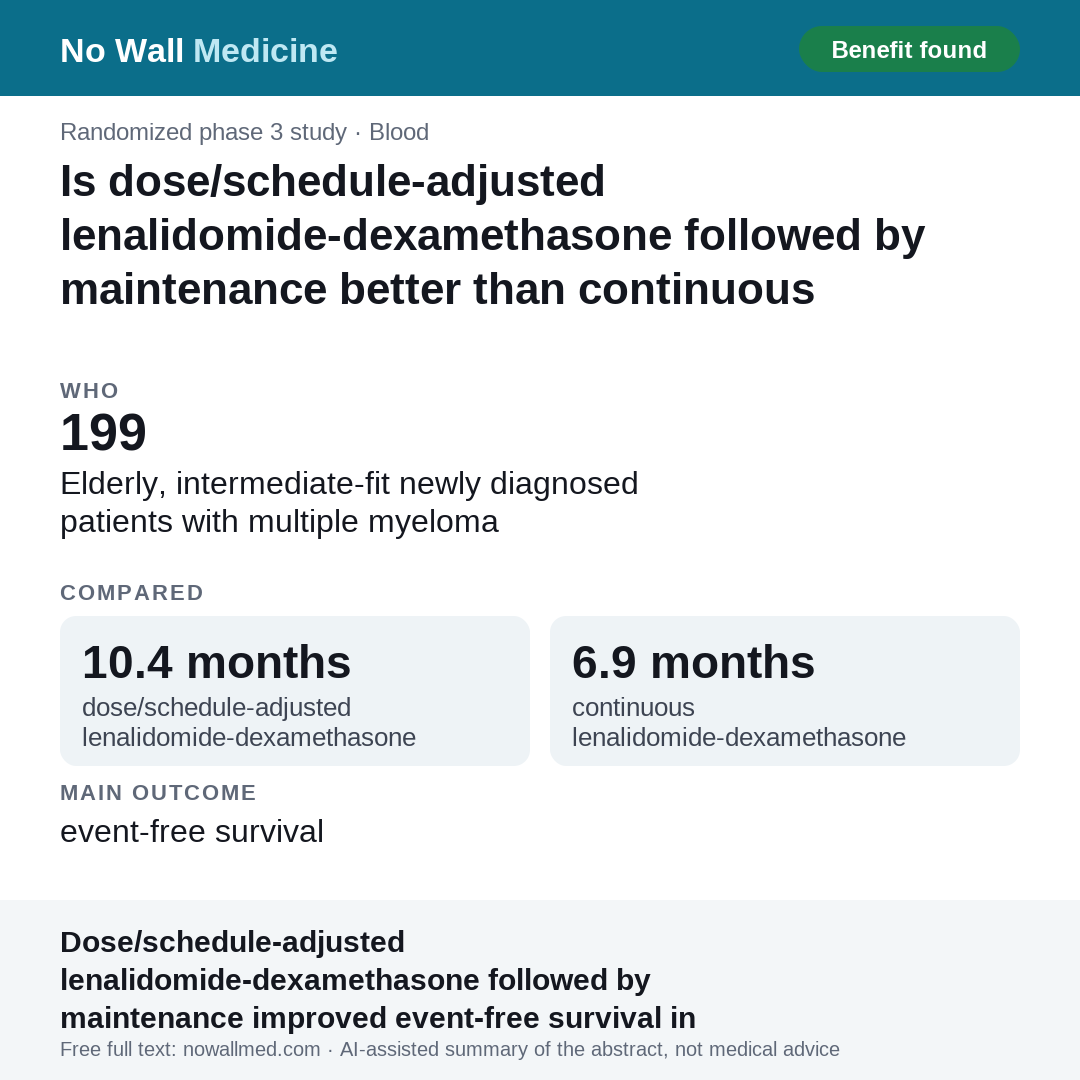
Is dose/schedule-adjusted lenalidomide-dexamethasone followed by maintenance better than continuous lenalidomide-dexamethasone?
Who
199
Elderly, intermediate-fit newly diagnosed patients with multiple myeloma
Compared
10.4 monthsdose/schedule-adjusted lenalidomide-dexamethasone followed by maintenance
6.9 monthscontinuous lenalidomide-dexamethasone
Main outcome
event-free survival
Result: hazard ratio 0.70 (95% confidence interval 0.51-0.95)
Bottom line: Dose/schedule-adjusted lenalidomide-dexamethasone followed by maintenance improved event-free survival in elderly patients with multiple myeloma.
Blood · 2021-03-20Download image
Key points
- 199 elderly, intermediate-fit patients with multiple myeloma were studied.
- Rd-R had 10.4 months event-free survival vs 6.9 months for Rd.
- 3-year overall survival was 74% vs 63% with Rd-R vs Rd.
Why it matters: Optimal treatment duration and schedule for lenalidomide-dexamethasone in elderly multiple myeloma patients was unknown
Discussion prompts
- Would these patients look like yours? Who was left out?
- Is the main outcome one that matters to patients?
- Is the difference large enough to change what you do?
Cite: Larocca A, Bonello F, Gaidano G, et al. Dose/schedule-adjusted Rd-R vs continuous Rd for elderly, intermediate-fit patients with newly diagnosed multiple myeloma. Blood. 2021. doi:10.1182/blood.2020009507
Free full text: Blood website · Summary and visual abstract: nowallmed.com/a/dose-schedule-adjusted-rd-r-vs-continuous-rd-for-elderly-intermediate-fsj6mq/ (AI-assisted from the abstract; check the paper before relying on it).