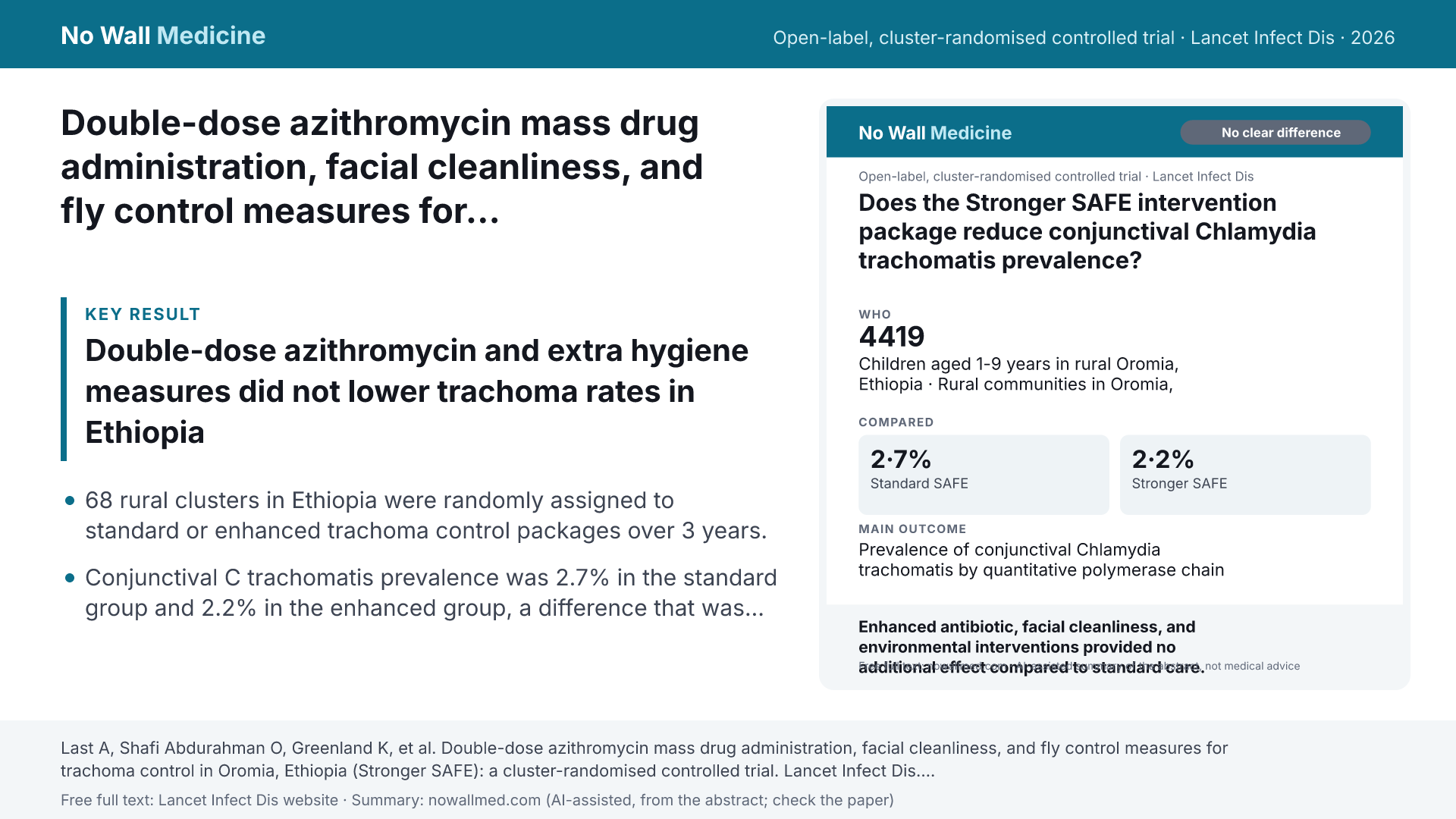
Double-dose azithromycin and extra hygiene measures did not lower trachoma rates in Ethiopia
Double-dose azithromycin mass drug administration, facial cleanliness, and fly control measures for trachoma control in Oromia, Ethiopia (Stronger SAFE): a cluster-randomised controlled trial
Open-label, cluster-randomised controlled trialNo clear difference
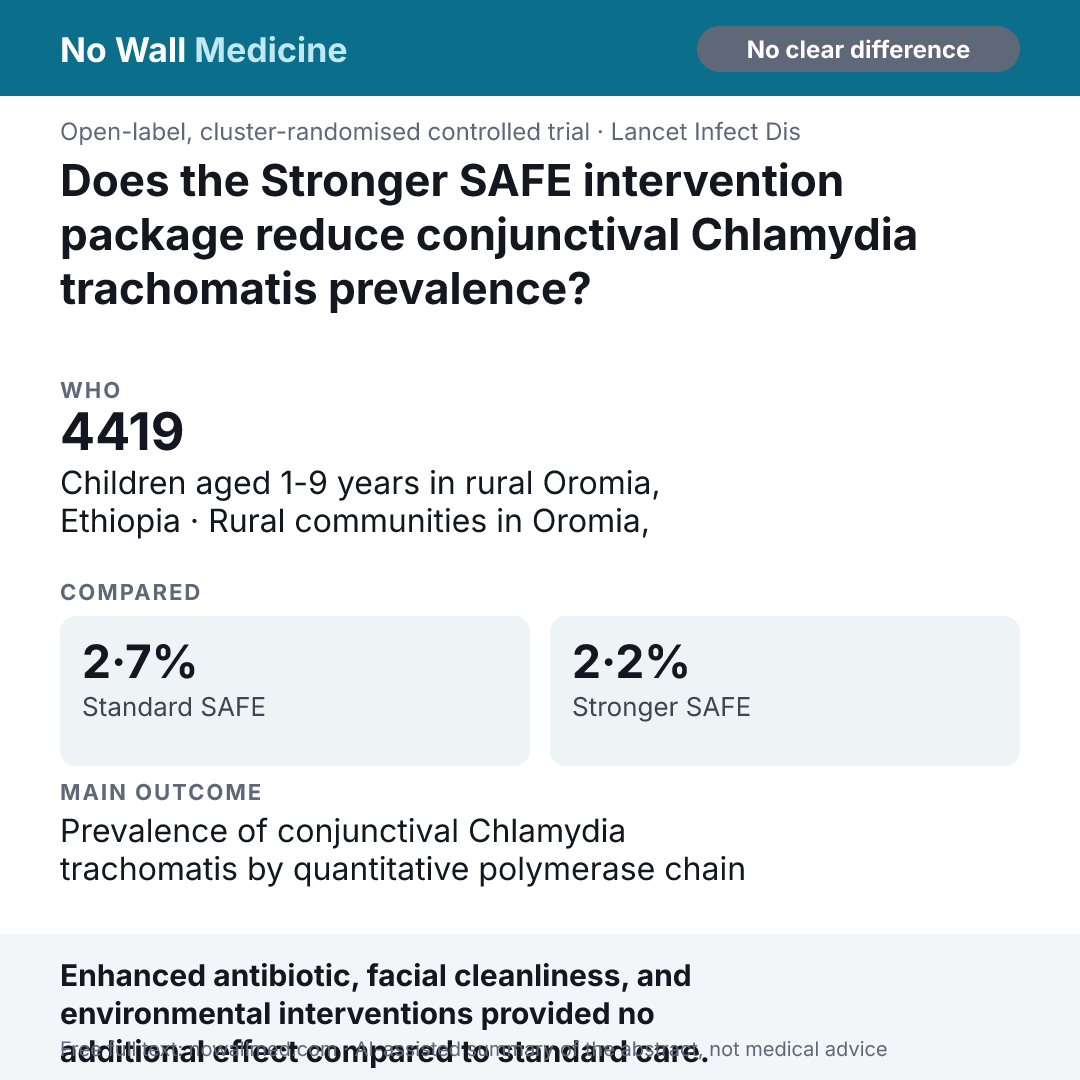
Does the Stronger SAFE intervention package reduce conjunctival Chlamydia trachomatis prevalence?
Who
4419
Children aged 1-9 years in rural Oromia, Ethiopia · Rural communities in Oromia, Ethiopia
Compared
2·7%Standard SAFE (95% CI 1·3-5·0)
2·2%Stronger SAFE (0·6-7·9)
Main outcome
Prevalence of conjunctival Chlamydia trachomatis by quantitative polymerase chain reaction
Result: adjusted prevalence difference of -0·02% [-2·73 to 2·68]
Bottom line: Enhanced antibiotic, facial cleanliness, and environmental interventions provided no additional effect compared to standard care.
Funded by: Wellcome Trust and Children's Investment Fund Foundation
Lancet Infect Dis · 2026-03-24 · Save PNG
Same trial (ISRCTN40760473)
Papers we list that report this registered trial, oldest first. Read a secondary analysis alongside the main results.
- Main results No clear difference
This paper Lancet Infect Dis 2026-03 - Related analysis Benefit found
Enhanced face-washing interventions increased soap use and face washing prevalence in Ethiopia Lancet Glob Health 2026-03
Clinical question: Does the Stronger SAFE intervention package reduce conjunctival Chlamydia trachomatis prevalence?
Why it matters: Multiple rounds of standard trachoma control have been insufficient to eliminate the disease in Ethiopia, where over 50% of the global burden remains.
Key points
- 68 rural clusters in Ethiopia were randomly assigned to standard or enhanced trachoma control packages over 3 years.
- Conjunctival C trachomatis prevalence was 2.7% in the standard group and 2.2% in the enhanced group, a difference that was not statistically significant.
- Azithromycin was well tolerated, with 13 mild adverse events reported and no serious adverse events occurring.
Headline and key points written with AI from the paper’s abstract, with every number checked against it. Read the paper before relying on them.
Was this summary helpful?
Abstract
Background
Trachoma is caused by the bacterium Chlamydia trachomatis. WHO recommends the SAFE strategy for trachoma elimination: surgery for trichiasis (S), antibiotics (A), facial cleanliness (F), and environmental improvement (E). Multiple rounds of SAFE implementation have proven insufficient to eliminate trachoma in Ethiopia, where over 50% of the global trachoma burden remains. We aimed to evaluate a package of interventions to reduce the prevalence of conjunctival C trachomatis and accelerate trachoma elimination. Methods
Stronger SAFE was an open-label, cluster-randomised controlled trial done in rural communities in the trachoma-endemic region of Oromia, Ethiopia. Clusters, each of about 90 households, were randomly assigned (1:1:1:1) using Stata 17 to: (1) standard A plus standard F and E (Standard SAFE; control group), (2) standard A plus enhanced F and E, (3) enhanced A plus standard F and E, or (4) enhanced A plus enhanced F and E (Stronger SAFE group). Standard A consisted of annual, single-dose, mass drug administration (MDA) of azithromycin. Enhanced A included two height-based doses of oral azithromycin (equivalent to 20 mg/kg) given as single doses in two MDA campaigns, 2 weeks apart, annually. Standard F and E involved promotion of latrine construction and facial hygiene, whereas enhanced F and E used additional fly control measures (permethrin-treated headwear [PTH] and odour-baited traps) and a household-level, facial hygiene behaviour change intervention. The interventions were implemented and reinforced over 3 years. Laboratory technicians and the trial statistician were masked. The primary outcome was the prevalence of conjunctival C trachomatis by quantitative PCR at 3 years in the control group versus the Stronger SAFE group, assessed on an intention-to-treat basis in a cross-sectional sample of 60 children aged 1-9 years from each cluster. Adverse events were monitored in all participants receiving MDA and/or PTH. The trial is registered with ISRCTN (ISRCTN40760473) and is complete. Findings
Between March 6, 2021, and Aug 31, 2024, 68 clusters were enrolled and randomly assigned to an intervention. From these clusters we surveyed 4419 children aged 1-9 years at baseline (control group n=1095; Stronger SAFE group n=1203) and 3480 (mean 50·7 [SD 9·9] per cluster) at endline (control group n=970; Stronger SAFE group n=862). At baseline, the cluster mean prevalence of conjunctival C trachomatis was 14·6% (15·5) in the control group and 13·3% (11·8) in the Stronger SAFE group. Following 3 years of intervention, the cluster-adjusted prevalence of conjunctival C trachomatis was 2·7% (95% CI 1·3-5·0) in the control group and 2·2% (0·6-7·9) in the Stronger SAFE group (adjusted prevalence difference of -0·02% [-2·73 to 2·68], p=0·99). Azithromycin was well tolerated with only 13 mild, self-limiting adverse events (almost exclusively nausea, diarrhoea, and headache) reported related to the MDA (eight in single-dose MDA communities and five in double-dose MDA communities). No serious adverse events were reported. Interpretation
Enhanced A, F, and E (Stronger SAFE) had no additional effect compared with standard of care on reducing the prevalence of conjunctival C trachomatis at 3 years in this setting. It is therefore unlikely that these enhanced intervention measures will accelerate trachoma elimination beyond well implemented, high coverage of single-dose MDA as part of standard SAFE. Funding
Wellcome Trust and Children's Investment Fund Foundation. Translations
For the Amharic and Afan Oromo translations of the abstract see Supplementary Materials section.
Abstract reproduced under the article’s CC BY licence.
Subject terms
Headline, design, result, key points, caveat and citation as plain text.
Cite this article
Last A, Shafi Abdurahman O, Greenland K, et al. Double-dose azithromycin mass drug administration, facial cleanliness, and fly control measures for trachoma control in Oromia, Ethiopia (Stronger SAFE): a cluster-randomised controlled trial. Lancet Infect Dis. 2026;26(7):680-691. doi:10.1016/S1473-3099(26)00024-1
Spotted a mistake? Suggest a correction