Double reflex testing for anti-HDV antibody following an HBsAg-positive test result and HDV RNA in those anti-HDV positive: a global systematic review and meta-analysis
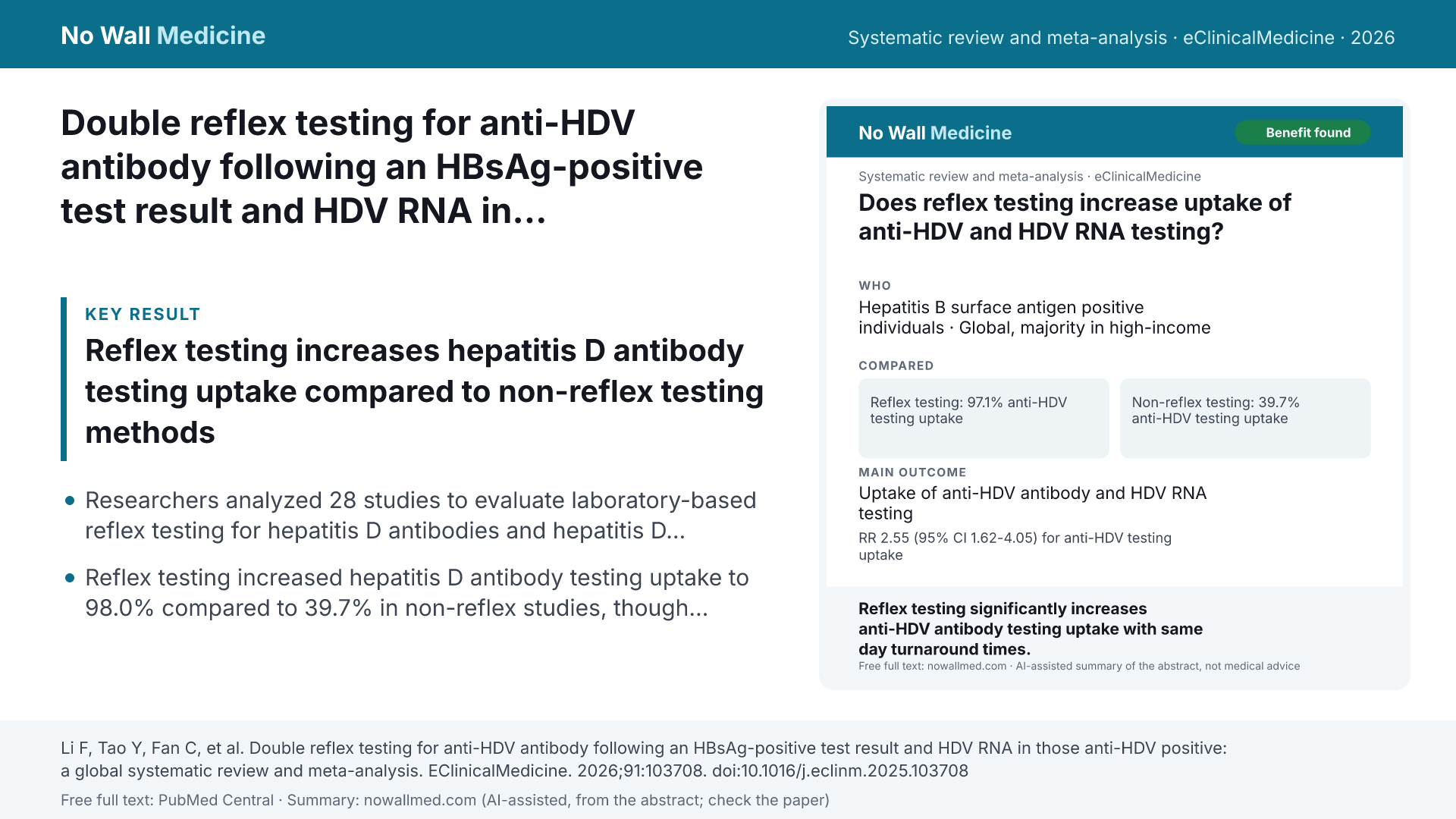
Key result: Reflex testing increases hepatitis D antibody testing uptake compared to non-reflex testing methods
Key points
- Researchers analyzed 28 studies to evaluate laboratory-based reflex testing for hepatitis D antibodies and hepatitis D RNA in people with hepatitis B surface antigen.
- Reflex testing increased hepatitis D antibody testing uptake to 98.0% compared to 39.7% in non-reflex studies, though the increase in hepatitis D RNA testing was not statistically significant.
- In studies using reflex testing, 97.1% of hepatitis B surface antigen-positive individuals had hepatitis D antibody testing, and 95.3% of those had hepatitis D RNA testing.
Why it matters: Only a small proportion of individuals who test positive for hepatitis B are currently tested for hepatitis D antibodies or confirmatory hepatitis D RNA.
Discussion prompts
- Would these patients look like yours? Who was left out?
- Is the main outcome one that matters to patients?
- Is the difference large enough to change what you do?
Cite: Li F, Tao Y, Fan C, et al. Double reflex testing for anti-HDV antibody following an HBsAg-positive test result and HDV RNA in those anti-HDV positive: a global systematic review and meta-analysis. EClinicalMedicine. 2026;91:103708. doi:10.1016/j.eclinm.2025.103708
Free full text: PubMed Central · Summary and visual abstract: nowallmed.com/a/double-reflex-testing-for-anti-hdv-antibody-following-an-hbsag-yl7ykl/ (AI-assisted from the abstract; check the paper before relying on it).