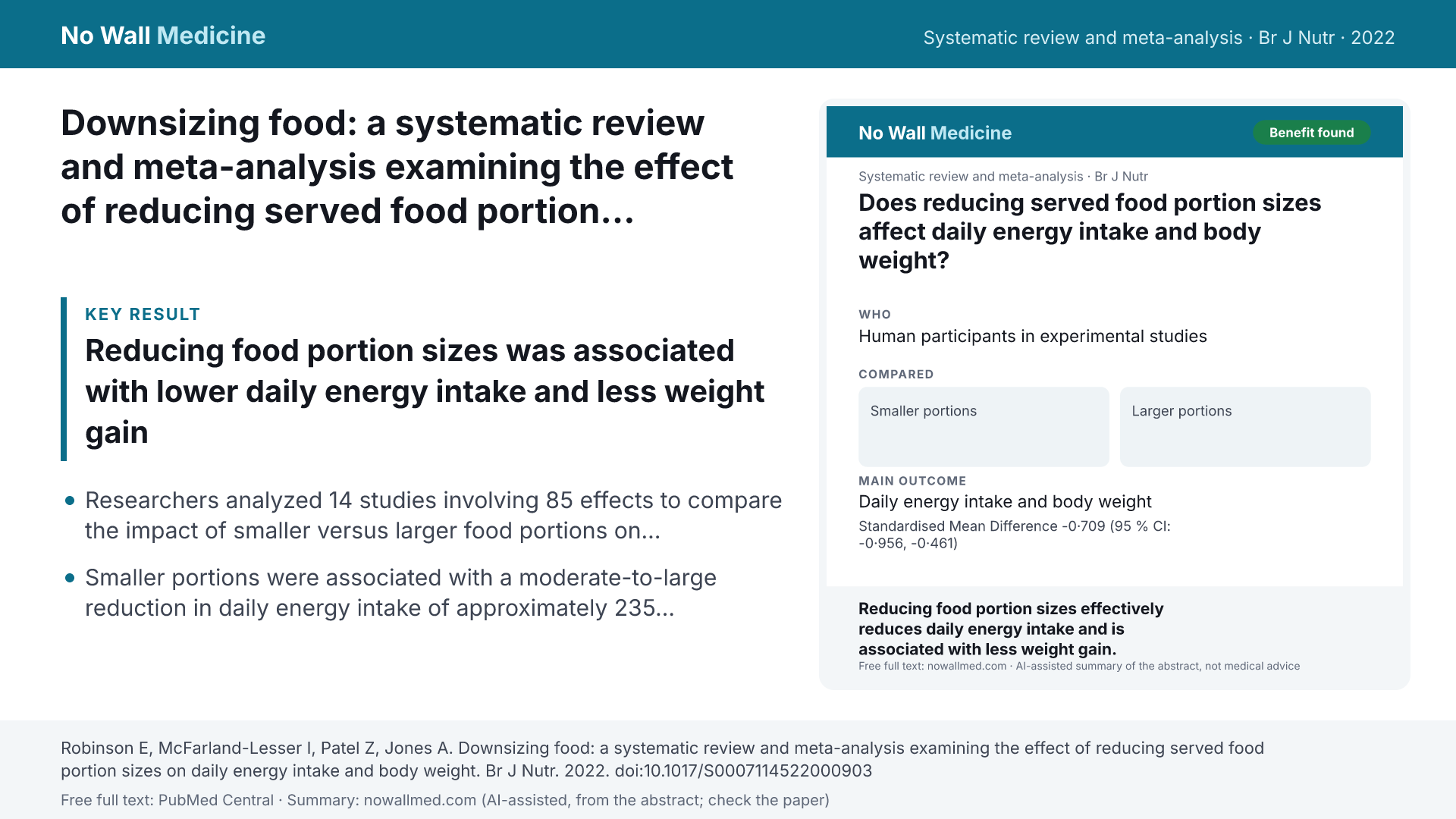
Downsizing food: a systematic review and meta-analysis examining the effect of reducing served food portion sizes on daily energy intake and body weight
Key result: Reducing food portion sizes was associated with lower daily energy intake and less weight gain
Systematic review and meta-analysisBenefit found
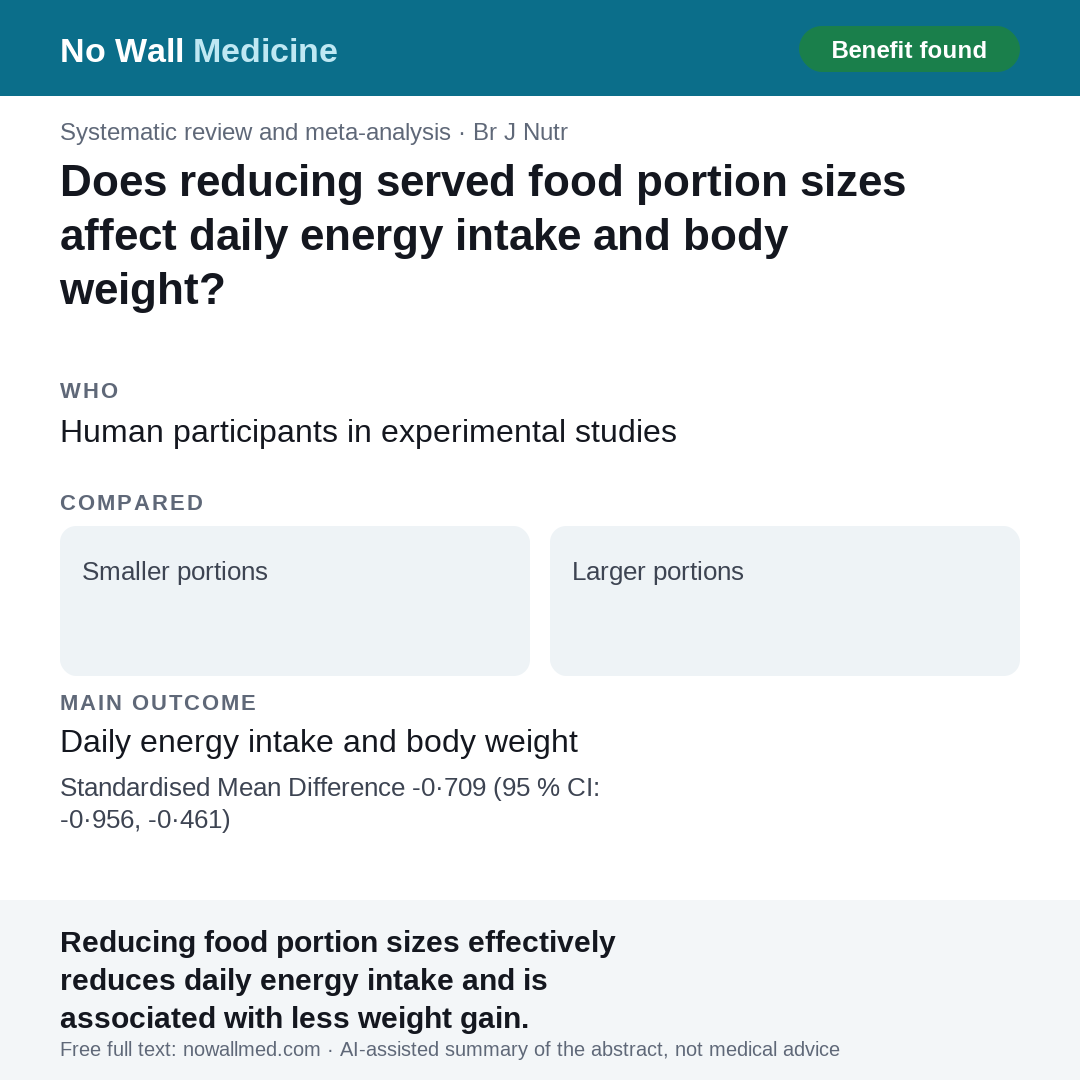
Does reducing served food portion sizes affect daily energy intake and body weight?
Who
Human participants in experimental studies
Compared
Smaller portions
Larger portions
Main outcome
Daily energy intake and body weight
Result: Standardised Mean Difference -0·709 (95 % CI: -0·956, -0·461)
Bottom line: Reducing food portion sizes effectively reduces daily energy intake and is associated with less weight gain.
Br J Nutr · 2022-04-07Download image
Key points
- Researchers analyzed 14 studies involving 85 effects to compare the impact of smaller versus larger food portions on energy intake and body weight.
- Smaller portions were associated with a moderate-to-large reduction in daily energy intake of approximately 235 kcal (983.24 kJ).
- In a subset of four studies, being served smaller portions was associated with 0.58 kg less weight gain compared to larger portions.
Why it matters: The size of the effect that reducing food portion sizes has on daily energy intake and body weight is less clear.
Discussion prompts
- Would these patients look like yours? Who was left out?
- Is the main outcome one that matters to patients?
- Is the difference large enough to change what you do?
Cite: Robinson E, McFarland-Lesser I, Patel Z, Jones A. Downsizing food: a systematic review and meta-analysis examining the effect of reducing served food portion sizes on daily energy intake and body weight. Br J Nutr. 2022. doi:10.1017/S0007114522000903
Free full text: PubMed Central · Summary and visual abstract: nowallmed.com/a/downsizing-food-a-systematic-review-and-meta-analysis-examining-the-1cacg7r/ (AI-assisted from the abstract; check the paper before relying on it).