Povidone-iodine-impregnated foam was most effective for skin graft donor site healing in meta-analysis
Dressing Influence on Re-epithelialization Rate Following Split-thickness Skin Graft Harvest: Network Meta-analysis of Randomized Controlled Trials
Network meta-analysis of randomized controlled trialsBenefit found
Which conventional dressing is most effective for re-epithelialization of split-thickness skin graft donor sites?
Who
25
Patients undergoing split-thickness skin graft harvest · MEDLINE, Cochrane, and Embase databases
Compared
90.4%povidone-iodine-impregnated foam
87.9%hydrocolloid
73.5%petrolatum
40.6%alginate
Main outcome
re-epithelialization rate
Bottom line: Povidone-iodine-impregnated foam was the most effective dressing for re-epithelialization of skin graft donor sites.
Plast Reconstr Surg Glob Open · 2025-05-09Download image
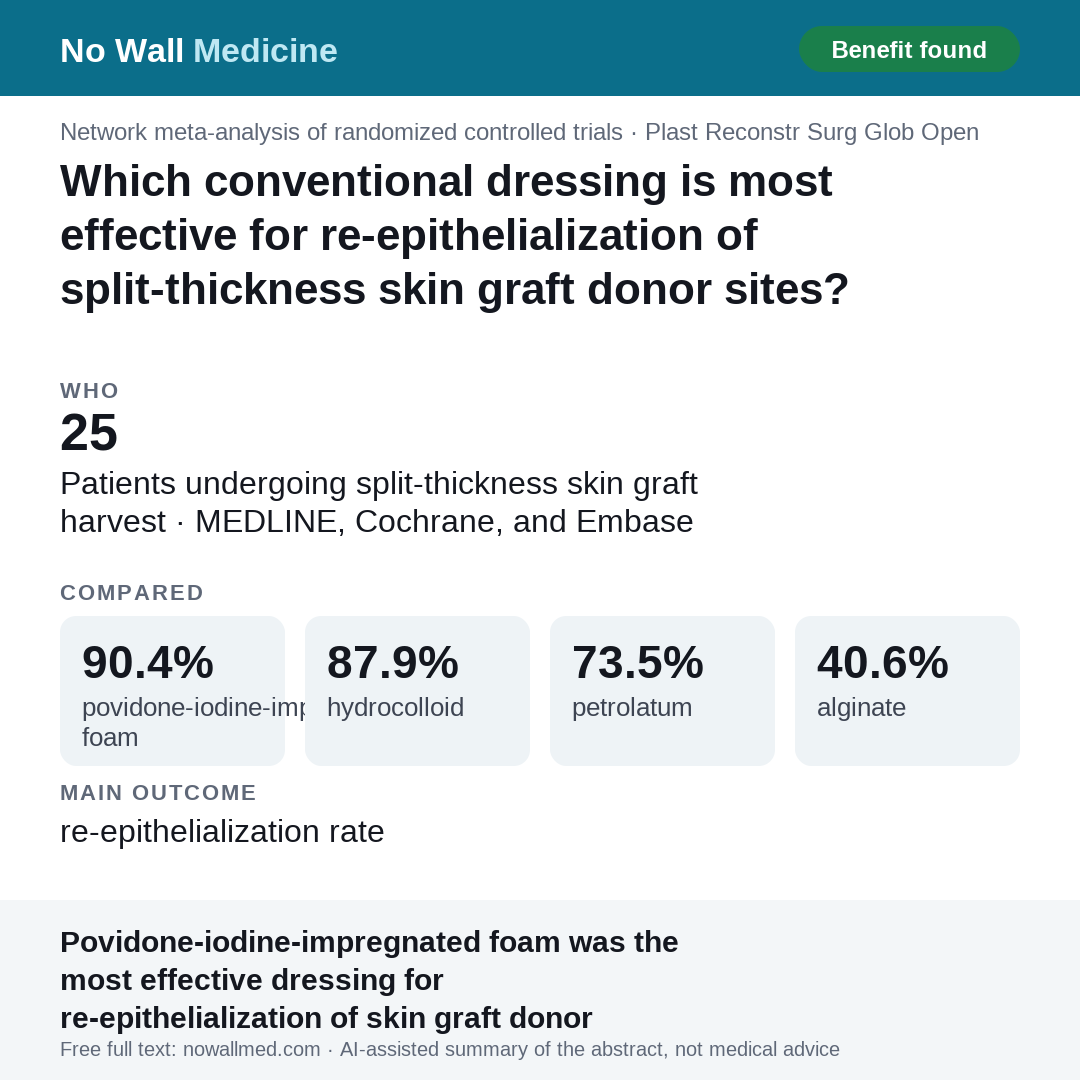
Clinical question: Which conventional dressing is most effective for re-epithelialization of split-thickness skin graft donor sites?
Why it matters: Clinicians need to know which conventional dressing options provide the fastest re-epithelialization, which is the process of new skin growing over a wound.
Key points
- Researchers conducted a network meta-analysis of 25 randomized controlled trials published between 1983 and 2022 to compare different dressings for split-thickness skin graft donor sites.
- Povidone-iodine-impregnated foam (Betafoam) had the highest re-epithelialization rate at 90.4%, followed by hydrocolloid at 87.9% and petrolatum at 73.5%.
- Alginate (40.6%), paraffin (18.1%), and cotton gauze (3.9%) were associated with lower rates of skin regrowth at the donor site.
Headline and key points written with AI from the paper’s abstract, with every number checked against it. Read the paper before relying on them.
Cite this article
Alhindi N, Qari S, Nukaly H, Althagafi A, Alzolaibani S, Akkour M. Dressing Influence on Re-epithelialization Rate Following Split-thickness Skin Graft Harvest: Network Meta-analysis of Randomized Controlled Trials. Plast Reconstr Surg Glob Open. 2025. doi:10.1097/GOX.0000000000006748
Spotted a mistake? Suggest a correction
Top studies every Monday
The week’s key trials and guidelines in your specialties, by email. Free.
Get the weekly digest