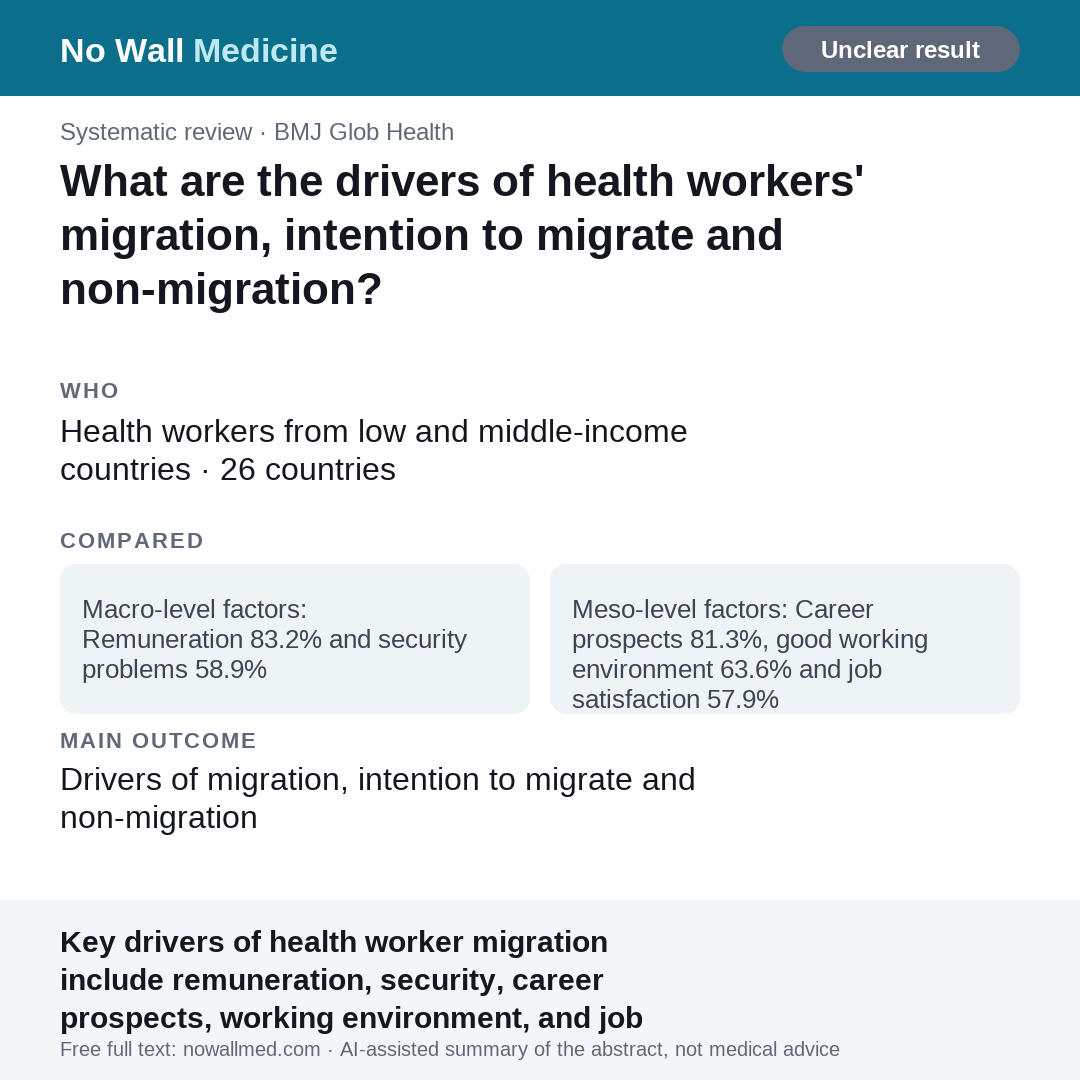
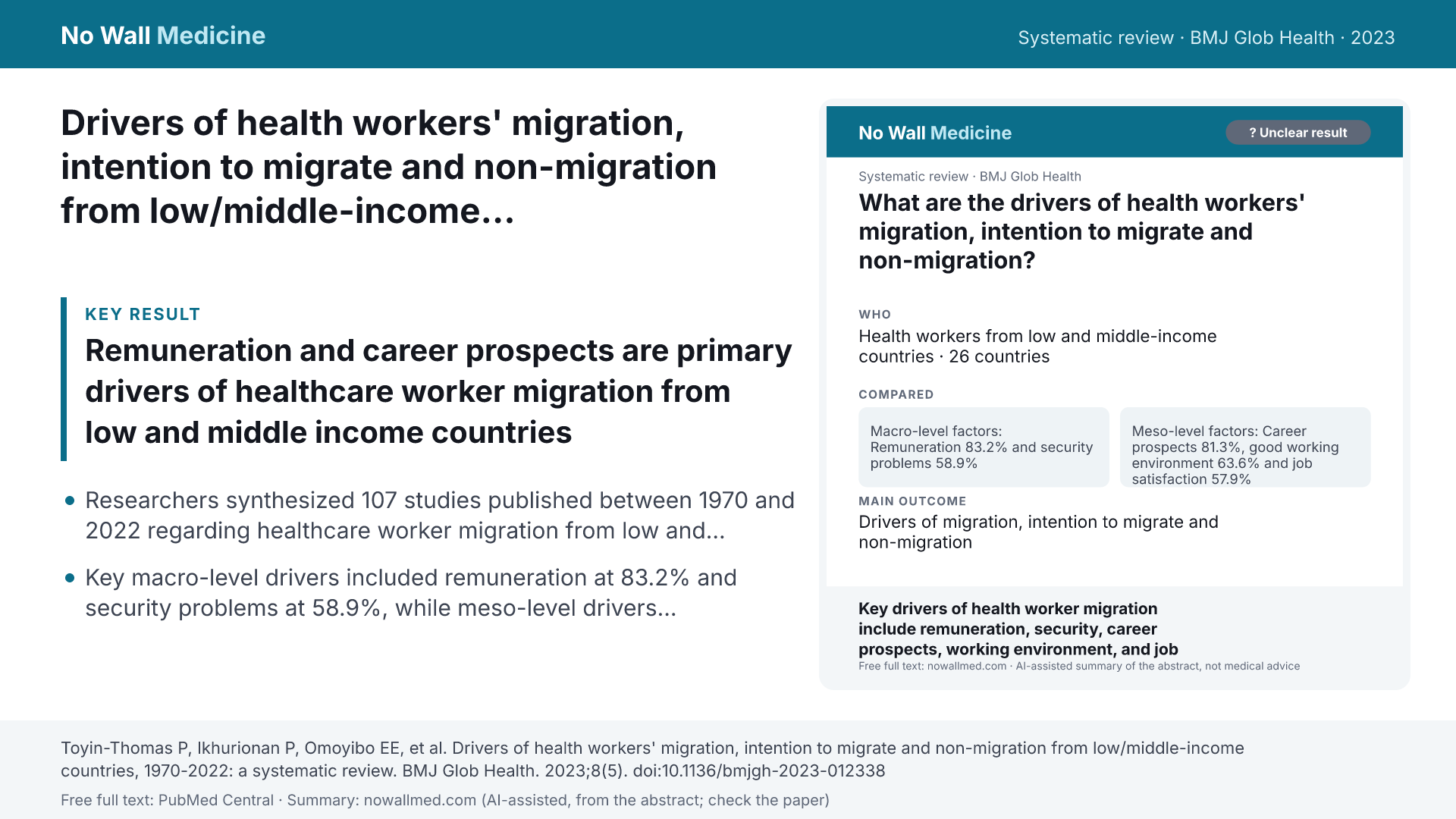
Remuneration and career prospects are primary drivers of healthcare worker migration from low and middle income countries
Drivers of health workers' migration, intention to migrate and non-migration from low/middle-income countries, 1970-2022: a systematic review
Systematic reviewUnclear result
What are the drivers of health workers' migration, intention to migrate and non-migration?
Who
Health workers from low and middle-income countries · 26 countries
Compared
Macro-level factors: Remuneration 83.2% and security problems 58.9%
Meso-level factors: Career prospects 81.3%, good working environment 63.6% and job satisfaction 57.9%
Main outcome
Drivers of migration, intention to migrate and non-migration
Bottom line: Key drivers of health worker migration include remuneration, security, career prospects, working environment, and job satisfaction.
BMJ Glob Health · 2023-05-09Download image
Clinical question: What are the drivers of health workers' migration, intention to migrate and non-migration?
Why it matters: The specific drivers that motivate healthcare workers to migrate, intend to migrate, or choose not to migrate from low and middle income countries were not fully synthesized.
Key points
- Researchers synthesized 107 studies published between 1970 and 2022 regarding healthcare worker migration from low and middle income countries.
- Key macro-level drivers included remuneration at 83.2% and security problems at 58.9%, while meso-level drivers included career prospects at 81.3%.
- The most frequently studied professionals were doctors at 64.5% and nurses at 54.2%, with the UK and USA being top destinations.
Headline and key points written with AI from the paper’s abstract, with every number checked against it. Read the paper before relying on them.
Was this summary helpful?
Abstract
Background
The migration of healthcare workers (HWs) from low/middle-income countries (LMICs) is a pressing global health issue with implications for population-level health outcomes. We aimed to synthesise the drivers of HWs' out-migration, intention to migrate and non-migration from LMICs. Methods
We searched Ovid MEDLINE, EMBASE, CINAHL, Global Health and Web of Science, as well as the reference lists of retrieved articles. We included studies (quantitative, qualitative or mixed-methods) on HWs' migration or intention to migrate, published in either English or French between 1 January 1970 and 31 August 2022. The retrieved titles were deduplicated in EndNote before being exported to Rayyan for independent screening by three reviewers. Results
We screened 21 593 unique records and included 107 studies. Of the included studies, 82 were single-country studies focusing on 26 countries, while the remaining 25 included data from multiple LMICs. Most of the articles focused on either doctors 64.5% (69 of 107) and/or nurses 54.2% (58 of 107). The UK (44.9% (48 of 107)) and the USA (42% (45 of 107)) were the top destination countries. The LMICs with the highest number of studies were South Africa (15.9% (17 of 107)), India (12.1% (13 of 107)) and the Philippines (6.5% (7 of 107)). The major drivers of migration were macro-level and meso-level factors. Remuneration (83.2%) and security problems (58.9%) were the key macro-level factors driving HWs' migration/intention to migrate. In comparison, career prospects (81.3%), good working environment (63.6%) and job satisfaction (57.9%) were the major meso-level drivers. These key drivers have remained relatively constant over the last five decades and did not differ among HWs who have migrated and those with intention to migrate or across geographical regions. Conclusion
Growing evidence suggests that the key drivers of HWs' migration or intention to migrate are similar across geographical regions in LMICs. Opportunities exist to build collaborations to develop and implement strategies to halt this pressing global health problem.
Abstract reproduced under the article’s CC BY NC licence.
Subject terms
Headline, design, result, key points, caveat and citation as plain text.
Cite this article
Toyin-Thomas P, Ikhurionan P, Omoyibo EE, et al. Drivers of health workers' migration, intention to migrate and non-migration from low/middle-income countries, 1970-2022: a systematic review. BMJ Glob Health. 2023. doi:10.1136/bmjgh-2023-012338
Spotted a mistake? Suggest a correction