Dual Antiplatelet Therapy Using Cilostazol in Patients With Stroke and Intracranial Arterial Stenosis
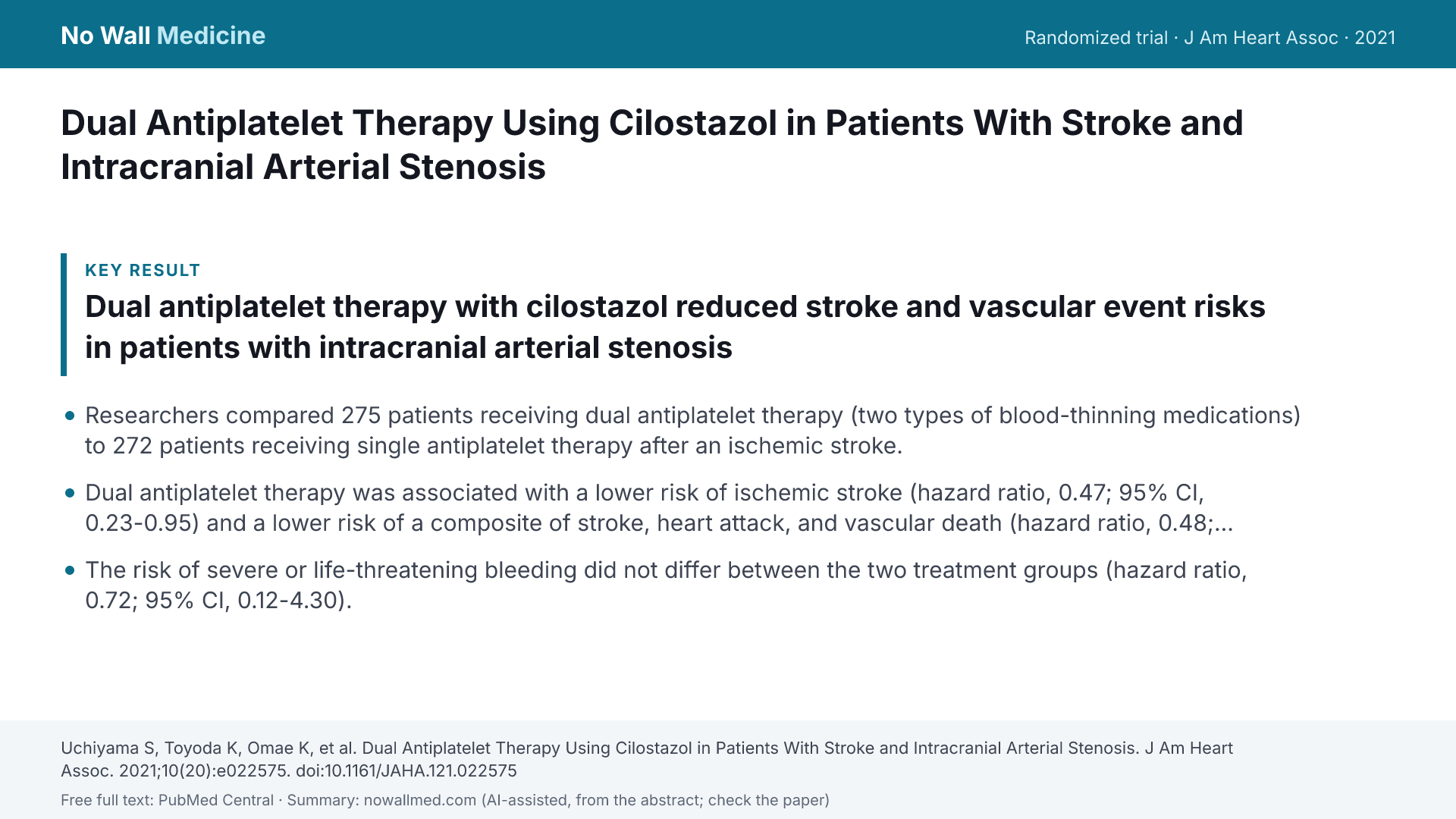
Key result: Dual antiplatelet therapy with cilostazol reduced stroke and vascular event risks in patients with intracranial arterial stenosis
Key points
- Researchers compared 275 patients receiving dual antiplatelet therapy (two types of blood-thinning medications) to 272 patients receiving single antiplatelet therapy after an ischemic stroke.
- Dual antiplatelet therapy was associated with a lower risk of ischemic stroke (hazard ratio, 0.47; 95% CI, 0.23-0.95) and a lower risk of a composite of stroke, heart attack, and vascular death (hazard ratio, 0.48; 95% CI, 0.26-0.91).
- The risk of severe or life-threatening bleeding did not differ between the two treatment groups (hazard ratio, 0.72; 95% CI, 0.12-4.30).
Why it matters: The long-term benefit of using two antiplatelet medications instead of one for preventing recurrent stroke in patients with intracranial arterial stenosis has not been established.
Discussion prompts
- Would these patients look like yours? Who was left out?
- Is the main outcome one that matters to patients?
- Is the difference large enough to change what you do?
Cite: Uchiyama S, Toyoda K, Omae K, et al. Dual Antiplatelet Therapy Using Cilostazol in Patients With Stroke and Intracranial Arterial Stenosis. J Am Heart Assoc. 2021;10(20):e022575. doi:10.1161/JAHA.121.022575
Free full text: PubMed Central · Summary and visual abstract: nowallmed.com/a/dual-antiplatelet-therapy-using-cilostazol-in-patients-with-stroke-mf5vhh/ (AI-assisted from the abstract; check the paper before relying on it).