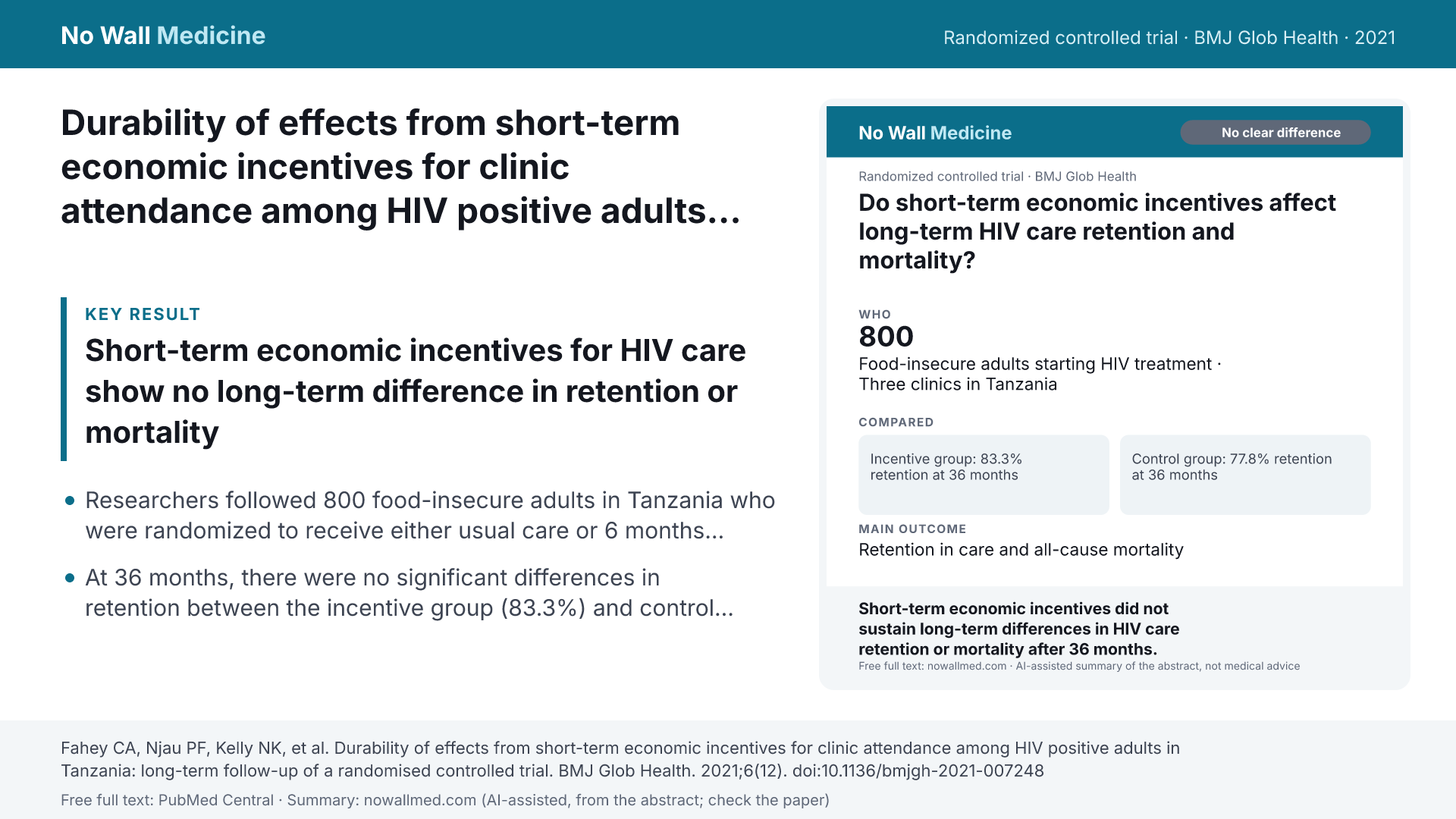
Short-term economic incentives for HIV care show no long-term difference in retention or mortality
Durability of effects from short-term economic incentives for clinic attendance among HIV positive adults in Tanzania: long-term follow-up of a randomised controlled trial
Randomized controlled trialNo clear difference
Do short-term economic incentives affect long-term HIV care retention and mortality?
Who
800
Food-insecure adults starting HIV treatment · Three clinics in Tanzania
Compared
Incentive group: 83.3% retention at 36 months
Control group: 77.8% retention at 36 months
Main outcome
Retention in care and all-cause mortality
Result: RD 5.6, -2.7 to 13.8
Bottom line: Short-term economic incentives did not sustain long-term differences in HIV care retention or mortality after 36 months.
Limitation: A minority of missing outcomes required multiple imputation.
BMJ Glob Health · 2021-12-25 · Save PNG
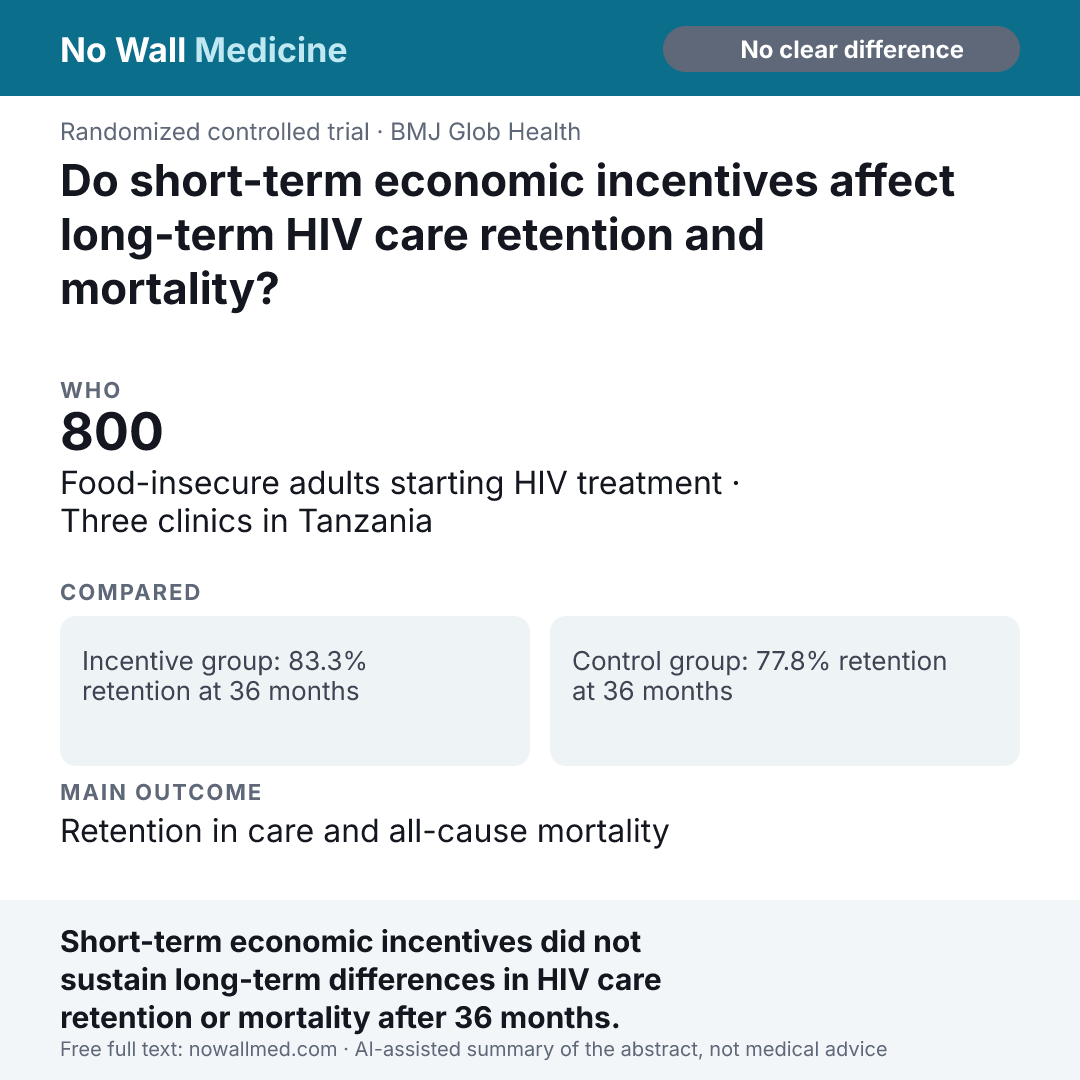
Clinical question: Do short-term economic incentives affect long-term HIV care retention and mortality?
Why it matters: The long-term harms or benefits of time-limited economic incentives for HIV medication adherence remain largely unevaluated.
Key points
- Researchers followed 800 food-insecure adults in Tanzania who were randomized to receive either usual care or 6 months of cash or food transfers for clinic attendance.
- At 36 months, there were no significant differences in retention between the incentive group (83.3%) and control group (77.8%) or in mortality rates.
- The incentive group had a lower rate of death during the first 18 months (HR 0.27, 95% CI 0.10 to 0.74), but mortality was similar after that period.
Headline and key points written with AI from the paper’s abstract, with every number checked against it. Read the paper before relying on them.
Was this summary helpful?
Abstract
Introduction
Conditional economic incentives are shown to promote medication adherence across a range of health conditions and settings; however, any long-term harms or benefits from these time-limited interventions remain largely unevaluated. We assessed 2-3 years outcomes from a 6-month incentive programme in Tanzania that originally improved short-term retention in HIV care and medication possession. Methods
We traced former participants in a 2013-2016 trial, which randomised 800 food-insecure adults starting HIV treatment at three clinics to receive either usual care (control) or up to 6 months of cash or food transfers (~US$11/month) contingent on timely attendance at monthly clinic appointments. The primary intention-to-treat analysis estimated 24-month and 36-month marginal risk differences (RD) between incentive and control groups for retention in care and all-cause mortality, using multiple imputation for a minority of missing outcomes. We also estimated mortality HRs from time-stratified Cox regression. Results
From 3 March 2018 to 19 September 2019, we determined 36-month retention and mortality statuses for 737 (92%) and 700 (88%) participants, respectively. Overall, approximately 660 (83%) participants were in care at 36 months while 43 (5%) had died. There were no differences between groups in retention at 24 months (86.5% intervention vs 84.4% control, RD 2.1, 95% CI -5.2 to 9.3) or 36 months (83.3% vs 77.8%, RD 5.6, -2.7 to 13.8), nor in mortality at either time point. The intervention group had a lower rate of death during the first 18 months (HR 0.27, 95% CI 0.10 to 0.74); mortality was similar thereafter (HR 1.13, 95% CI 0.33 to 3.79). Conclusion
These findings confirm that incentives are a safe and effective tool to promote short-term adherence and potentially avert early deaths at the critical time of HIV treatment initiation. Complementary strategies are recommended to sustain lifelong retention in HIV care. Trial registration number
NCT01957917.
Abstract reproduced under the article’s CC BY NC licence.
Subject terms
Headline, design, result, key points, caveat and citation as plain text.
Cite this article
Fahey CA, Njau PF, Kelly NK, et al. Durability of effects from short-term economic incentives for clinic attendance among HIV positive adults in Tanzania: long-term follow-up of a randomised controlled trial. BMJ Glob Health. 2021;6(12). doi:10.1136/bmjgh-2021-007248
Spotted a mistake? Suggest a correction