Triple combination therapy maintained lower blood sugar levels longer than stepwise addition therapy in type 2 diabetes
Durability of Triple Combination Therapy Versus Stepwise Addition Therapy in Patients With New-Onset T2DM: 3-Year Follow-up of EDICT
Randomized trialBenefit found
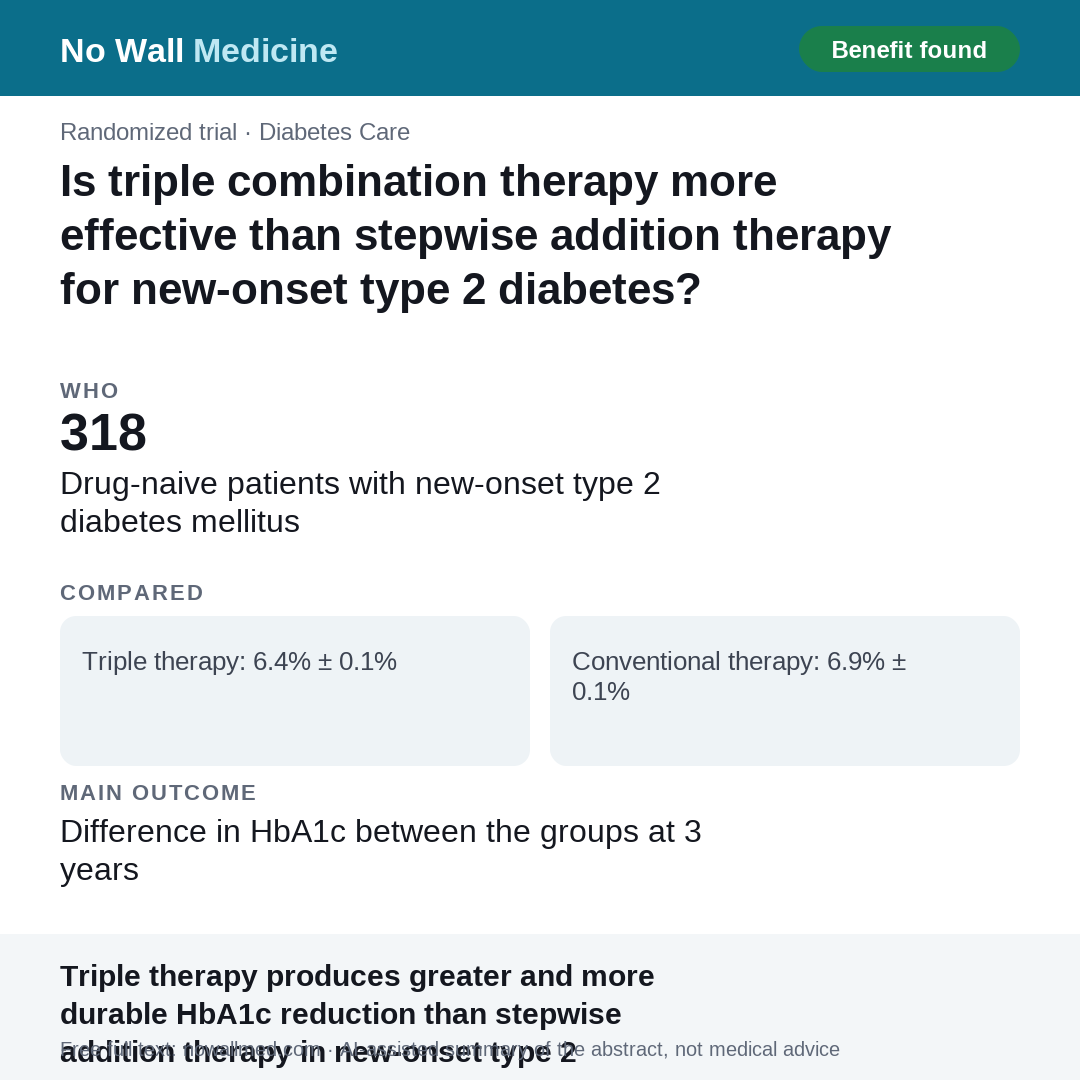
Is triple combination therapy more effective than stepwise addition therapy for new-onset type 2 diabetes?
Who
318
Drug-naive patients with new-onset type 2 diabetes mellitus
Compared
Triple therapy: 6.4% ± 0.1%
Conventional therapy: 6.9% ± 0.1%
Main outcome
Difference in HbA1c between the groups at 3 years
Result: 0.50% (95% CI 0.39-0.61)
Bottom line: Triple therapy produces greater and more durable HbA1c reduction than stepwise addition therapy in new-onset type 2 diabetes.
Diabetes Care · 2020-12-03Download image
Clinical question: Is triple combination therapy more effective than stepwise addition therapy for new-onset type 2 diabetes?
Why it matters: It is unknown whether starting with three medications simultaneously is more effective over the long term than adding medications one by one for patients newly diagnosed with type 2 diabetes.
Key points
- Researchers studied 318 patients with new-onset type 2 diabetes who were randomly assigned to receive either triple combination therapy or sequential addition of metformin, glipizide, and insulin.
- At 3 years, the triple therapy group had an HbA1c of 6.4% ± 0.1% compared to 6.9% ± 0.1% in the conventional therapy group.
- Triple therapy was associated with a threefold increase in insulin sensitivity and a 30-fold increase in beta-cell function, which is the ability of the pancreas to produce insulin.
Headline and key points written with AI from the paper’s abstract, with every number checked against it. Read the paper before relying on them.
Was this summary helpful?
Subject terms
Cite this article
Abdul-Ghani M, Puckett C, Adams J, Khattab A, Baskoy G, Cersosimo E. Durability of Triple Combination Therapy Versus Stepwise Addition Therapy in Patients With New-Onset T2DM: 3-Year Follow-up of EDICT. Diabetes Care. 2020. doi:10.2337/dc20-0978
Spotted a mistake? Suggest a correction
Top studies every Monday
The week’s key trials and guidelines in your specialties, plus any topics you follow. By email, free.
Get the weekly digest