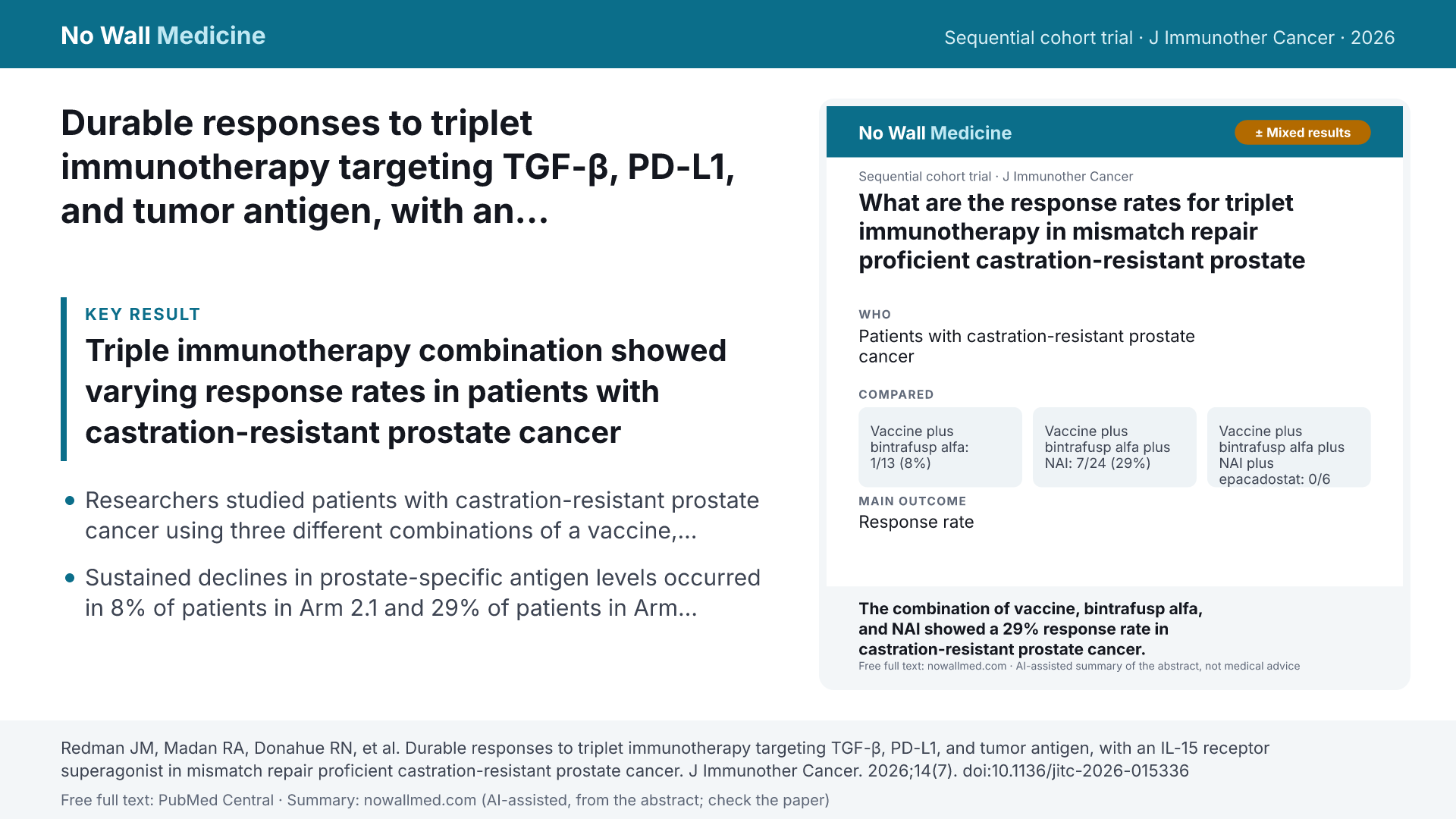
Triple immunotherapy combination showed varying response rates in patients with castration-resistant prostate cancer
Durable responses to triplet immunotherapy targeting TGF-β, PD-L1, and tumor antigen, with an IL-15 receptor superagonist in mismatch repair proficient castration-resistant prostate cancer
Sequential cohort trialMixed results
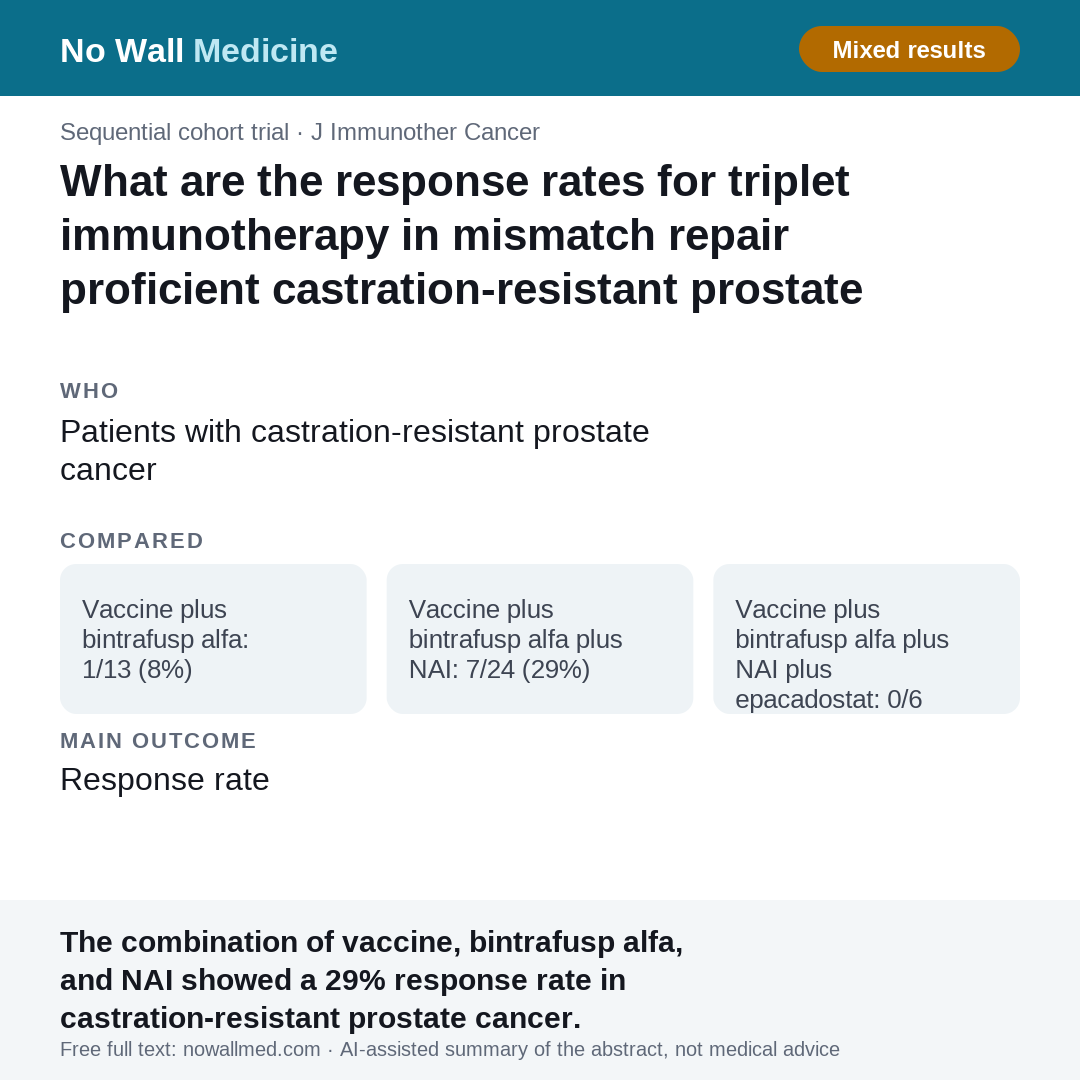
What are the response rates for triplet immunotherapy in mismatch repair proficient castration-resistant prostate cancer?
Who
Patients with castration-resistant prostate cancer
Compared
Vaccine plus bintrafusp alfa: 1/13 (8%)
Vaccine plus bintrafusp alfa plus NAI: 7/24 (29%)
Vaccine plus bintrafusp alfa plus NAI plus epacadostat: 0/6 (0%)
Main outcome
Response rate
Bottom line: The combination of vaccine, bintrafusp alfa, and NAI showed a 29% response rate in castration-resistant prostate cancer.
J Immunother Cancer · 2026-07-24Download image
Clinical question: What are the response rates for triplet immunotherapy in mismatch repair proficient castration-resistant prostate cancer?
Why it matters: Immune checkpoint blockade is minimally active in unselected castration-resistant prostate cancer and does not reliably produce lasting decreases in prostate-specific antigen levels.
Key points
- Researchers studied patients with castration-resistant prostate cancer using three different combinations of a vaccine, an interleukin-15 receptor superagonist, and a dual inhibitor of PD-L1 and TGF-beta.
- Sustained declines in prostate-specific antigen levels occurred in 8% of patients in Arm 2.1 and 29% of patients in Arm 2.2, while 0% of patients in Arm 2.3 responded.
- Five individuals in the first two treatment arms developed isolated adrenocorticotropic hormone deficiency, and Arm 2.3 was closed early due to skin toxicity.
Headline and key points written with AI from the paper’s abstract, with every number checked against it. Read the paper before relying on them.
Was this summary helpful?
Abstract
Background
Immune checkpoint blockade is minimally active in unselected castration-resistant prostate cancer (CRPC) and does not reproducibly yield durable decreases in prostate-specific antigen (PSA) levels. Methods
The Quick Efficacy Seeking Trial was designed to employ a combination of agents to initiate an immune response (with BN-Brachyury vaccine), potentiate that response (with nogapendekin-alfa inbakicept (NAI), an interleukin (IL)-15 receptor superagonist), and reduce or eliminate immunosuppressive entities in the tumor microenvironment (with bintrafusp alfa, a dual inhibitor of programmed death-ligand 1 and transforming growth factor beta). Epacadostat (an indoleamine 2,3-dioxygenase (IDO) inhibitor) was also employed in one cohort to reduce immune suppression induced by IDO's conversion of tryptophan to kynurenine. Results
Patients with CRPC enrolled sequentially to receive vaccine + bintrafusp alfa (Arm 2.1), vaccine + bintrafusp alfa + NAI (Arm 2.2), and vaccine + bintrafusp alfa + NAI + epacadostat (Arm 2.3), with the primary objective to determine response rate. Adverse events in Arms 2.1 and 2.2 were manageable and consistent with the safety profiles of each agent individually, and notable for five individuals developing isolated adrenocorticotropic hormone deficiency. Arm 2.3 was closed early due to skin toxicity. Sustained declines in PSA were seen in 1/13 (8%) patients in Arm 2.1, 7/24 (29%) patients in Arm 2.2, including six with proficient mismatch repair/microsatellite stable tumors, and 0/6 (0%) patients in Arm 2.3. Conclusions
Analyses of peripheral immune profiles provided evidence of a multifaceted antitumor immune response, including IL-15 receptor superagonist NAI-dependent expansion and activation of natural killer cells and CD8+ T cells, increased effector-to-suppressor immune cell ratios, and induction of cytotoxic immune gene programs. Trial registration number
NCT03493945.
Abstract reproduced under the article’s CC BY NC licence.
Subject terms
Cite this article
Redman JM, Madan RA, Donahue RN, et al. Durable responses to triplet immunotherapy targeting TGF-β, PD-L1, and tumor antigen, with an IL-15 receptor superagonist in mismatch repair proficient castration-resistant prostate cancer. J Immunother Cancer. 2026. doi:10.1136/jitc-2026-015336
Spotted a mistake? Suggest a correction