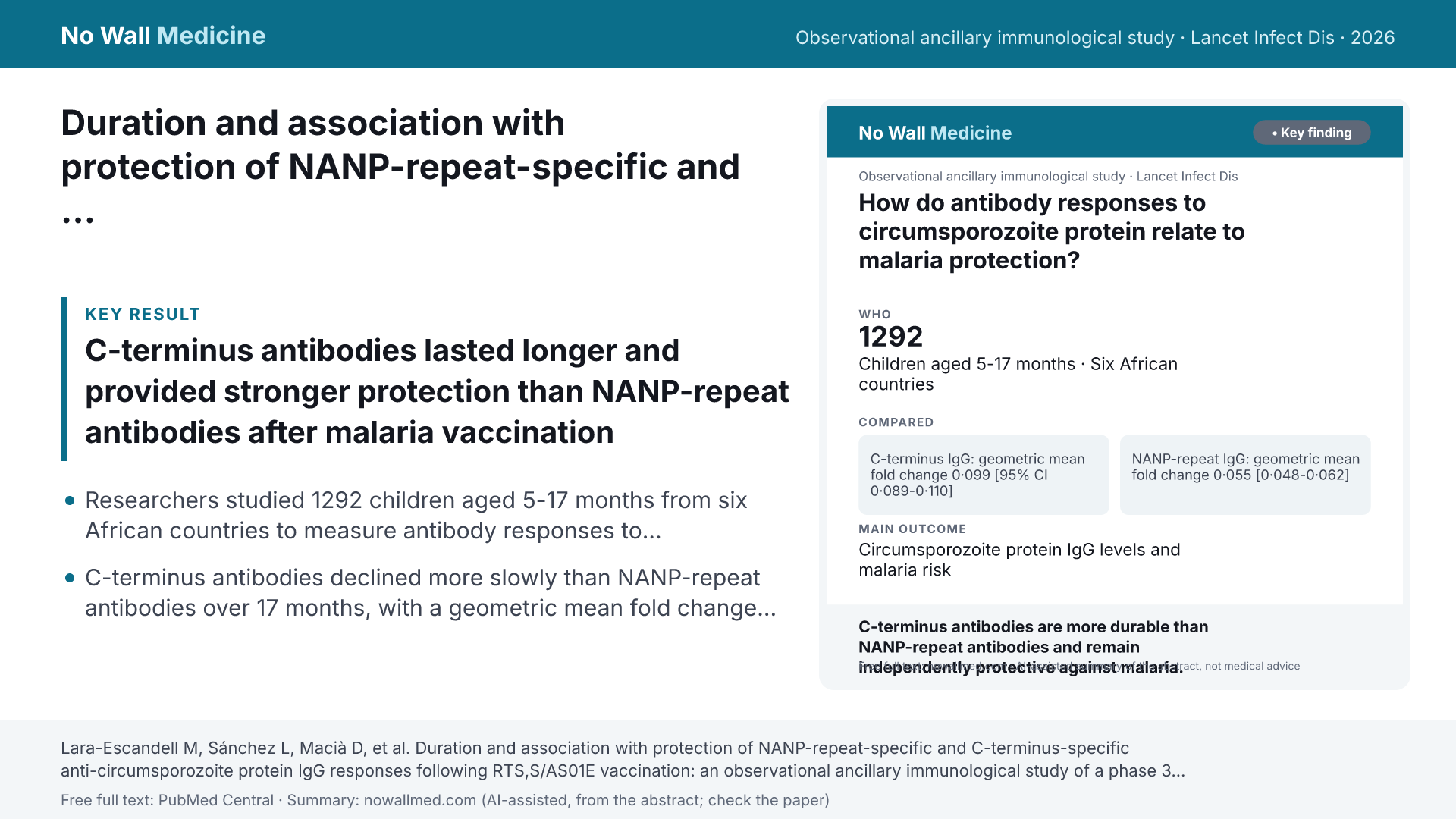
C-terminus antibodies lasted longer and provided stronger protection than NANP-repeat antibodies after malaria vaccination
Duration and association with protection of NANP-repeat-specific and C-terminus-specific anti-circumsporozoite protein IgG responses following RTS,S/AS01E vaccination: an observational ancillary immunological study of a phase 3 clinical trial
Observational ancillary immunological studyKey finding
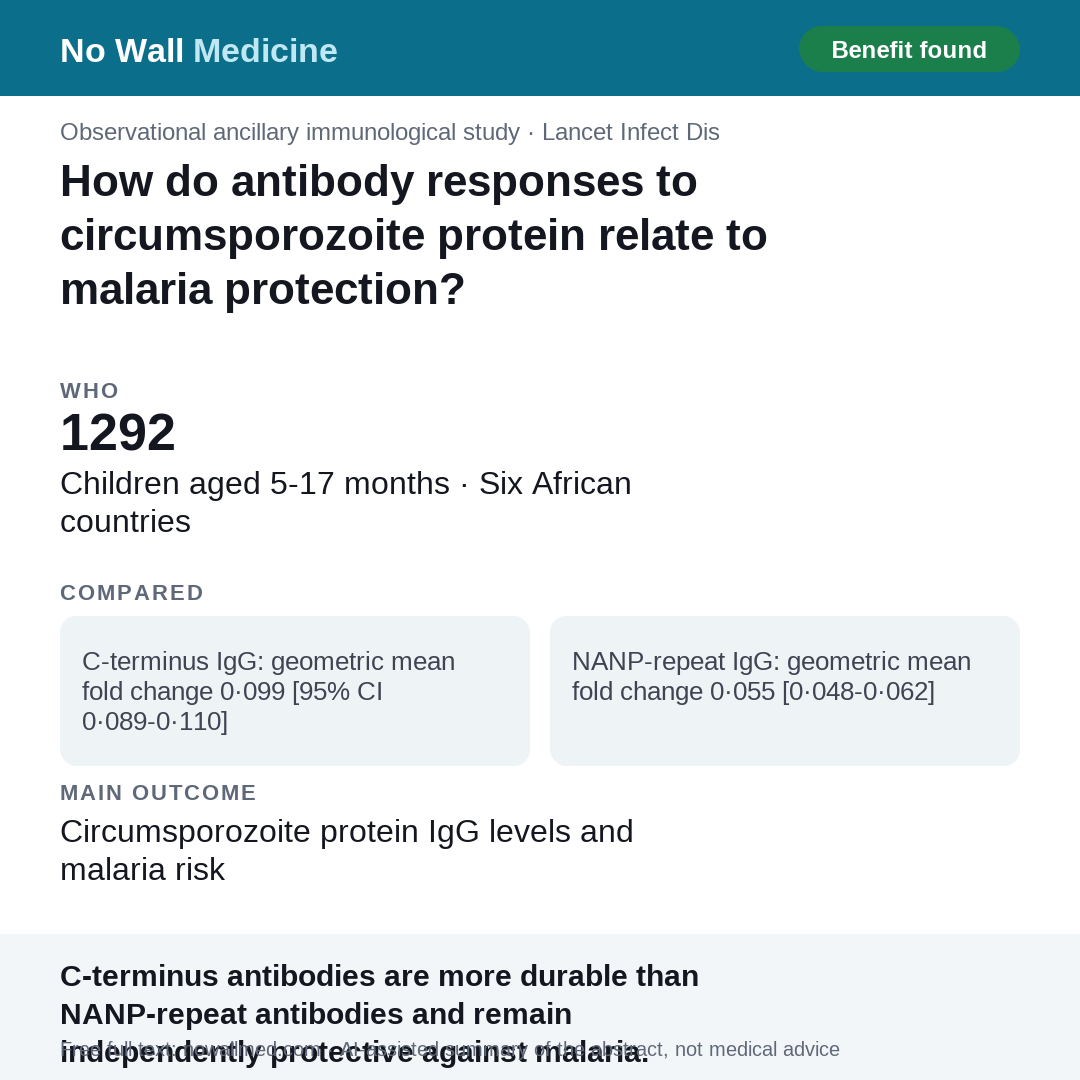
How do antibody responses to circumsporozoite protein relate to malaria protection?
Who
1292
Children aged 5-17 months · Six African countries
Compared
C-terminus IgG: geometric mean fold change 0·099 [95% CI 0·089-0·110]
NANP-repeat IgG: geometric mean fold change 0·055 [0·048-0·062]
Main outcome
Circumsporozoite protein IgG levels and malaria risk
Result: hazard ratio 0·60, 95% CI 0·43-0·83
Bottom line: C-terminus antibodies are more durable than NANP-repeat antibodies and remain independently protective against malaria.
Funded by: National Institute of Allergy and Infectious Diseases and others
Lancet Infect Dis · 2026-04-21Download image
Clinical question: How do antibody responses to circumsporozoite protein relate to malaria protection?
Why it matters: It is not fully known how long vaccine-induced antibodies last or how responses to the C-terminus of the circumsporozoite protein relate to protection.
Key points
- Researchers studied 1292 children aged 5-17 months from six African countries to measure antibody responses to the RTS,S/AS01E malaria vaccine.
- C-terminus antibodies declined more slowly than NANP-repeat antibodies over 17 months, with a geometric mean fold change of 0.099 versus 0.055.
- Higher levels of C-terminus antibodies were associated with a reduced malaria risk, showing a hazard ratio of 0.60.
Headline and key points written with AI from the paper’s abstract, with every number checked against it. Read the paper before relying on them.
Was this summary helpful?
Abstract
Background
The RTS,S/AS01E malaria vaccine provides partial protection against Plasmodium falciparum, largely mediated by antibodies targeting the circumsporozoite protein. Correlates of protection remain incompletely defined and have focused mainly on peak IgG responses to the immunodominant NANP-repeats, with less known about antibody durability or responses to the C-terminus of circumsporozoite protein. Methods
In this observational study, we evaluated IgG responses to NANP-repeat, C-terminus, and full-length circumsporozoite protein constructs at five timepoints before and after primary and booster vaccination, in children aged 5-17 months from six African countries enrolled in the RTS,S/AS01E phase 3 trial (NCT00866619, 2009-11). Antibody kinetics were analysed with linear regressions, and associations with clinical malaria risk over 1 year with Cox models. Findings
Between May 25, 2009, to March 5, 2010, 1292 children were recruited and included for analysis in this study. IgG levels declined more slowly for C-terminus than for NANP-repeat over 17 months after primary vaccination (geometric mean fold change 0·099 [95% CI 0·089-0·110] vs 0·055 [0·048-0·062]; p<0·0001). The booster significantly enhanced C-terminal IgG, exceeding post-primary peak levels (geometric mean fold change 1·98 [95% CI 1·77-2·21]), whereas NANP-repeat responses were restored but remained below post-primary levels (geometric mean fold changes 0·57 [95% CI 0·51-0·63]). Higher circumsporozoite protein IgG levels correlated with reduced malaria risk, particularly during maintenance phases, with stronger associations for C-terminus, which remained independently protective after adjustment for NANP-repeat antibodies (hazard ratio 0·60, 95% CI 0·43-0·83; p=0·0021). After boosting, maintenance but not peak IgG levels correlated with reduced malaria risk. Interpretation
IgG to circumsporozoite protein C-terminus are more durable than those to the NANP-repeats. Antibody maintenance emerges as a stronger predictor of RTS,S/AS01E vaccine efficacy than peak responses. Funding
USA National Institute of Allergy and Infectious Diseases, National Institutes of Health; PATH and Malaria Vaccine Initiative; Spanish Ministerio de Economía y Competitividad; Instituto de Salud Carlos III; CERCA programme; and Secretaria d'Universitats i Recerca del Departament d'Empresa i Coneixement, Generalitat de Catalunya.
Abstract reproduced under the article’s CC BY NC ND licence.
Subject terms
Cite this article
Lara-Escandell M, Sánchez L, Macià D, et al. Duration and association with protection of NANP-repeat-specific and C-terminus-specific anti-circumsporozoite protein IgG responses following RTS,S/AS01E vaccination: an observational ancillary immunological study of a phase 3 clinical trial. Lancet Infect Dis. 2026;26(8):832-842. doi:10.1016/S1473-3099(26)00081-2
Spotted a mistake? Suggest a correction