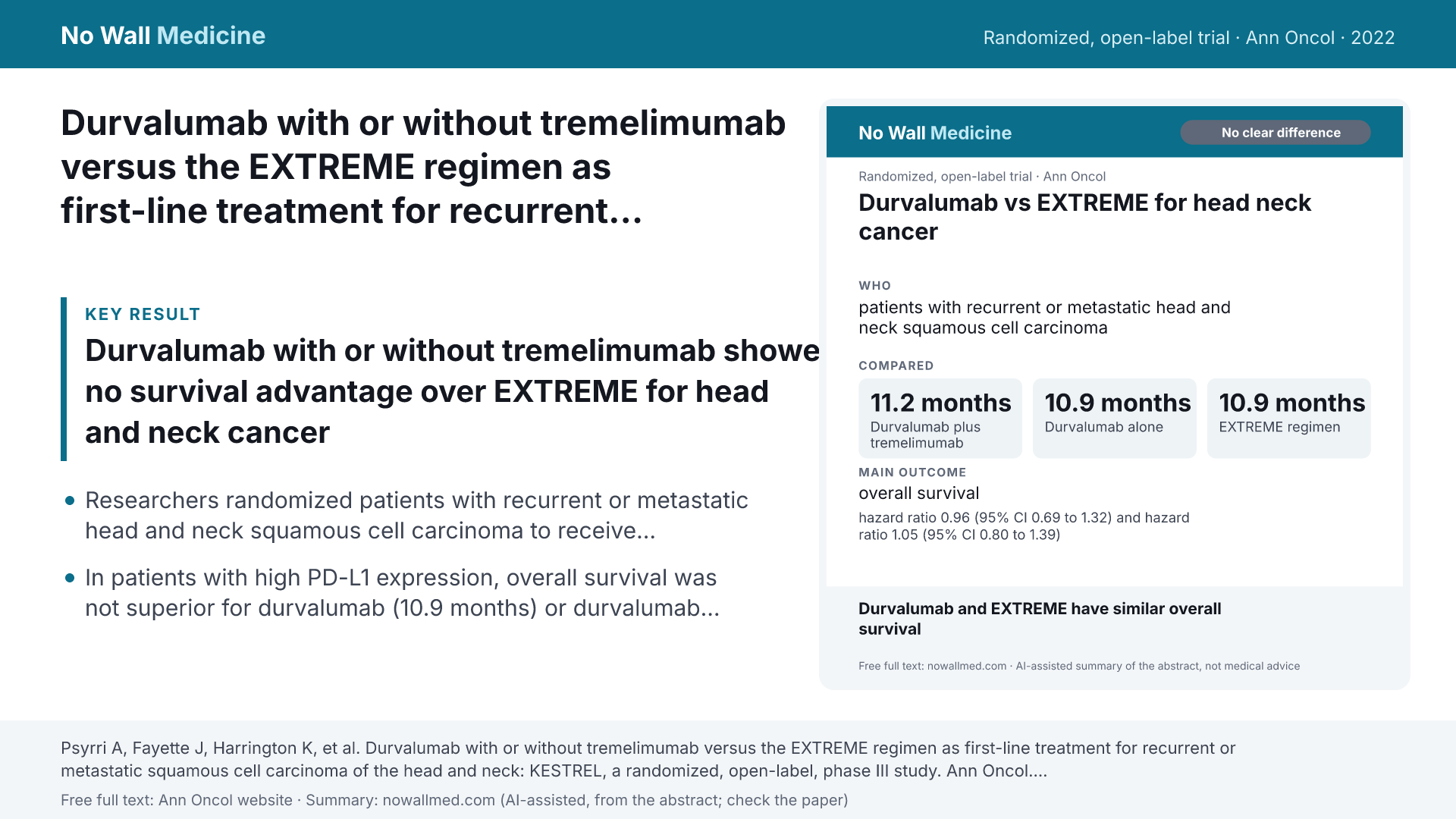
Durvalumab with or without tremelimumab showed no survival advantage over EXTREME for head and neck cancer
Durvalumab with or without tremelimumab versus the EXTREME regimen as first-line treatment for recurrent or metastatic squamous cell carcinoma of the head and neck: KESTREL, a randomized, open-label, phase III study
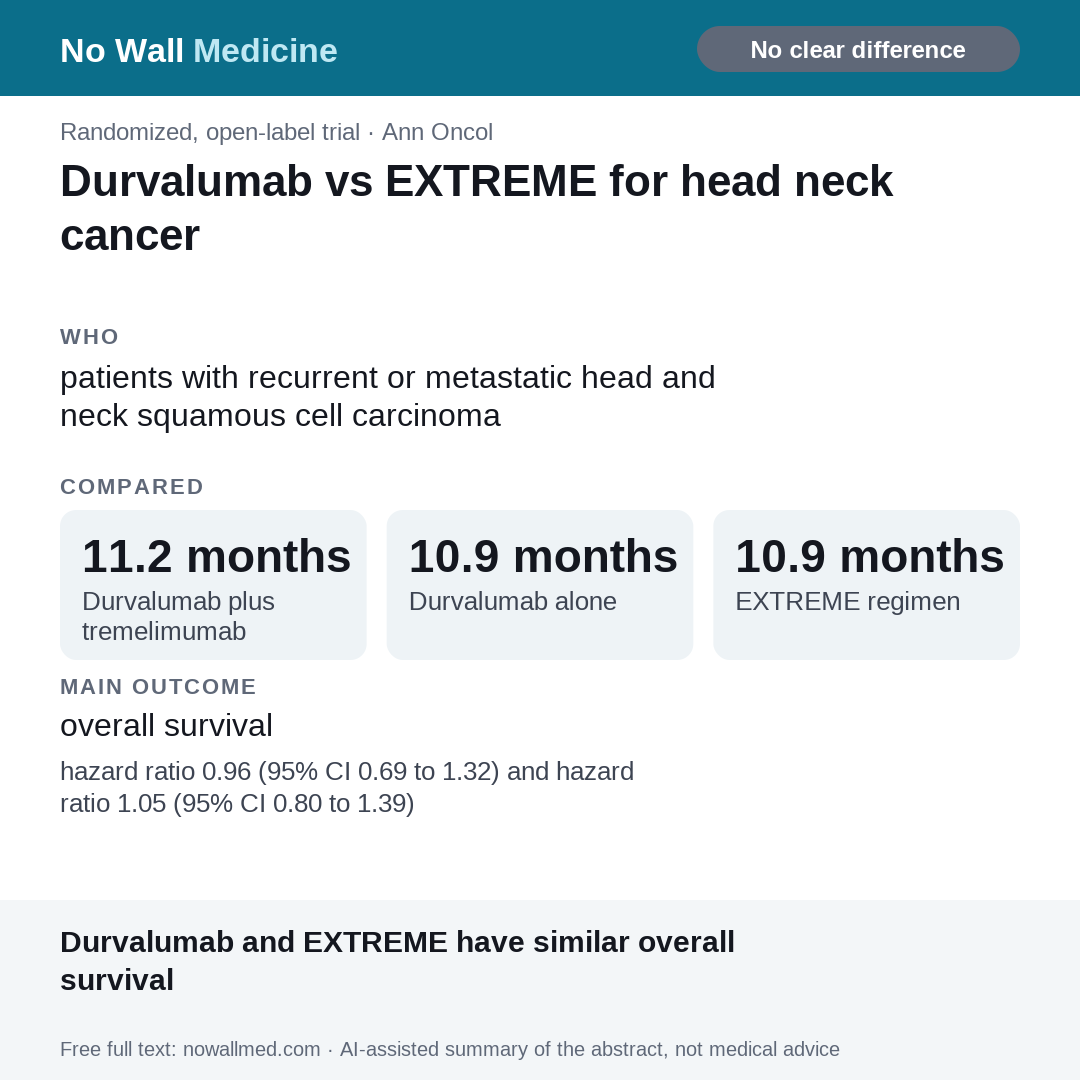
Randomized, open-label trialNo clear difference
Durvalumab vs EXTREME for head neck cancer
Who
patients with recurrent or metastatic head and neck squamous cell carcinoma
Compared
11.2 monthsDurvalumab plus tremelimumab
10.9 monthsDurvalumab alone
10.9 monthsEXTREME regimen
Main outcome
overall survival
Result: hazard ratio 0.96 (95% CI 0.69 to 1.32) and hazard ratio 1.05 (95% CI 0.80 to 1.39)
Bottom line: Durvalumab and EXTREME have similar overall survival
Limitation: subsequent immunotherapy use affected outcomes
Ann Oncol · 2022-12-16Download image
Why it matters: It was unknown if adding immunotherapy to durvalumab or using durvalumab alone would improve survival compared to the standard EXTREME chemotherapy regimen in patients with recurrent or metastatic head and neck squamous cell carcinoma.
Key points
- Researchers randomized patients with recurrent or metastatic head and neck squamous cell carcinoma to receive durvalumab plus tremelimumab, durvalumab alone, or the EXTREME chemotherapy regimen.
- In patients with high PD-L1 expression, overall survival was not superior for durvalumab (10.9 months) or durvalumab plus tremelimumab (11.2 months) compared to EXTREME (10.9 months).
- Grade 3/4 treatment-related adverse events were 8.9% for durvalumab, 19.1% for durvalumab plus tremelimumab, and 53.1% for the EXTREME regimen.
Headline and key points written with AI from the paper’s abstract, with every number checked against it. Read the paper before relying on them.
Was this summary helpful?
Subject terms
Cite this article
Psyrri A, Fayette J, Harrington K, et al. Durvalumab with or without tremelimumab versus the EXTREME regimen as first-line treatment for recurrent or metastatic squamous cell carcinoma of the head and neck: KESTREL, a randomized, open-label, phase III study. Ann Oncol. 2022. doi:10.1016/j.annonc.2022.12.008
Spotted a mistake? Suggest a correction