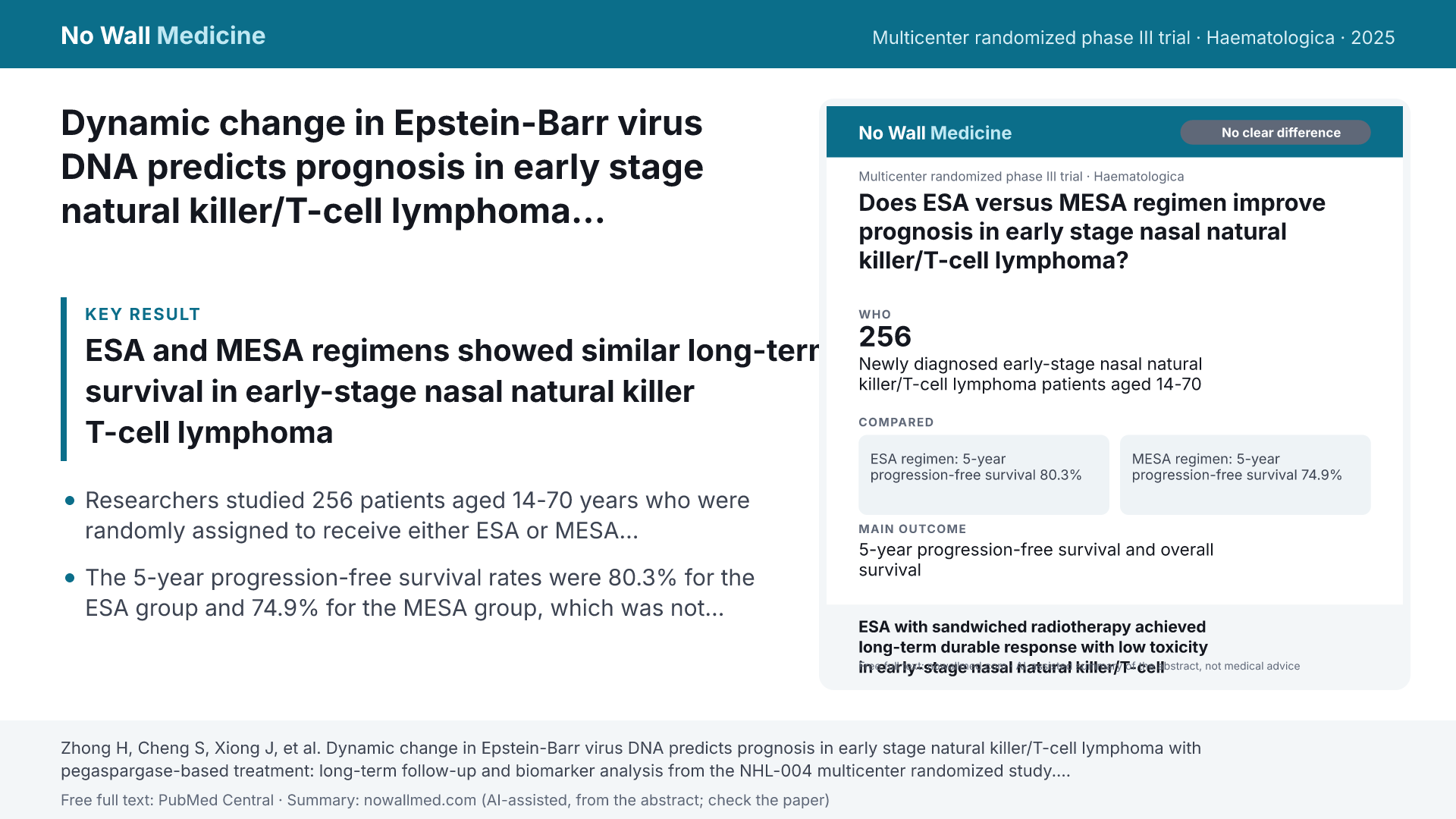
ESA and MESA regimens showed similar long-term survival in early-stage nasal natural killer T-cell lymphoma
Dynamic change in Epstein-Barr virus DNA predicts prognosis in early stage natural killer/T-cell lymphoma with pegaspargase-based treatment: long-term follow-up and biomarker analysis from the NHL-004 multicenter randomized study
Multicenter randomized phase III trialNo clear difference
Does ESA versus MESA regimen improve prognosis in early stage nasal natural killer/T-cell lymphoma?
Who
256
Newly diagnosed early-stage nasal natural killer/T-cell lymphoma patients aged 14-70 years · Multicenter
Compared
ESA regimen: 5-year progression-free survival 80.3%
MESA regimen: 5-year progression-free survival 74.9%
Main outcome
5-year progression-free survival and overall survival
Result: hazard ratio 0.78 (95% CI 0.46-1.33)
Bottom line: ESA with sandwiched radiotherapy achieved long-term durable response with low toxicity in early-stage nasal natural killer/T-cell lymphoma.
Haematologica · 2025-04-10 · Save PNG
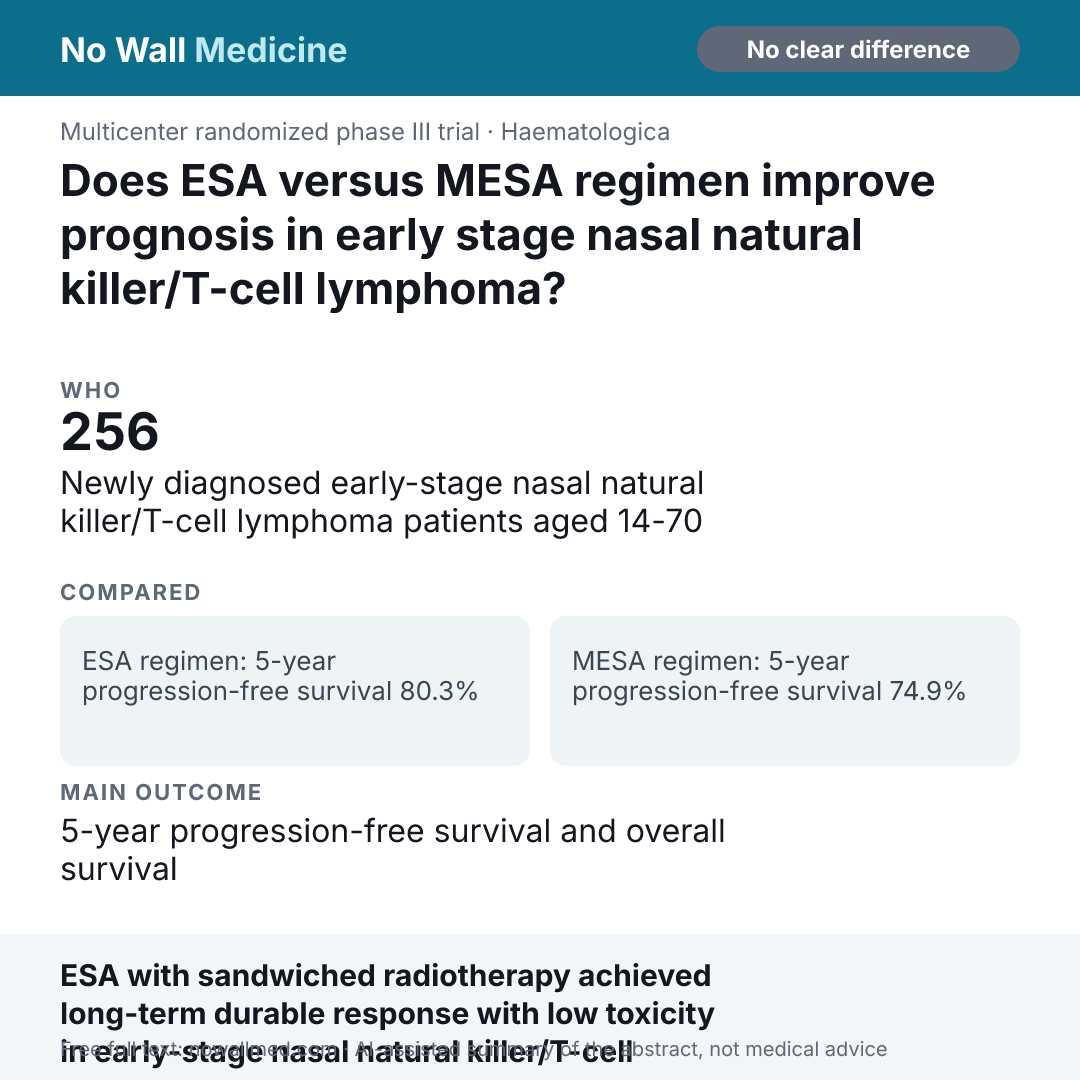
Clinical question: Does ESA versus MESA regimen improve prognosis in early stage nasal natural killer/T-cell lymphoma?
Key points
- Researchers studied 256 patients aged 14-70 years who were randomly assigned to receive either ESA or MESA treatment combined with radiotherapy.
- The 5-year progression-free survival rates were 80.3% for the ESA group and 74.9% for the MESA group, which was not a statistically significant difference.
- Interim plasma Epstein-Barr virus DNA positivity was an independent predictor of inferior progression-free survival and overall survival.
Headline and key points written with AI from the paper’s abstract, with every number checked against it. Read the paper before relying on them.
Was this summary helpful?
Subject terms
Headline, design, result, key points, caveat and citation as plain text.
Cite this article
Zhong H, Cheng S, Xiong J, et al. Dynamic change in Epstein-Barr virus DNA predicts prognosis in early stage natural killer/T-cell lymphoma with pegaspargase-based treatment: long-term follow-up and biomarker analysis from the NHL-004 multicenter randomized study. Haematologica. 2025;110(11):2714-2725. doi:10.3324/haematol.2025.287513
Spotted a mistake? Suggest a correction