Dynamic Prevalence of Sleep Disorders Following Stroke or Transient Ischemic Attack: Systematic Review and Meta-Analysis
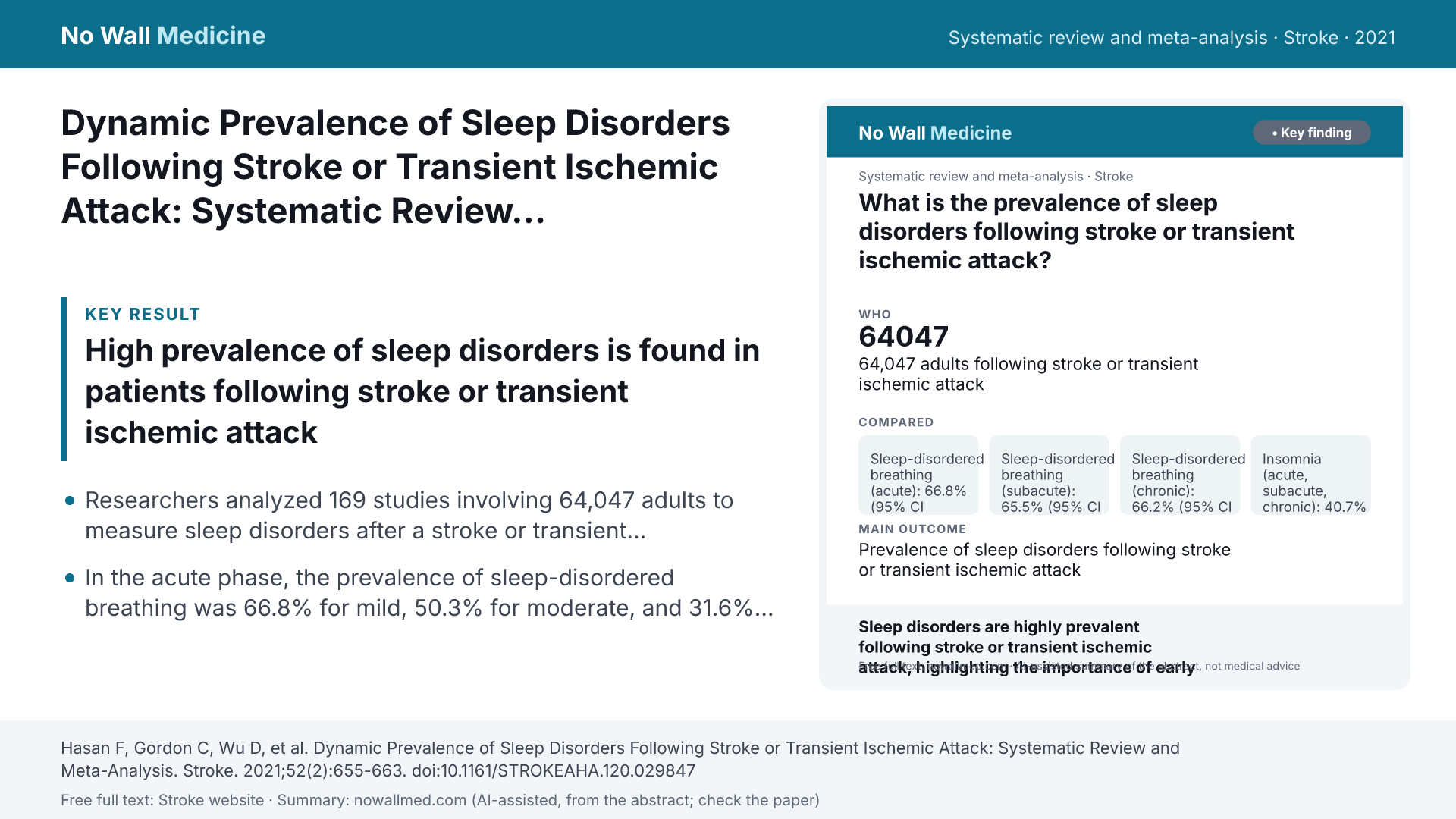
Key result: High prevalence of sleep disorders is found in patients following stroke or transient ischemic attack
Systematic review and meta-analysisKey finding
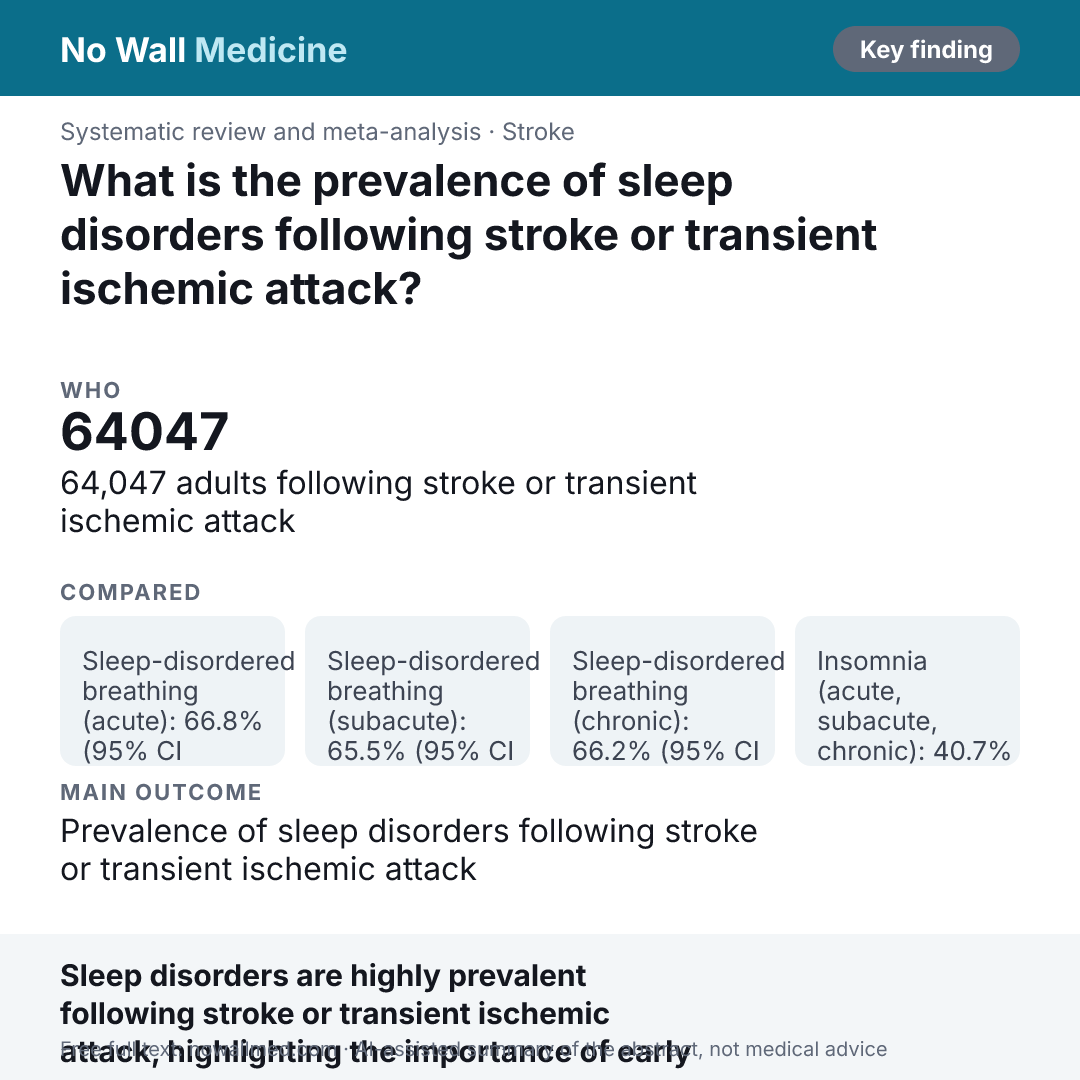
What is the prevalence of sleep disorders following stroke or transient ischemic attack?
Who
64047
64,047 adults following stroke or transient ischemic attack
Compared
Sleep-disordered breathing (acute): 66.8% (95% CI 63.8-69.7) mild, 50.3% (95% CI 41.9-58.7) moderate, 31.6% (95% CI 24.9-39.1) severe
Sleep-disordered breathing (subacute): 65.5% (95% CI 58.9-71.5) mild, 44.3% (95% CI 36.1-52.8) moderate, 36.1% (95% CI 22.2-52.8) severe
Sleep-disordered breathing (chronic): 66.2% (95% CI 58.6-73.1) mild, 33.1% (95% CI 24.8-42.6) moderate, 25.1% (95% CI 10.9-47.6) severe
Insomnia (acute, subacute, chronic): 40.7% (95% CI 31.8-50.3), 42.6% (95% CI 31.7-54.1), 35.9% (95% CI 28.6-44.0)
Main outcome
Prevalence of sleep disorders following stroke or transient ischemic attack
Bottom line: Sleep disorders are highly prevalent following stroke or transient ischemic attack, highlighting the importance of early screening and treatment.
Stroke · 2021-01-07 · Save PNG
Key points
- Researchers analyzed 169 studies involving 64,047 adults to measure sleep disorders after a stroke or transient ischemic attack, which is a temporary blockage of blood flow to the brain.
- In the acute phase, the prevalence of sleep-disordered breathing was 66.8% for mild, 50.3% for moderate, and 31.6% for severe cases.
- Insomnia prevalence was 40.7% in the acute phase, 42.6% in the subacute phase, and 35.9% in the chronic phase.
Discussion prompts
- Would these patients look like yours? Who was left out?
- Is the main outcome one that matters to patients?
- Is the difference large enough to change what you do?
Cite: Hasan F, Gordon C, Wu D, et al. Dynamic Prevalence of Sleep Disorders Following Stroke or Transient Ischemic Attack: Systematic Review and Meta-Analysis. Stroke. 2021;52(2):655-663. doi:10.1161/STROKEAHA.120.029847
Free full text: Stroke website · Summary and visual abstract: nowallmed.com/a/dynamic-prevalence-of-sleep-disorders-following-stroke-or-transient-6d69cb/ (AI-assisted from the abstract; check the paper before relying on it).