Dynamic Testing for Differential Diagnosis of ACTH-Dependent Cushing Syndrome: A Systematic Review and Meta-analysis
Systematic review and meta-analysisBenefit found
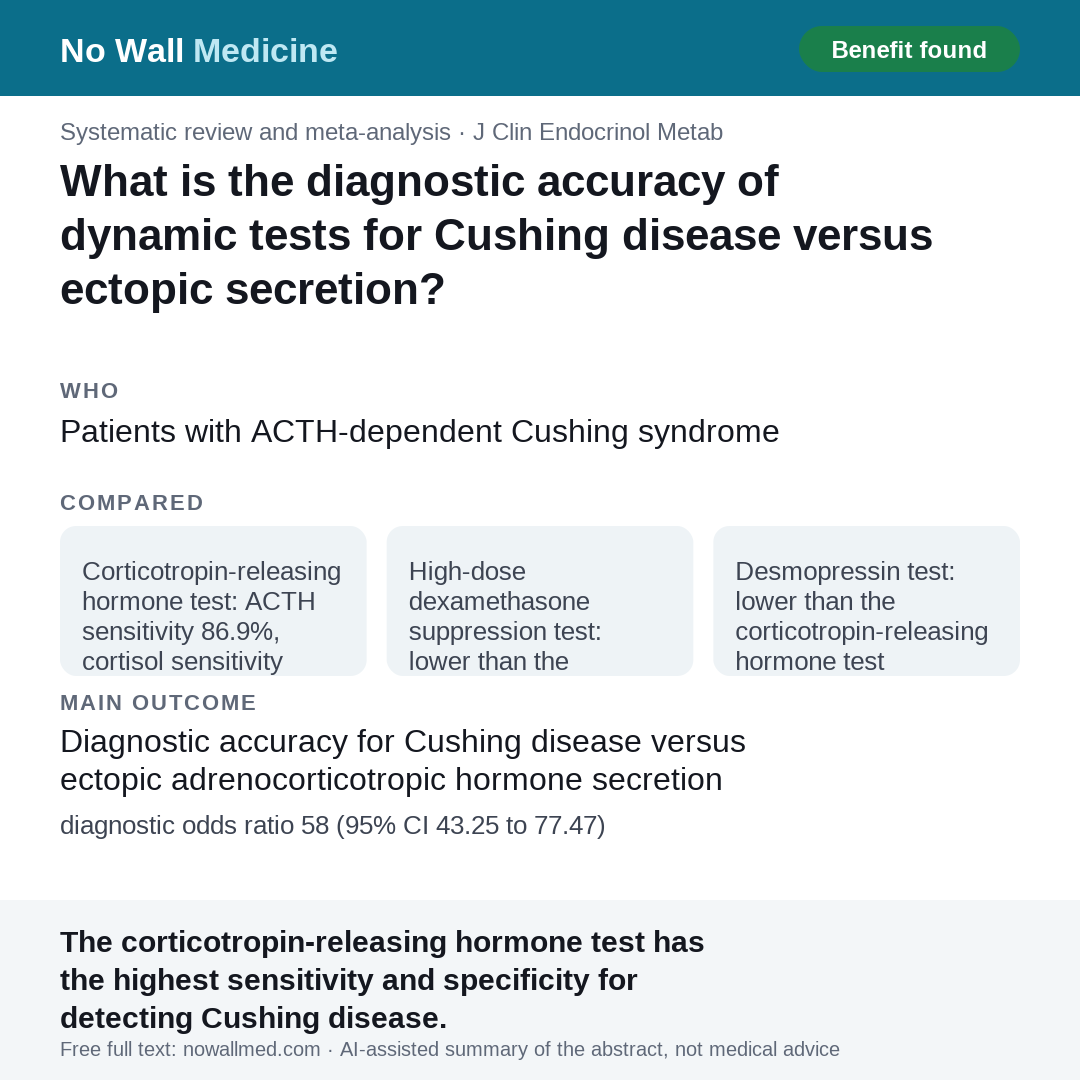
What is the diagnostic accuracy of dynamic tests for Cushing disease versus ectopic secretion?
Who
Patients with ACTH-dependent Cushing syndrome
Compared
Corticotropin-releasing hormone test: ACTH sensitivity 86.9%, cortisol sensitivity 86.2%
High-dose dexamethasone suppression test: lower than the corticotropin-releasing hormone test
Desmopressin test: lower than the corticotropin-releasing hormone test
Main outcome
Diagnostic accuracy for Cushing disease versus ectopic adrenocorticotropic hormone secretion
Result: diagnostic odds ratio 58 (95% CI 43.25 to 77.47)
Bottom line: The corticotropin-releasing hormone test has the highest sensitivity and specificity for detecting Cushing disease.
J Clin Endocrinol Metab · 2022-12-02Download image
Clinical question: What is the diagnostic accuracy of dynamic tests for Cushing disease versus ectopic secretion?
Abstract
Context
Diagnostic accuracy of testing currently used for the differential diagnosis of Cushing disease (CD) vs ectopic adrenocorticotropic hormone secretion (EAS) is difficult to interpret. Objective
The present study aimed to identify and evaluate the diagnostic accuracy of the corticotropin-releasing hormone (CRH) test, the desmopressin test, and the high-dose dexamethasone suppression test (HDDST) when used to establish a CD or EAS diagnosis. Methods
This study is a systematic review of the literature and meta-analysis. MEDLINE, OVID, and Web of Science databases were searched for articles published between 1990 and 2021. Articles included described at least 1 test(s) (CRH, desmopressin, or HDDST) and the diagnostic reference standard(s) (histopathology, petrosal sinus sampling, surgical remission, imaging, and long-term follow-up) used to establish a CD or EAS diagnosis. Results
Sixty-two studies were included: 43 reported the use of the HDDST; 32, the CRH test; and the 21, the desmopressin test. The CRH test was found to have the highest sensitivity in detecting CD (ACTH 86.9%, 95% CI 82.1-90.6, cortisol 86.2%, 95% CI 78.3-91.5) and the highest specificity in detecting EAS (ACTH 93.9%, 95% CI 87-98.3, cortisol 89.4%, 95% CI 82.8-93.7). This resulted in a high diagnostic odds ratio (58, 95% CI 43.25-77.47), large area under the curve, and a receiver operating characteristic of 0.934. The diagnostic accuracy of the HDDST and desmopressin test was lower than that of the CRH test. Conclusion
The meta-analysis indicates that a patient with a positive ACTH response after a CRH test is highly likely to have CD. Further studies analyzing role of dynamic testing in addition to imaging are needed.
Subject terms
Cite this article
Ceccato F, Barbot M, Mondin A, Boscaro M, Fleseriu M, Scaroni C. Dynamic Testing for Differential Diagnosis of ACTH-Dependent Cushing Syndrome: A Systematic Review and Meta-analysis. J Clin Endocrinol Metab. 2022. doi:10.1210/clinem/dgac686
Spotted a mistake? Suggest a correction
Top studies every Monday
The week’s key trials and guidelines in your specialties, plus any topics you follow. By email, free.
Get the weekly digest