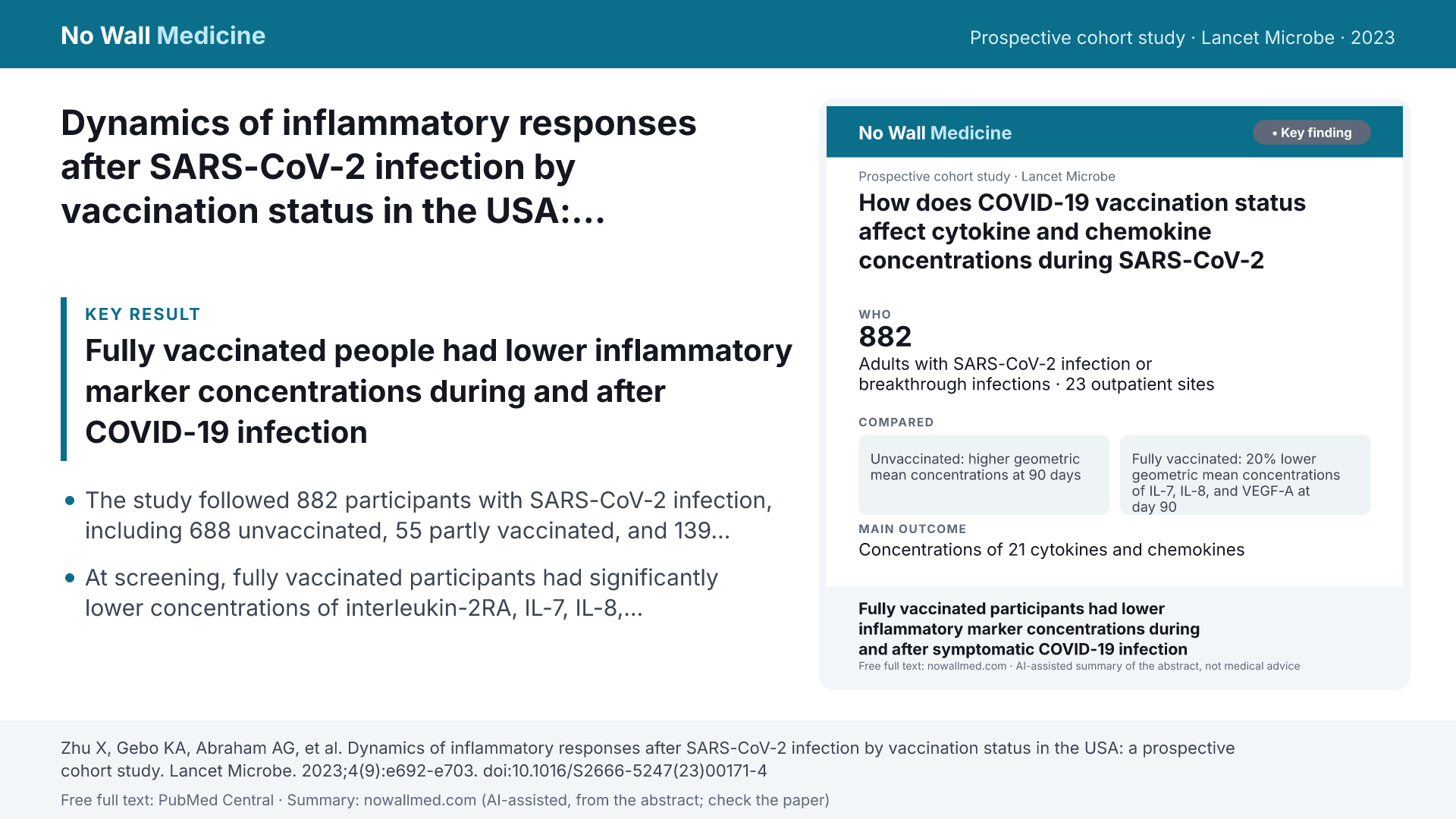
Fully vaccinated people had lower inflammatory marker concentrations during and after COVID-19 infection
Dynamics of inflammatory responses after SARS-CoV-2 infection by vaccination status in the USA: a prospective cohort study
Prospective cohort studyKey finding
How does COVID-19 vaccination status affect cytokine and chemokine concentrations during SARS-CoV-2 infection?
Who
882
Adults with SARS-CoV-2 infection or breakthrough infections · 23 outpatient sites in the USA
Compared
Unvaccinated: higher geometric mean concentrations at 90 days
Fully vaccinated: 20% lower geometric mean concentrations of IL-7, IL-8, and VEGF-A at day 90
Main outcome
Concentrations of 21 cytokines and chemokines
Bottom line: Fully vaccinated participants had lower inflammatory marker concentrations during and after symptomatic COVID-19 infection compared to unvaccinated participants.
Funded by: US Department of Defense, NIH, Bloomberg Philanthropies, and others
Lancet Microbe · 2023-08-07 · Save PNG
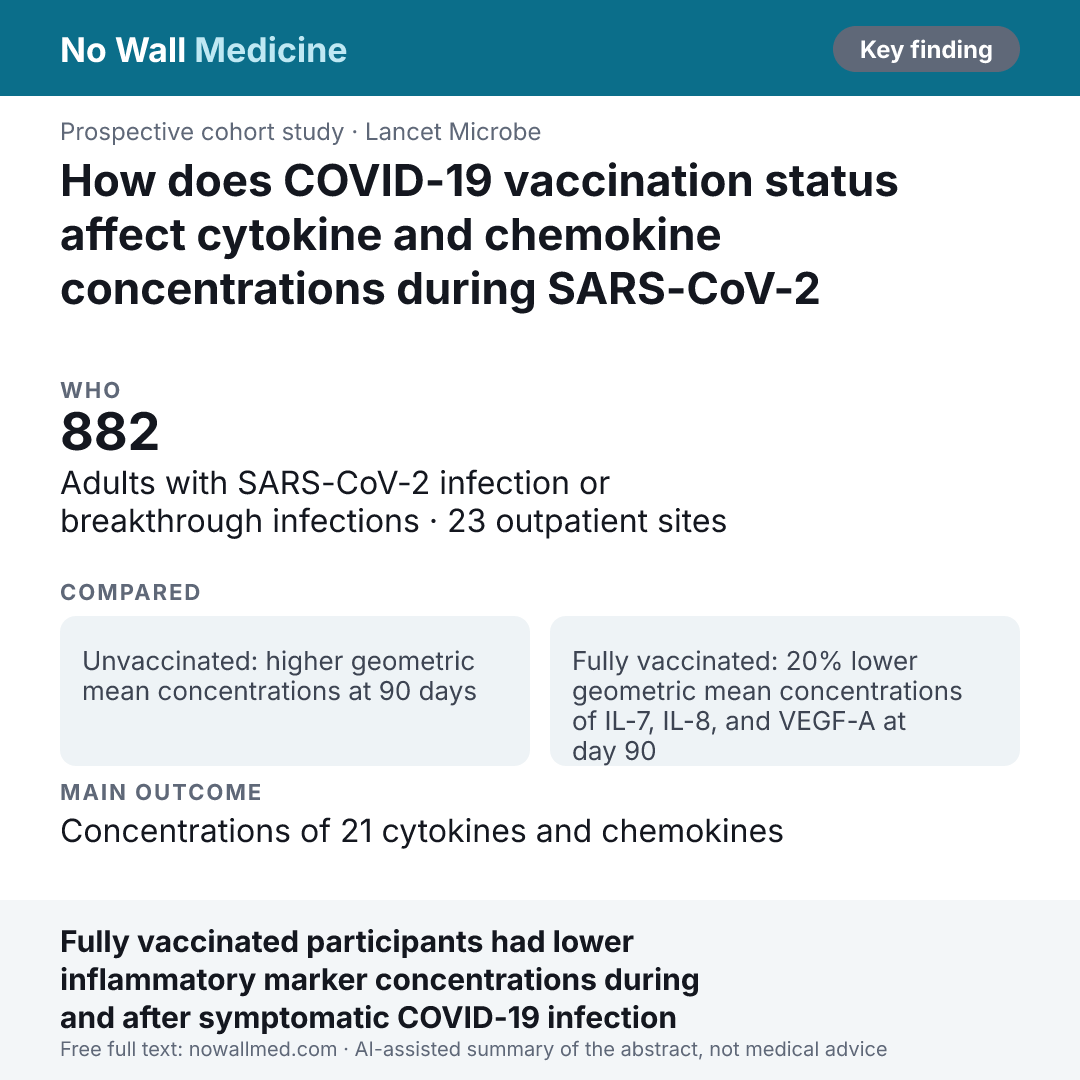
Clinical question: How does COVID-19 vaccination status affect cytokine and chemokine concentrations during SARS-CoV-2 infection?
Key points
- The study followed 882 participants with SARS-CoV-2 infection, including 688 unvaccinated, 55 partly vaccinated, and 139 fully vaccinated individuals.
- At screening, fully vaccinated participants had significantly lower concentrations of interleukin-2RA, IL-7, IL-8, IL-15, IL-29, inducible protein-10, monocyte chemoattractant protein-1, and tumour necrosis factor-α.
- By day 90, fully vaccinated participants had approximately 20% lower geometric mean concentrations of IL-7, IL-8, and vascular endothelial growth factor-A compared to unvaccinated participants.
Headline and key points written with AI from the paper’s abstract, with every number checked against it. Read the paper before relying on them.
Was this summary helpful?
Abstract
Background
Cytokines and chemokines play a critical role in the response to infection and vaccination. We aimed to assess the longitudinal association of COVID-19 vaccination with cytokine and chemokine concentrations and trajectories among people with SARS-CoV-2 infection. Methods
In this longitudinal, prospective cohort study, blood samples were used from participants enrolled in a multi-centre randomised trial assessing the efficacy of convalescent plasma therapy for ambulatory COVID-19. The trial was conducted in 23 outpatient sites in the USA. In this study, participants (aged ≥18 years) were restricted to those with COVID-19 before vaccination or with breakthrough infections who had blood samples and symptom data collected at screening (pre-transfusion), day 14, and day 90 visits. Associations between COVID-19 vaccination status and concentrations of 21 cytokines and chemokines (measured using multiplexed sandwich immunoassays) were examined using multivariate linear mixed-effects regression models, adjusted for age, sex, BMI, hypertension, diabetes, trial group, and COVID-19 waves (pre-alpha or alpha and delta). Findings
Between June 29, 2020, and Sept 30, 2021, 882 participants recently infected with SARS-CoV-2 were enrolled, of whom 506 (57%) were female and 376 (43%) were male. 688 (78%) of 882 participants were unvaccinated, 55 (6%) were partly vaccinated, and 139 (16%) were fully vaccinated at baseline. After adjusting for confounders, geometric mean concentrations of interleukin (IL)-2RA, IL-7, IL-8, IL-15, IL-29 (interferon-λ), inducible protein-10, monocyte chemoattractant protein-1, and tumour necrosis factor-α were significantly lower among the fully vaccinated group than in the unvaccinated group at screening. On day 90, fully vaccinated participants had approximately 20% lower geometric mean concentrations of IL-7, IL-8, and vascular endothelial growth factor-A than unvaccinated participants. Cytokine and chemokine concentrations decreased over time in the fully and partly vaccinated groups and unvaccinated group. Log10 cytokine and chemokine concentrations decreased faster among participants in the unvaccinated group than in other groups, but their geometric mean concentrations were generally higher than fully vaccinated participants at 90 days. Days since full vaccination and type of vaccine received were not correlated with cytokine and chemokine concentrations. Interpretation
Initially and during recovery from symptomatic COVID-19, fully vaccinated participants had lower concentrations of inflammatory markers than unvaccinated participants suggesting vaccination is associated with short-term and long-term reduction in inflammation, which could in part explain the reduced disease severity and mortality in vaccinated individuals. Funding
US Department of Defense, National Institutes of Health, Bloomberg Philanthropies, State of Maryland, Mental Wellness Foundation, Moriah Fund, Octapharma, HealthNetwork Foundation, and the Shear Family Foundation.
Abstract reproduced under the article’s CC BY NC ND licence.
Subject terms
Headline, design, result, key points, caveat and citation as plain text.
Cite this article
Zhu X, Gebo KA, Abraham AG, et al. Dynamics of inflammatory responses after SARS-CoV-2 infection by vaccination status in the USA: a prospective cohort study. Lancet Microbe. 2023;4(9):e692-e703. doi:10.1016/S2666-5247(23)00171-4
Spotted a mistake? Suggest a correction