E-health intervention for preventing recurrent ankle sprains: a randomised controlled trial in general practice
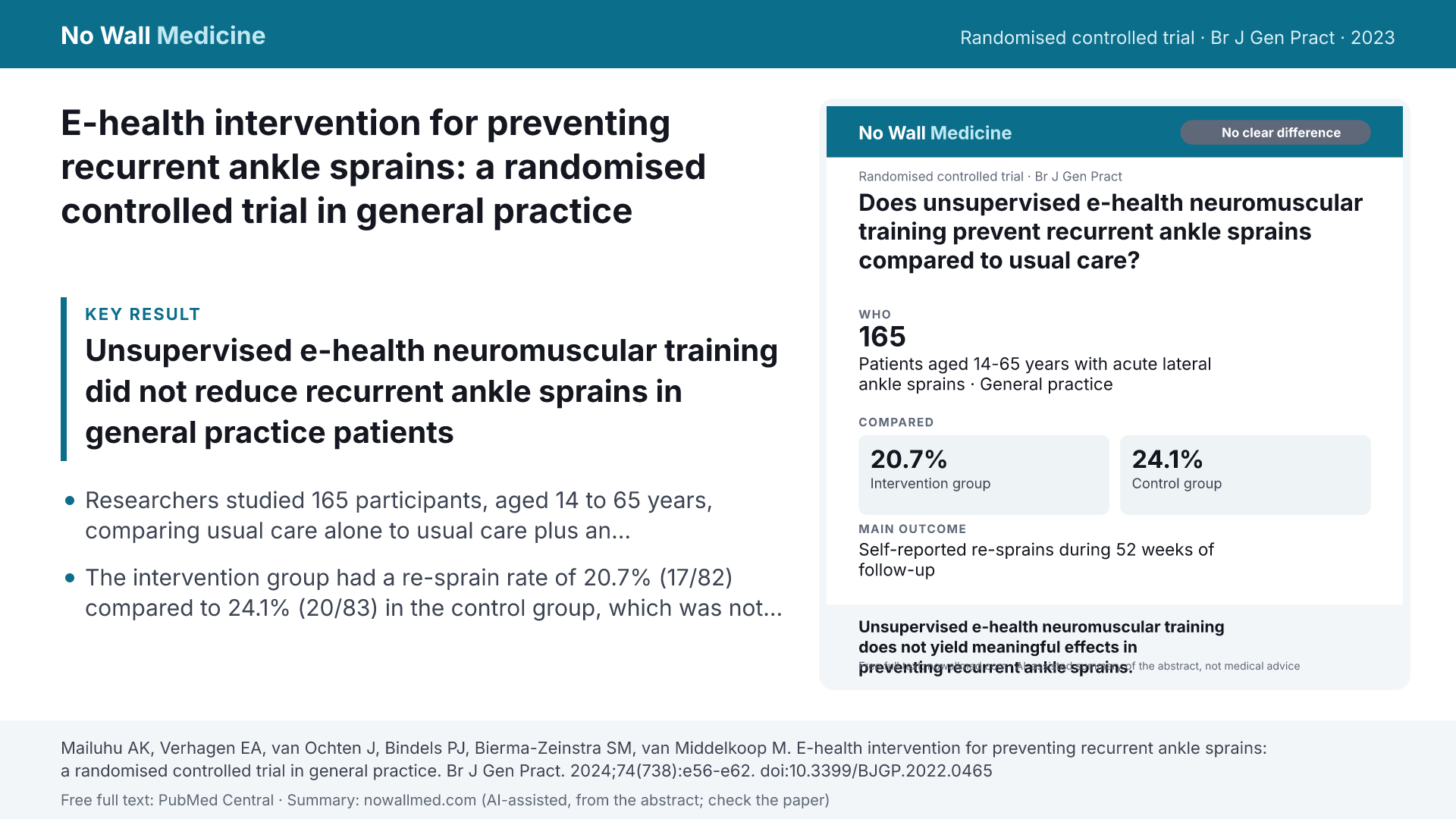
Key result: Unsupervised e-health neuromuscular training did not reduce recurrent ankle sprains in general practice patients
Randomised controlled trialNo clear difference
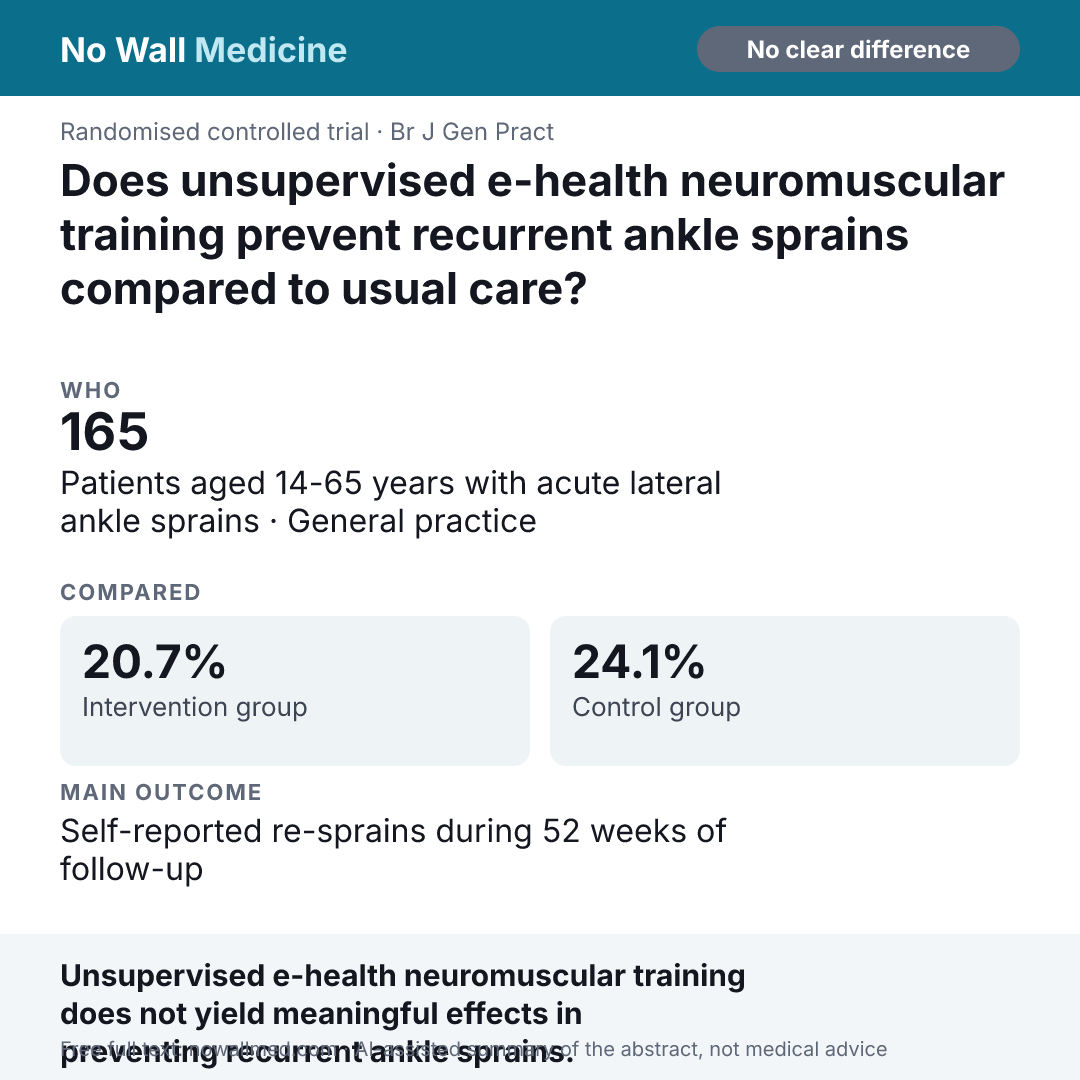
Does unsupervised e-health neuromuscular training prevent recurrent ankle sprains compared to usual care?
Who
165
Patients aged 14-65 years with acute lateral ankle sprains · General practice
Compared
20.7%Intervention group (17/82)
24.1%Control group (20/83)
Main outcome
Self-reported re-sprains during 52 weeks of follow-up
Result: hazard ratio 1.14, 95% confidence interval = 0.59 to 2.21
Bottom line: Unsupervised e-health neuromuscular training does not yield meaningful effects in preventing recurrent ankle sprains.
Limitation: The adherence rate to the programme was low (6.1%, 5/82).
Br J Gen Pract · 2023-12-28 · Save PNG
Key points
- Researchers studied 165 participants, aged 14 to 65 years, comparing usual care alone to usual care plus an unsupervised e-health-supported neuromuscular training programme.
- The intervention group had a re-sprain rate of 20.7% (17/82) compared to 24.1% (20/83) in the control group, which was not a statistically significant difference.
- The adherence rate to the e-health training programme was low at 6.1% (5/82).
Discussion prompts
- Would these patients look like yours? Who was left out?
- Is the main outcome one that matters to patients?
- Is the difference large enough to change what you do?
Cite: Mailuhu AK, Verhagen EA, van Ochten J, Bindels PJ, Bierma-Zeinstra SM, van Middelkoop M. E-health intervention for preventing recurrent ankle sprains: a randomised controlled trial in general practice. Br J Gen Pract. 2024;74(738):e56-e62. doi:10.3399/BJGP.2022.0465
Free full text: PubMed Central · Summary and visual abstract: nowallmed.com/a/e-health-intervention-for-preventing-recurrent-ankle-sprains-a-5mu7vf/ (AI-assisted from the abstract; check the paper before relying on it).