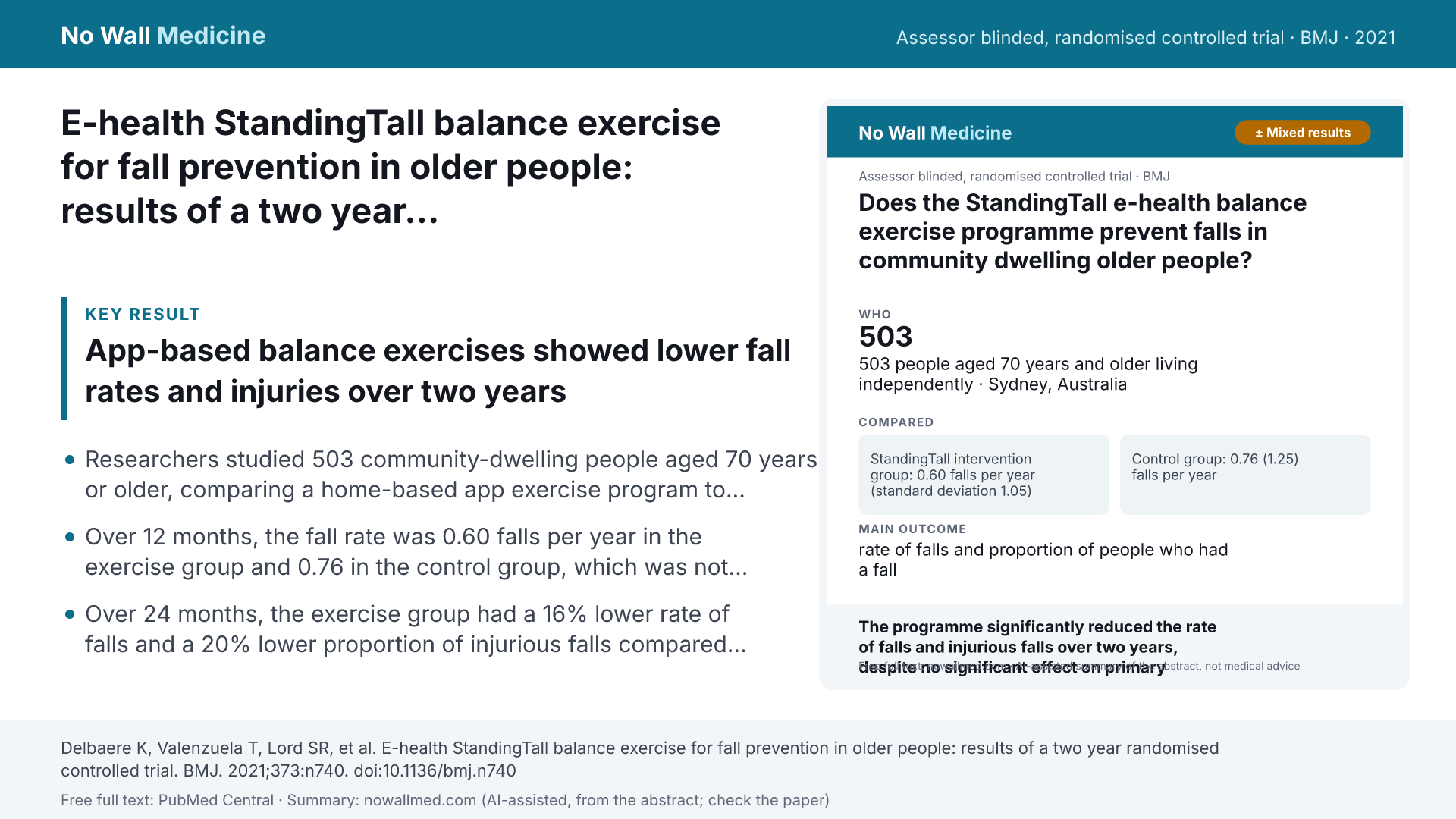
App-based balance exercises showed lower fall rates and injuries over two years
E-health StandingTall balance exercise for fall prevention in older people: results of a two year randomised controlled trial
Assessor blinded, randomised controlled trialMixed results
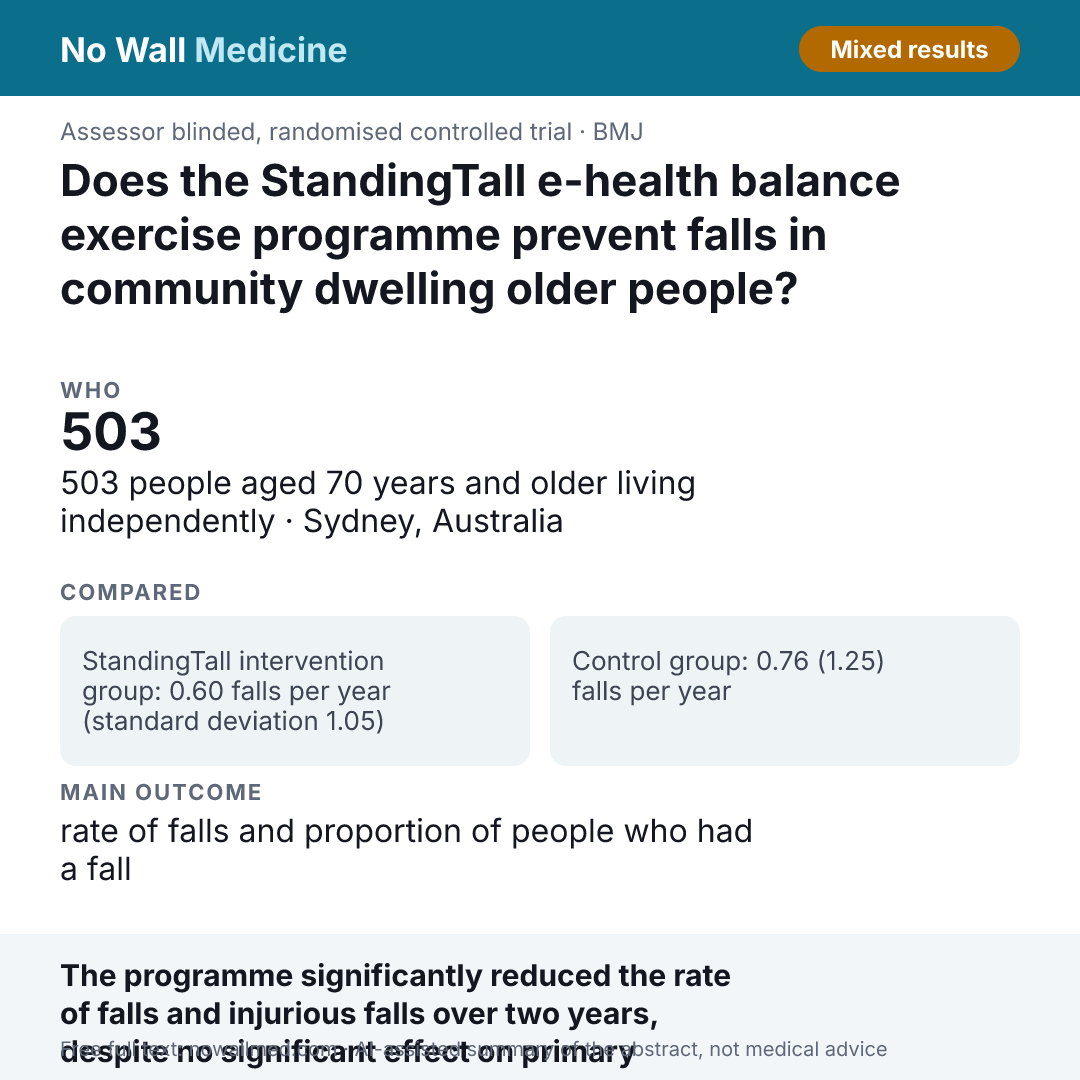
Does the StandingTall e-health balance exercise programme prevent falls in community dwelling older people?
Who
503
503 people aged 70 years and older living independently · Sydney, Australia
Compared
StandingTall intervention group: 0.60 falls per year (standard deviation 1.05)
Control group: 0.76 (1.25) falls per year
Main outcome
rate of falls and proportion of people who had a fall
Result: incidence rate ratio 0.84, 95% confidence interval 0.62 to 1.13
Bottom line: The programme significantly reduced the rate of falls and injurious falls over two years, despite no significant effect on primary outcomes at 12 months.
BMJ · 2021-04-06 · Save PNG
Same trial (ACTRN12615000138583)
Papers we list that report this registered trial, oldest first. Read a secondary analysis alongside the main results.
- Main results Mixed results
This paper BMJ 2021-04 - Related analysis
Digital balance exercise program shows potential cost-effectiveness for preventing falls in older adults Age Ageing 2022-06
Clinical question: Does the StandingTall e-health balance exercise programme prevent falls in community dwelling older people?
Key points
- Researchers studied 503 community-dwelling people aged 70 years or older, comparing a home-based app exercise program to health education alone.
- Over 12 months, the fall rate was 0.60 falls per year in the exercise group and 0.76 in the control group, which was not a statistically significant difference.
- Over 24 months, the exercise group had a 16% lower rate of falls and a 20% lower proportion of injurious falls compared to the control group.
Headline and key points written with AI from the paper’s abstract, with every number checked against it. Read the paper before relying on them.
Was this summary helpful?
Abstract
Objective
To test whether StandingTall, a home based, e-health balance exercise programme delivered through an app, could provide an effective, self-managed fall prevention programme for community dwelling older people. Design
Assessor blinded, randomised controlled trial. Setting
Older people living independently in the community in Sydney, Australia. Participants
503 people aged 70 years and older who were independent in activities of daily living, without cognitive impairment, progressive neurological disease, or any other unstable or acute medical condition precluding exercise. Interventions
Participants were block randomised to an intervention group (two hours of StandingTall per week and health education; n=254) or a control group (health education; n=249) for two years. Main outcome measures
The primary outcomes were the rate of falls (number of falls per person year) and the proportion of people who had a fall over 12 months. Secondary outcomes were the number of people who had a fall and the number who had an injurious fall (resulting in any injury or requiring medical care), adherence, mood, health related quality of life, and activity levels over 24 months; and balance and mobility outcomes over 12 months. Results
The fall rates were not statistically different in the two groups after the first 12 months (0.60 falls per year (standard deviation 1.05) in the intervention group; 0.76 (1.25) in the control group; incidence rate ratio 0.84, 95% confidence interval 0.62 to 1.13, P=0.071). Additionally, the proportion of people who fell was not statistically different at 12 months (34.6% in intervention group, 40.2% in control group; relative risk 0.90, 95% confidence interval 0.67 to 1.20, P=0.461). However, the intervention group had a 16% lower rate of falls over 24 months compared with the control group (incidence rate ratio 0.84, 95% confidence interval 0.72 to 0.98, P=0.027). Both groups had a similar proportion of people who fell over 24 months (relative risk 0.87, 95% confidence interval 0.68 to 1.10, P=0.239), but the proportion of people who had an injurious fall over 24 months was 20% lower in the intervention group compared with the control group (relative risk 0.80, 95% confidence interval 0.66 to 0.98, P=0.031). In the intervention group, 68.1% and 52.0% of participants exercised for a median of 114.0 min/week (interquartile range 53.5) after 12 months and 120.4 min/week (38.6) after 24 months, respectively. Groups remained similar in mood and activity levels. The intervention group had a 0.03 (95% confidence interval 0.01 to 0.06) improvement on the EQ-5D-5L (EuroQol five dimension five level) utility score at six months, and an improvement in standing balance of 11 s (95% confidence interval 2 to 19 s) at six months and 10 s (1 to 19 s) at 12 months. No serious training related adverse events occurred. Conclusions
The StandingTall balance exercise programme did not significantly affect the primary outcomes of this study. However, the programme significantly reduced the rate of falls and the number of injurious falls over two years, with similar but not statistically significant effects at 12 months. E-health exercise programmes could provide promising scalable fall prevention strategies. Trial registration
ACTRN12615000138583.
Abstract reproduced under the article’s CC BY NC licence.
Subject terms
Headline, design, result, key points, caveat and citation as plain text.
Cite this article
Delbaere K, Valenzuela T, Lord SR, et al. E-health StandingTall balance exercise for fall prevention in older people: results of a two year randomised controlled trial. BMJ. 2021;373:n740. doi:10.1136/bmj.n740
Spotted a mistake? Suggest a correction