Early epinephrine administration was not associated with survival in children receiving CPR for bradycardia
Early bolus epinephrine administration during pediatric cardiopulmonary resuscitation for bradycardia with poor perfusion: an ICU-resuscitation study
Multicenter cluster randomized trial secondary analysisNo clear difference
Does early epinephrine administration improve survival in pediatric cardiopulmonary resuscitation for bradycardia?
Who
452
Children under 19 years receiving cardiopulmonary resuscitation for bradycardia · 18 intensive care units in the United States
Compared
Early epinephrine
No early epinephrine
Main outcome
Survival to discharge and survival with favorable neurologic outcome
Result: aRR 0.97 (95% CI 0.82 to 1.14) for survival to discharge
Bottom line: Early epinephrine administration was not associated with improved survival outcomes in children receiving cardiopulmonary resuscitation for bradycardia.
Crit Care · 2024-07-16Download image
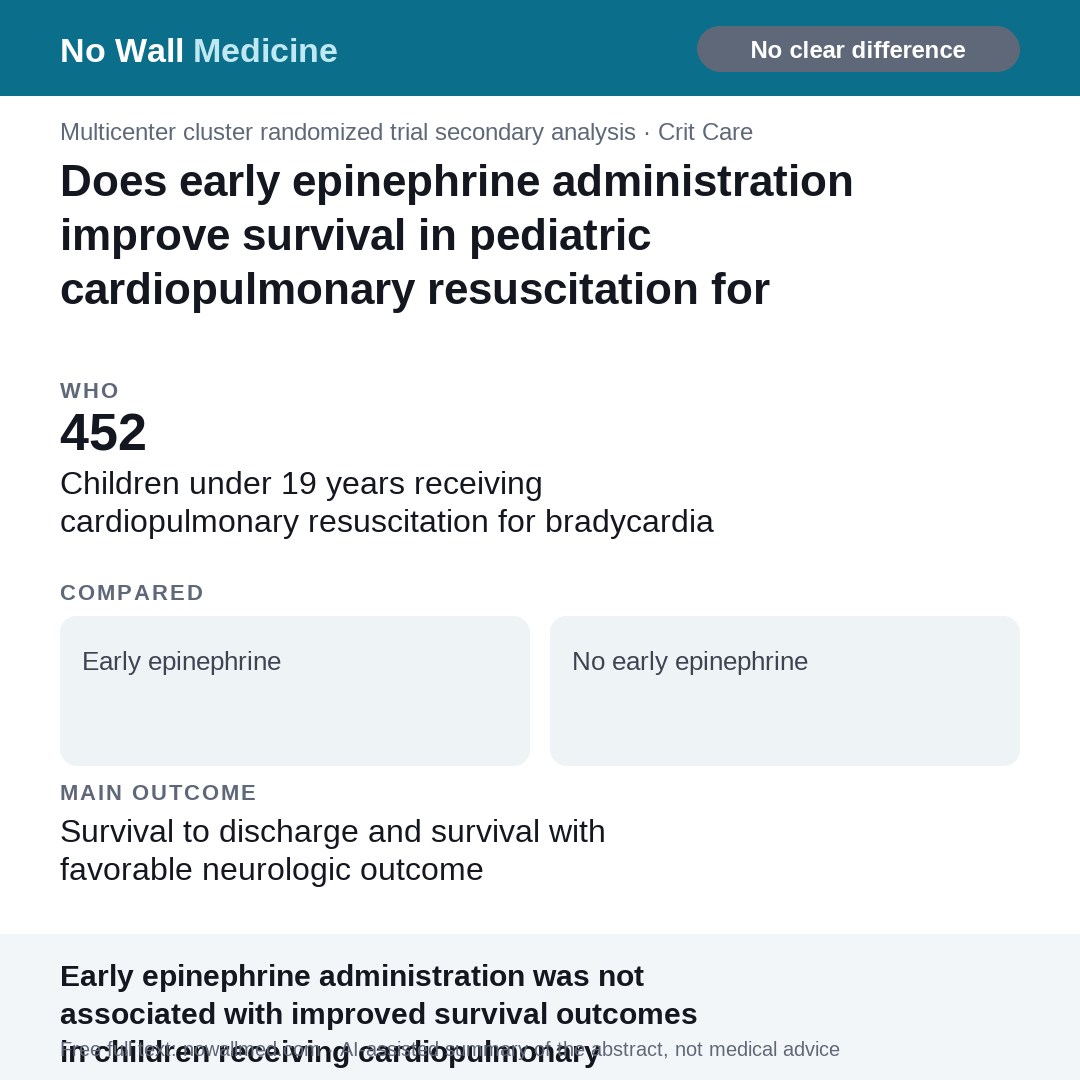
Clinical question: Does early epinephrine administration improve survival in pediatric cardiopulmonary resuscitation for bradycardia?
Why it matters: It is unknown if giving epinephrine early during cardiopulmonary resuscitation for children with a slow heart rate and poor perfusion improves survival or neurologic outcomes.
Key points
- Researchers analyzed 452 children under 19 years old who received cardiopulmonary resuscitation (CPR) for bradycardia, or a slow heart rate, with poor perfusion.
- Early epinephrine administration within the first 2 minutes of CPR was not associated with survival to discharge (aRR 0.97, 95%CI 0.82, 1.14) or favorable neurologic outcomes.
- Among 186 patients with invasive blood pressure monitoring, 63% experienced at least one period of pulselessness during the first 10 minutes of CPR.
Headline and key points written with AI from the paper’s abstract, with every number checked against it. Read the paper before relying on them.
Was this summary helpful?
Subject terms
Cite this article
O'Halloran AJ, Reeder RW, Berg RA, Ahmed T, Bell MJ, Bishop R. Early bolus epinephrine administration during pediatric cardiopulmonary resuscitation for bradycardia with poor perfusion: an ICU-resuscitation study. Crit Care. 2024. doi:10.1186/s13054-024-05018-7
Spotted a mistake? Suggest a correction
Top studies every Monday
The week’s key trials and guidelines in your specialties, plus any topics you follow. By email, free.
Get the weekly digest